Hardware choice starts with the network
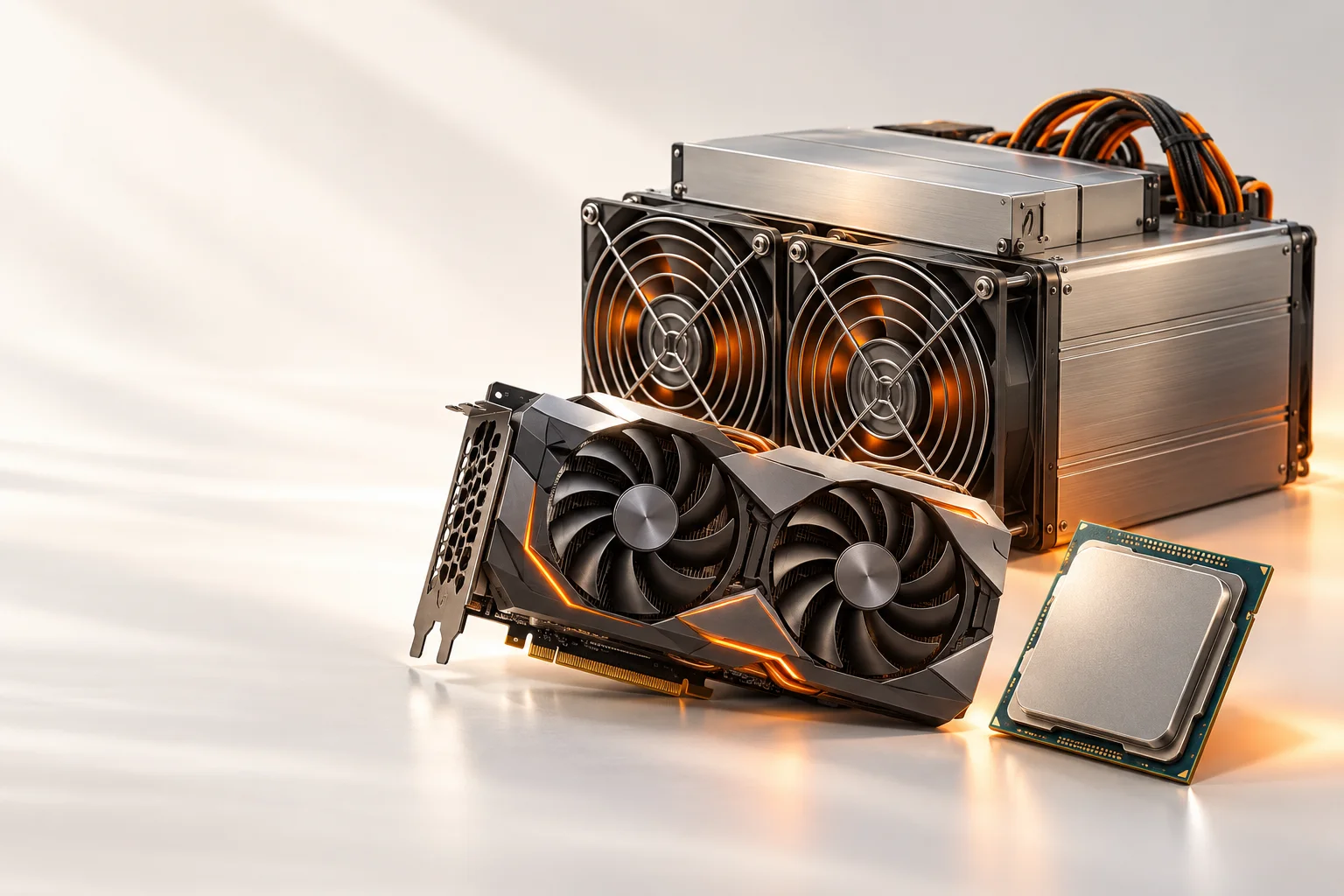
An application-specific integrated circuit, or ASIC, is specialized hardware. Graphics processing units, or GPUs, and central processing units, or CPUs, serve broader computing workloads. Being able to run a hashing program does not establish that a device is economically competitive.
Compatibility, available software, network competition, energy cost, and resale use all matter. Bitcoin mining is dominated by specialized SHA-256 hardware; a desktop’s ability to calculate SHA-256 is not equivalent to an ASIC’s sustained mining performance. Other networks require their own current evaluation.
Step-by-step
- Check the algorithm. Use the network’s official documentation, then match the equipment’s published algorithm rather than its marketing category.
- Establish practical support. Confirm software, firmware, pool compatibility, required memory, and manufacturer support for the exact model.
- Compare total operation. Include power, cooling, noise, purchase cost, and alternative uses. Assess machines on one workload with consistent units.
Worked example
Illustrative example. An operator compares a hypothetical desktop and a SHA-256 ASIC for Bitcoin. Both can compute hashes, but their measured hashrates and energy use differ. A purchase decision needs those measurements and site constraints, not just the word ‘compatible’.
A processor category describes architecture. It cannot by itself answer which coin to mine or whether a setup covers its expenses.
Common mistakes
- Assuming all ASICs can mine Bitcoin.
- Buying hardware before checking the coin’s algorithm.
- Counting a general-purpose computer’s resale value as guaranteed.
Questions and answers
Can an ASIC change to any coin?
Usually it can only serve supported algorithms. A change between coins sharing an algorithm may be possible, subject to firmware and pool support; changing to an unrelated algorithm generally requires different hardware.
Apply this to your setup
Build a shortlist with the intended network, algorithm, supported software, measured power, and evidence of usable mining output. Eliminate unsupported workloads before comparing purchase prices. A device that can run a demonstration hash but lacks a practical supported mining stack should not be budgeted as productive capacity.
Sources and next steps
Check coin compatibility, then read algorithm compatibility.
How this guide was prepared: AI-generated drafting with the linked technical references and illustrative calculations. It does not report first-hand equipment tests or a named specialist review.