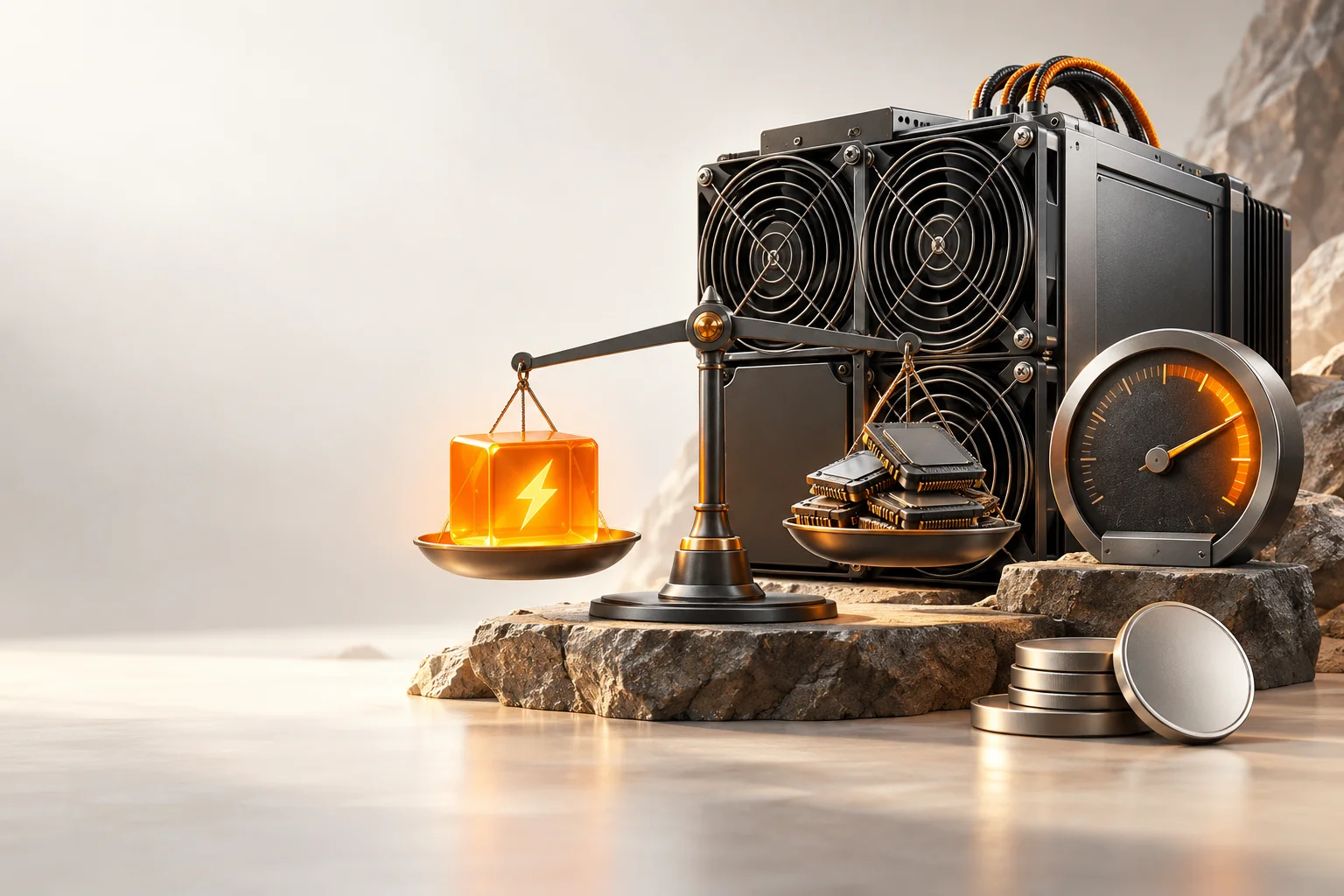
Efficiency is a ratio with a boundary
For a given algorithm, divide input power by hashrate to express electricity demand per unit of hashing speed. A SHA-256 miner’s result is often stated in W/TH/s, numerically equivalent to joules per terahash, or J/TH.
Lower input power for the same hashrate means a lower ratio. That comparison is meaningful only with matching algorithms, units, modes, and measurement boundaries. Whole-site energy including cooling is not directly comparable to a miner-only nominal figure.
Step-by-step
- Normalize inputs. Convert power to watts and hashrate to the chosen unit. State the algorithm and whether values are nominal or measured.
- Divide and label. Calculate watts divided by hashrate. Retain enough precision to compare sensibly without inventing accuracy beyond the source.
- Compare operation. Include purchase price, usable capacity, support, and site overhead separately. A lower ratio does not alone establish total profitability or payback.
Worked example
Illustrative example. A hypothetical SHA-256 miner consumes 3,000 W at 120 TH/s. Its miner-only ratio is 3,000 ÷ 120 = 25 W/TH/s, equivalent to 25 J/TH under those conditions.
If dedicated cooling adds 300 W, the combined boundary would yield 27.5 W/TH/s at the same hashrate. Label the boundary before comparing that number.
Common mistakes
- Comparing W/GH/s with W/TH/s without conversion.
- Comparing different algorithms by their numerical ratios.
- Assuming the best nominal efficiency guarantees the lowest total cost.
Questions and answers
Does efficiency stay fixed across modes?
Not necessarily. Firmware settings and operating conditions can change both power and hashrate. Measure supported modes under consistent conditions and report each ratio separately.
Apply this to your setup
Keep algorithm, mode, input-power boundary, hashrate unit, and the ratio together. Recompute the ratio after any unit conversion and distinguish nominal from measured inputs. Add cooling energy in a separate site comparison. The most efficient miner by one ratio can still have a higher overall cost for your actual capacity and installation.
Sources and next steps
Use ASIC comparison and power measurement.
How this guide was prepared: AI-generated drafting with the linked technical references and illustrative calculations. It does not report first-hand equipment tests or a named specialist review.