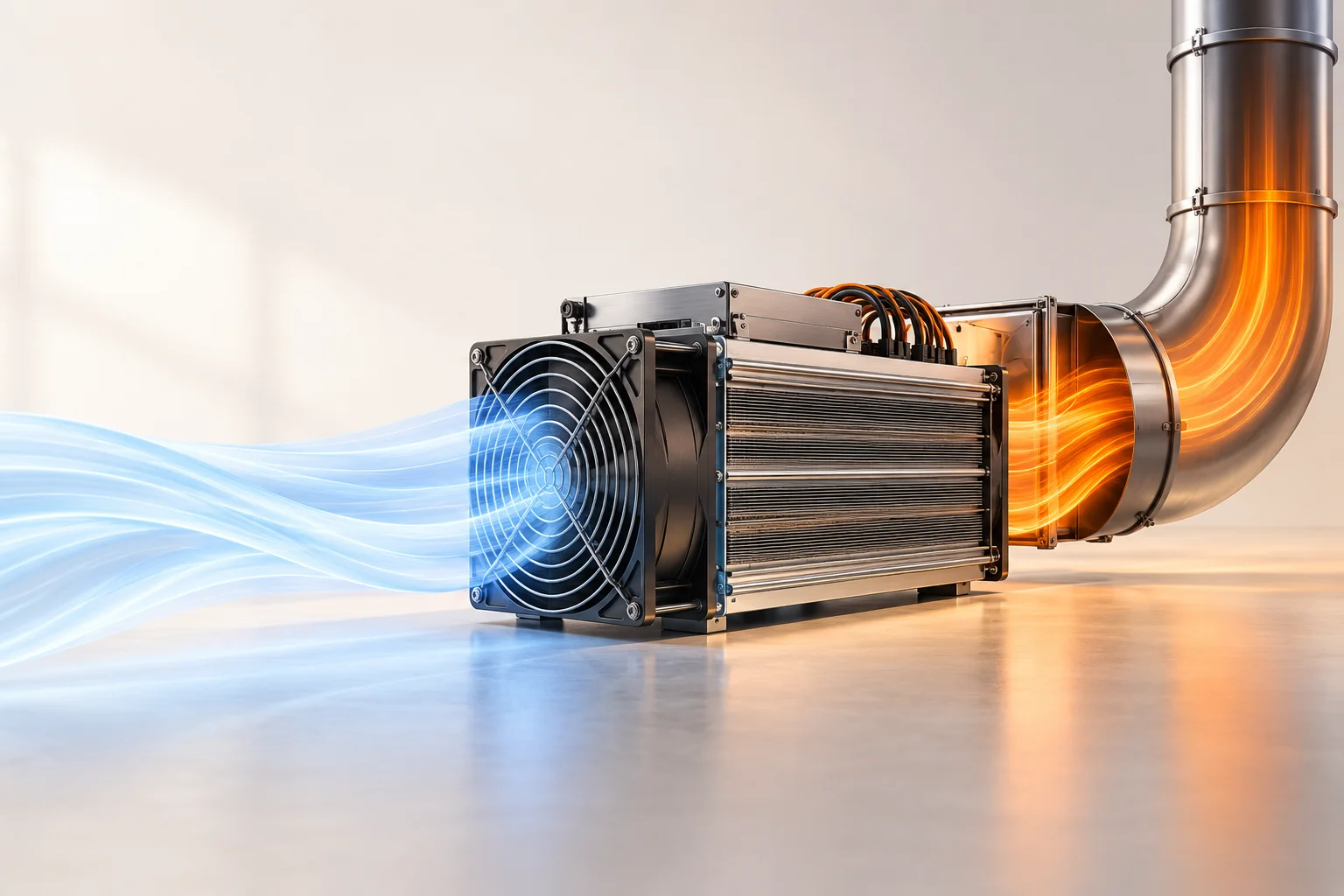
Air must carry heat away from the intake
An air-cooled miner needs an appropriate path for intake and exhaust. If exhaust returns to the intake, the inlet temperature can rise even when room temperature elsewhere seems acceptable. Measure the relevant locations instead of relying on a distant thermostat.
Ducts, filters, silencers, and enclosures can change airflow resistance. An addition intended to reduce noise or dust can worsen cooling if it restricts flow. Follow the specific manufacturer’s installation requirements and obtain a qualified cooling assessment for site changes.
Step-by-step
- Trace airflow. Identify the manufacturer’s flow direction, clearances, inlet measurement point, and likely recirculation paths. Include adjacent equipment.
- Review modifications. Evaluate proposed filters, ducts, and noise controls against supported limits. Do not disable protection systems to make a restrictive arrangement appear workable.
- Validate a controlled trial. Log inlet and device temperatures, fan behavior, power, and faults under realistic ambient conditions. Stop according to the supported procedure if limits are exceeded.
Worked example
Illustrative example. A hypothetical enclosure reduces perceived noise but directs hot exhaust toward the inlet. Rising inlet temperature and faults reveal that the arrangement is not an acceptable cooling design.
Noise and thermal goals must be solved together. A visually tidy enclosure is not evidence of adequate airflow or safe sustained operation.
Common mistakes
- Using exhaust temperature as the manufacturer’s inlet limit.
- Adding dense filters without evaluating resistance.
- Ignoring hot-air interaction between neighboring miners.
Questions and answers
Can I use one universal fan speed target?
No. Fan control and operating requirements depend on the model, mode, and conditions. Use the supported documentation and investigate abnormal patterns rather than imposing an unrelated RPM value.
Apply this to your setup
Draw the intake-to-exhaust path and mark clearances, neighboring equipment, restrictions, and measurement locations. Include any proposed filter, duct, or noise-control change in the professional review. Preserve inlet conditions from a controlled trial. A cooler remote room reading does not demonstrate that the miner’s actual intake receives adequate air.
Sources and next steps
- BITMAIN: model-specific operating temperatures
- BITMAIN: S19 Pro server manual
- OSHA: occupational noise exposure
See heat planning and temperature monitoring.
How this guide was prepared: AI-generated drafting with the linked technical references and illustrative calculations. It does not report first-hand equipment tests or a named specialist review.