Define what the meter includes
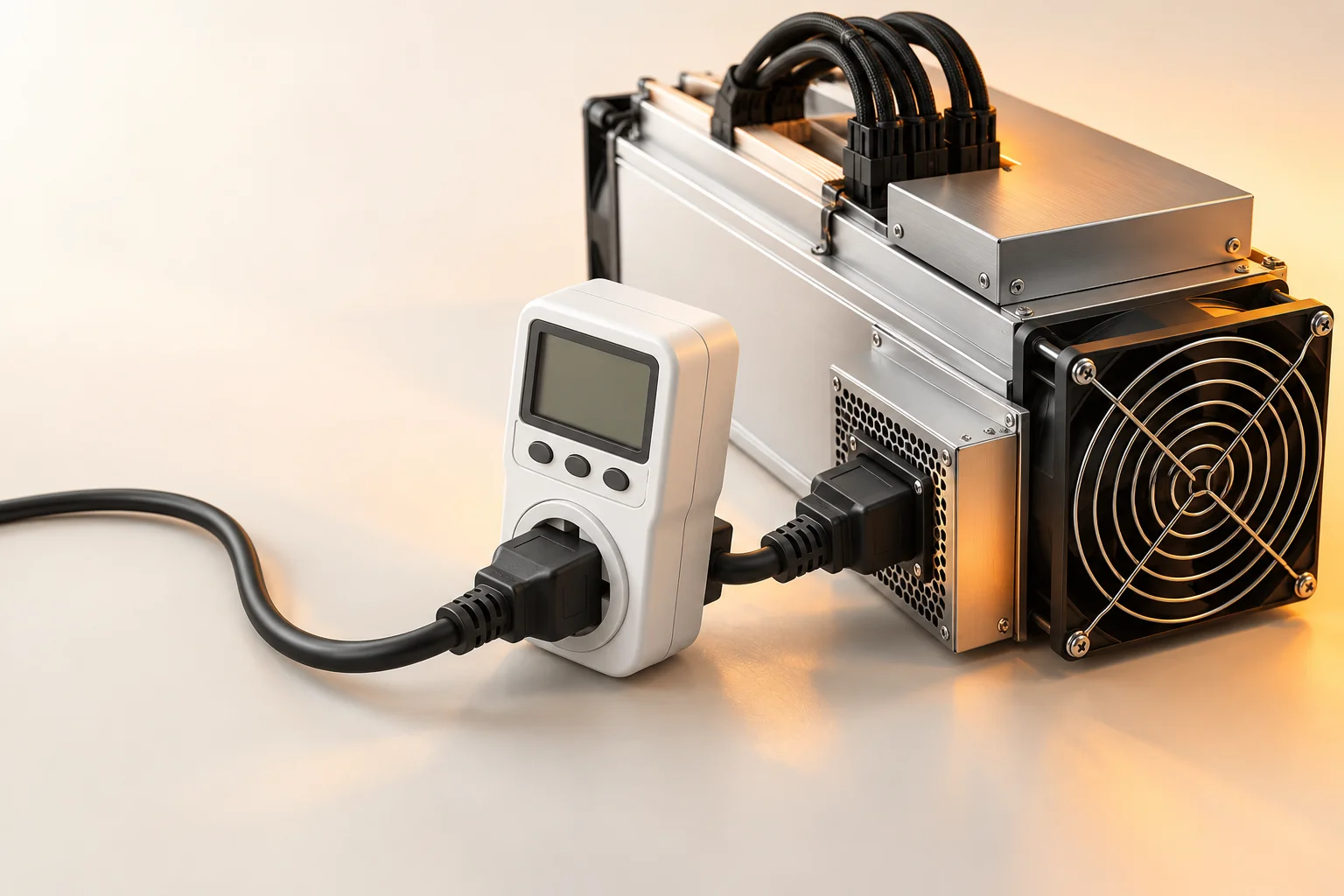
A useful power reading states the measurement boundary. At the miner’s supply input, power includes the equipment served by that connection. A meter for an entire circuit may include other loads; a software estimate may exclude power-supply losses or use a different method.
Mining loads can exceed the rating of ordinary household plug-in meters. Have a qualified professional select and install equipment appropriate for the voltage, current, connectors, and local requirements. Do not modify energized wiring to obtain a reading.
Step-by-step
- Choose a safe boundary. Identify the intended load and suitable rated metering with professional help where required. Document what auxiliary loads are included.
- Stabilize the conditions. Record mode, hashrate, ambient conditions, and the time after startup. Capture multiple readings or logged energy rather than one transient value.
- Reconcile the units. Keep watts for power and kWh for energy. Compare actual logged consumption with your constant-power estimate and investigate material differences.
Worked example
Illustrative example. A hypothetical meter records 6.2 kWh over two hours for one miner. Average power over that interval is 6.2 ÷ 2 = 3.1 kW, even if a dashboard briefly displays 3.0 kW.
An interval average can support an energy budget better than a single instant. Check the meter’s accuracy and included loads before drawing conclusions about efficiency.
Common mistakes
- Using an underrated meter or adapter.
- Comparing whole-circuit energy with a chip-only software estimate.
- Measuring only during startup and calling it steady-state draw.
Questions and answers
Can I infer exact energy from a nameplate?
A nominal specification is useful for initial planning, but actual draw depends on model, mode, supply, and conditions. Label estimates clearly and replace them with safe measurements when available.
Apply this to your setup
Record the meter’s supported rating, measurement boundary, interval, energy reading, and device mode. Derive average power from logged energy and elapsed time when appropriate. Do not compare a software estimate with a measured whole-circuit value without reconciling included loads. Stop the measurement plan if suitable safe equipment is unavailable.
Sources and next steps
Learn efficiency calculations and monitoring baselines.
How this guide was prepared: AI-generated drafting with the linked technical references and illustrative calculations. It does not report first-hand equipment tests or a named specialist review.