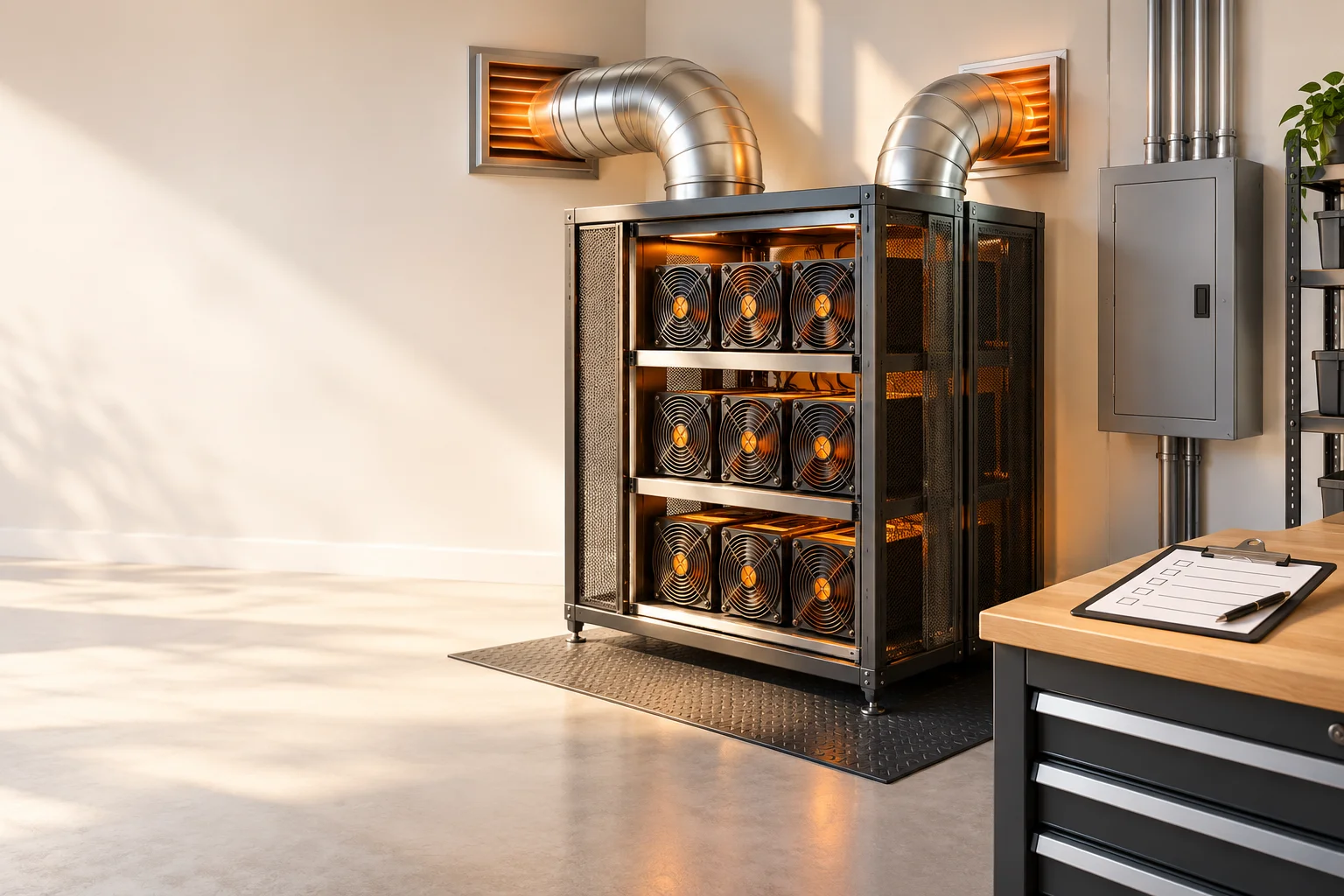
Home mining equipment can run continuously at high electrical load while producing concentrated heat and noise. Treat installation as an electrical and thermal engineering problem, rather than assuming it behaves like an ordinary household appliance. This checklist prepares questions for qualified professionals; it does not approve an installation.
Verify the circuit
Ask a qualified local electrician to assess the exact model’s supply requirements, sustained loading, wiring, connectors, protective devices, and applicable rules. Provide the manufacturer’s manual and the other loads planned for the site. Do not replace breakers, improvise adapters, or work on energized wiring to make a machine fit.
OSHA’s guidance on flexible cords identifies electrical hazards in its US workplace context. Your installation still needs the rules and professional assessment applicable to its own jurisdiction; an internet checklist does not establish compliance.
Plan the airflow
Keep the manufacturer’s required intake and exhaust paths clear and prevent hot exhaust from recirculating into an intake. Monitor the specified sensor locations and use limits for the exact model. A thermostat elsewhere in the room may not describe the miner’s inlet conditions.
Review proposed filters, ducts, enclosures, and weather protection with suitable professionals. They can affect airflow resistance, moisture, and access. Refer to the manufacturer’s model-specific operating ranges, rather than adopting one universal temperature limit.
Prepare to stop safely
Document the supported stop procedure and verified electrical isolation process before startup. Name the people authorized to act and maintain access to the relevant controls. Fault investigation that requires electrical access belongs with qualified personnel.
Smoke, damaged supply components, unusual heating, or loss of required cooling should trigger the site’s safe emergency response. Do not reach into energized equipment or repeatedly restart it to silence an unexplained fault. Keep combustible materials away and maintain access for the response plan.
Check noise and the location
Consider sustained noise exposure, other occupants, neighboring properties, and applicable local restrictions. A quiet-looking cabinet or a seller’s short video is not a reliable exposure assessment. OSHA’s noise overview explains workplace exposure assessment and controls in its jurisdiction; seek appropriate local advice for your actual setting.
Step-by-step
- Collect requirements. Record exact model, supply, cooling method, operating range, planned hours, and included equipment.
- Resolve site conditions. Obtain the relevant electrical and cooling assessments, review location and noise, and retain their findings and outstanding conditions.
- Commission gradually. Follow supported startup, observe power, temperatures and accepted work, then verify alarms and the shutdown procedure before unattended operation.
Worked example
Illustrative example. A buyer has an available outlet but no verified supply or cooling assessment for a hypothetical 3 kW miner. Connector fit does not establish readiness. The buyer resolves the installation requirements before energizing the machine.
The useful result is a documented readiness decision. This example gives no universal circuit rating, connector choice, temperature limit, or ventilation size.
Questions and answers
Can I use an extension cord if the plug fits?
Do not infer suitability from physical fit. Ratings, installation, sustained load, damage, and local requirements must be assessed by the qualified professional with the manufacturer’s instructions.
Does normal hashrate prove safe operation?
No. Productive output and installation safety are separate checks. A miner can hash while operating in unsuitable electrical or environmental conditions.
Sources and next steps
- OSHA: electrical hazards and flexible cords
- BITMAIN: model-specific operating temperatures
- OSHA: noise exposure
Prepare the electrical review pack and commissioning checklist. Preserve a supported shutdown procedure.
How this guide was prepared: AI-generated drafting with the linked technical references and an illustrative readiness scenario. It does not report first-hand equipment tests or a named specialist review.