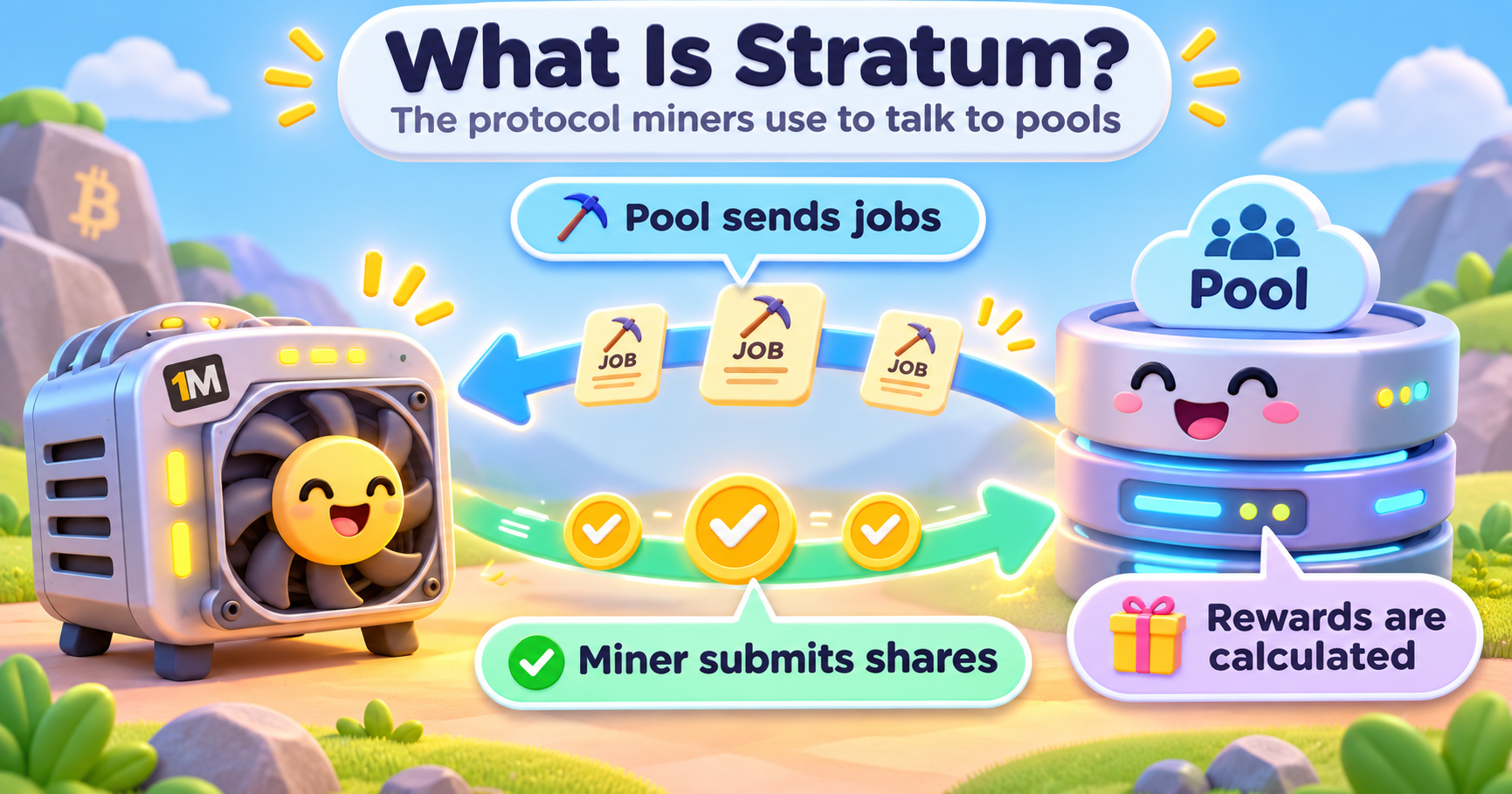
Every Bitcoin miner connected to a pool is constantly exchanging information with that pool. The pool distributes mining work, the miner submits shares that prove it is hashing, and the pool uses those shares to calculate rewards. The protocol carrying that conversation is called Stratum.
Most pooled Bitcoin mining still relies on Stratum V1, a protocol introduced in 2012. It has served the industry for more than a decade, but it has important limitations: its normal connections are unencrypted, its JSON-based messages use more bandwidth than necessary, and traditional pooled mining leaves transaction selection and block-template construction largely in the hands of pool operators.
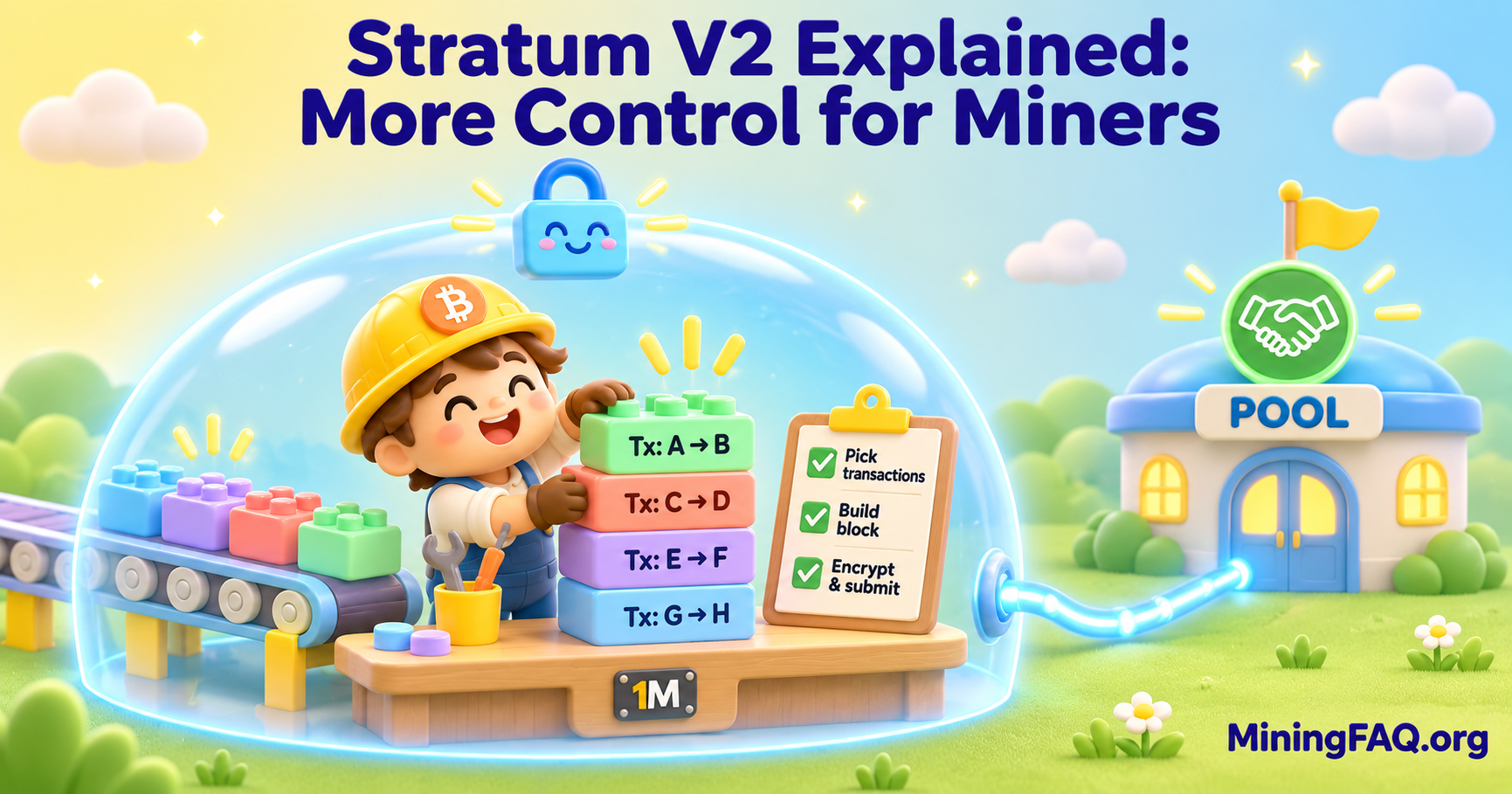
Stratum V2 modernizes that system. It introduces authenticated encryption, a compact binary protocol and an optional Job Declaration system that can return transaction selection to miners.
The important word is optional. A miner can use Stratum V2’s more secure transport without using Job Declaration. That distinction becomes important when we look at adoption later in this article.
In this guide, I’ll explain what Stratum V2 changes, how Job Declaration works, where real deployment stands in late 2026 and what the upgrade means whether you operate one Bitaxe or a hosted mining fleet.
Key Takeaways
- Stratum is the protocol miners use to communicate with mining pools. Stratum V1 has been the dominant pooled-mining protocol since 2012.
- Stratum V2 adds authenticated encryption, helping protect miner-to-pool traffic against interception and network-path tampering.
- Its binary message format is much more efficient. The Stratum V2 project reports roughly 70% lower bandwidth for miners and 60% for pools compared with V1.
- Job Declaration is the decentralization feature. It lets miners construct their own transaction sets instead of automatically accepting the pool’s template.
- Stratum V2 transport and Job Declaration are not the same thing. A pool can support encrypted V2 connections while still constructing the blocks for its miners.
- Transport adoption is ahead of Job Declaration adoption. Native V2 clients and production V2 endpoints exist today, while miner-selected templates remain much less widely deployed.
- Many miners can already gain V2’s transport benefits through compatible firmware or a translation proxy, while full Job Declaration still requires additional infrastructure.
What Is Stratum?
Mining pools combine many miners’ hashrate and split the rewards. To do that, pools need a standard way to:
- Send each miner a job (a block template to work on)
- Receive “shares,” which prove the miner is doing real work
- Track contributions for payouts
That’s what Stratum does. When you enter a pool address like stratum+tcp://… into your miner’s settings, you’re telling it to speak Stratum V1 to that pool.
The important detail is who builds the job. Under Stratum V1, the pool builds the block template. It decides which transactions are included, in what order and which are left out. Your miner just hashes whatever it’s given.
What’s Wrong With Stratum V1?
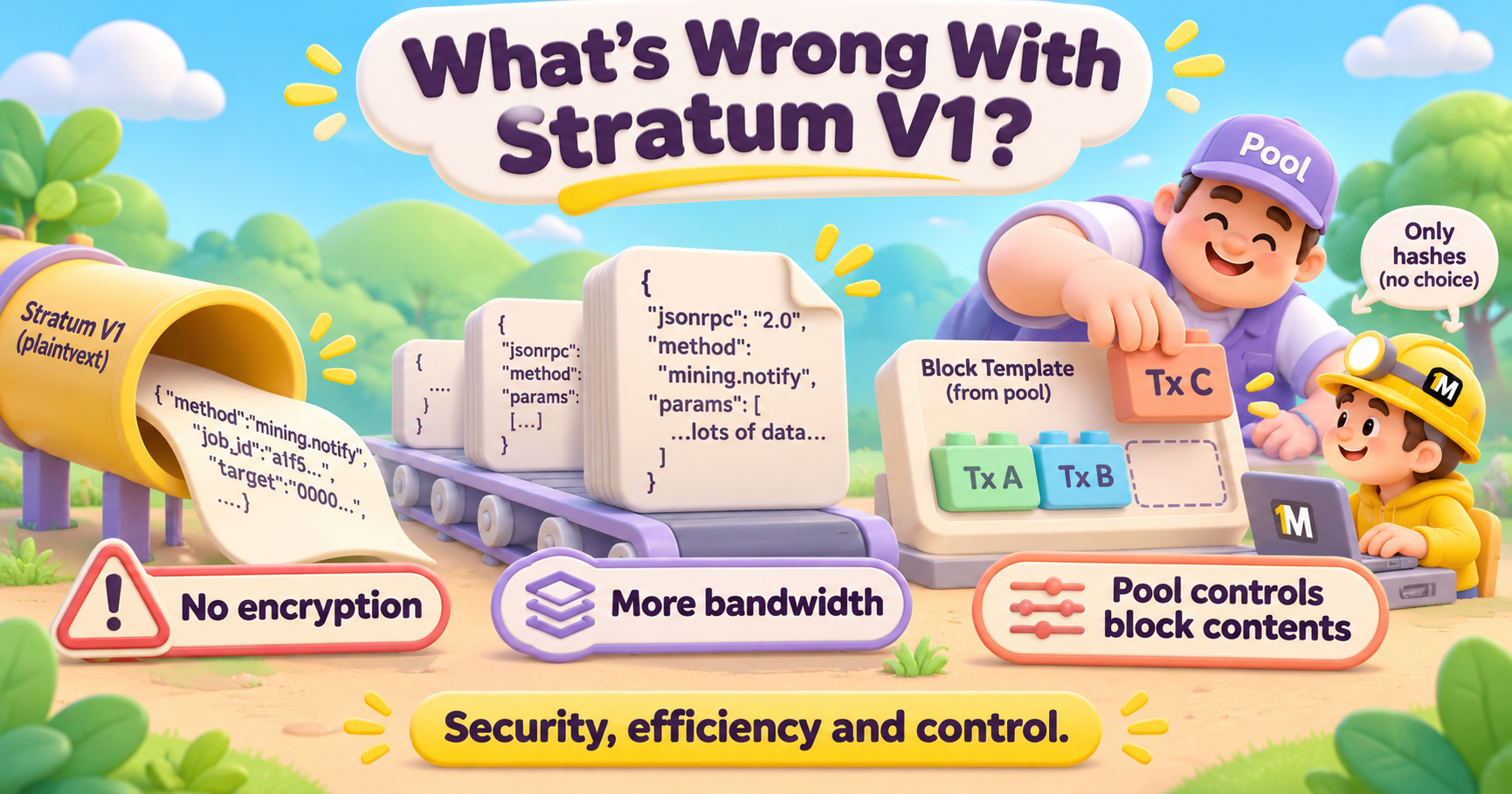
1. No Encryption
Stratum V1 sends messages as plain text. Anyone sitting between your miner and the pool, such as a compromised network or a malicious actor on the internet route, can potentially read or alter that traffic. The most serious risk is hashrate hijacking, where an attacker quietly redirects your work so that your shares credit someone else. This isn’t theoretical: in 2014, researchers documented an attacker who used internet routing tricks to redirect miners’ traffic and steal cryptocurrency.
2. It’s Inefficient
V1 uses JSON, a human-readable text format. That’s convenient for developers, but wasteful for machines exchanging huge numbers of messages. More data means more bandwidth and slightly slower job delivery, which can lead to more stale shares, work that arrives too late to count.
3. Pools Control Block Contents
This is the big one. Because pools build the templates, a handful of pool operators effectively decide what goes into most Bitcoin blocks. According to OneMiners’ analysis of mining pool centralization and Stratum V2, just four operators build about 70% of Bitcoin blocks. Recent block data from mempool.space, cited in OneMiners’ Binance Pool shutdown checklist, shows Foundry USA (26.9%), AntPool (20.2%) and F2Pool (16.6%) alone finding about 64% of blocks in a recent week.
That doesn’t mean those pools are doing anything wrong. But it does mean that if a few pools were ever pressured to censor certain transactions, thousands of individual miners would have no say in it.
How Stratum V2 Works
That does not mean those pools are doing anything wrong. Concentration is a structural issue, not an accusation about individual pool operators.
The concern is that under traditional Stratum V1 pooled mining, individual miners normally hash the block template supplied by their pool. If a miner disagrees with the pool’s transaction-selection policy, the practical response is usually to switch to another pool.
That still gives miners some choice, but it does not give them independent control over the transactions in a block while remaining with that pool.
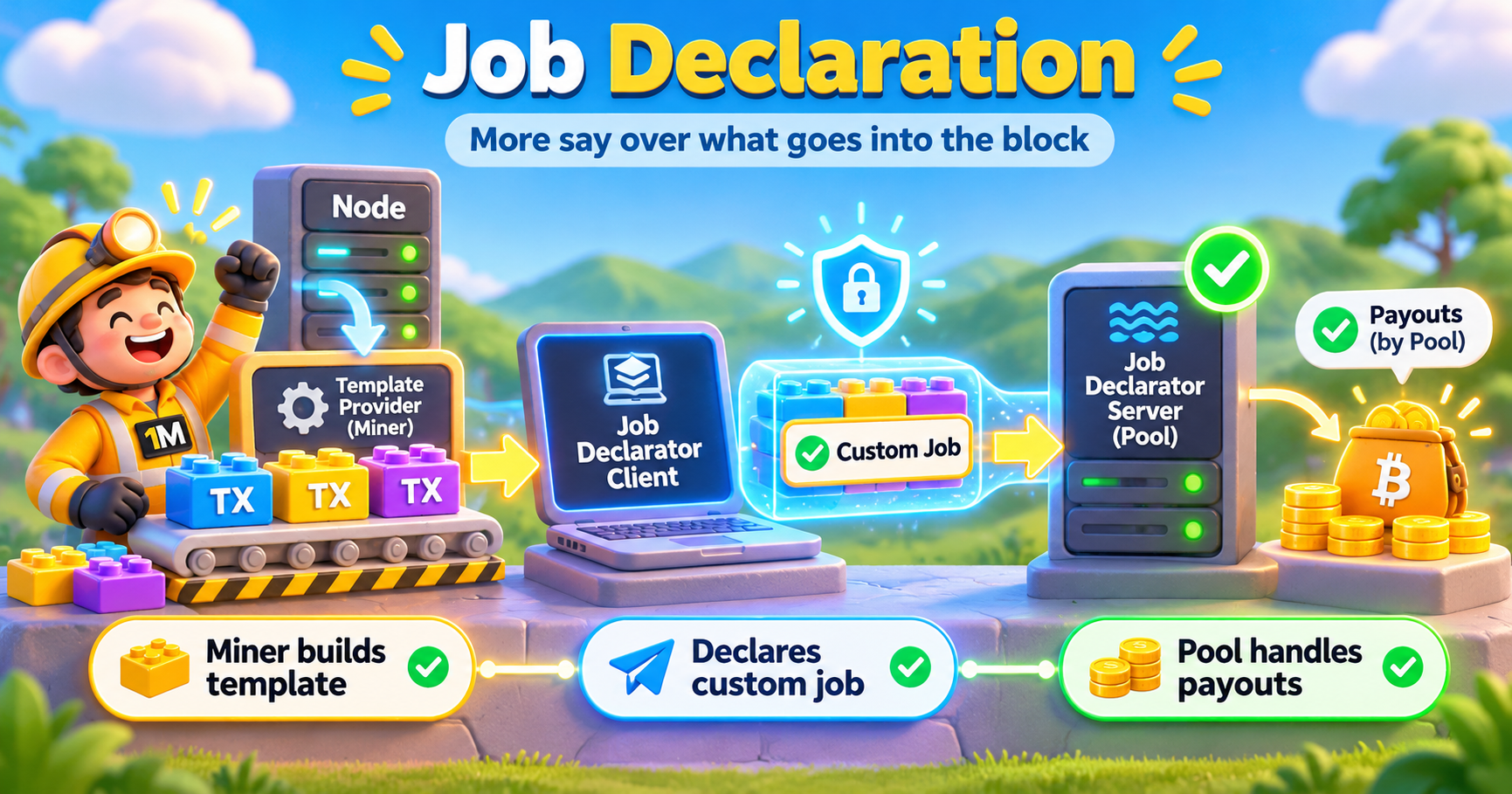
Job Declaration changes that relationship. It allows a miner to construct its own transaction set while the pool continues handling share accounting and payouts. That separates two functions that Stratum V1 traditionally bundled together: who pays the miner and who decides what goes into the block.
Encrypted, Authenticated Connections
Stratum V2 protects remote miner-to-pool communication with authenticated encryption. That means the connection provides confidentiality and integrity: an attacker sitting on the network path should not be able to simply read the mining traffic, substitute pool credentials or silently modify messages without detection.
This directly addresses the class of network-path attacks that made plaintext Stratum V1 vulnerable to hashrate redirection.
It does not make a mining setup immune to every attack. Compromised miner firmware, stolen account credentials, malicious software or a compromised endpoint remain separate security problems. Stratum V2 specifically makes the communication channel between legitimate endpoints substantially safer.
Binary Messages
Stratum V2 also replaces V1’s text-heavy JSON messages with a compact binary format. The official Stratum V2 project reports roughly 70% lower bandwidth for miners and 60% for pools, while lower job-delivery latency can reduce wasted work and stale shares.
Benchmarking published by the Stratum V2 project has shown measurable efficiency gains under particular test conditions, including a headline result of up to 7.4% higher profitability in some deployments. I would treat that as a best-case benchmark rather than an expected return for every miner.
Job Declaration: Miners Choose the Transactions
This is the feature that changes who constructs a block.
With Job Declaration, a miner-side Template Provider builds a candidate template from a Bitcoin node, and a Job Declarator Client (JDC) coordinates that custom work with a pool-side Job Declarator Server (JDS).
The pool can continue handling share accounting and payouts while the miner controls the transaction set.
The official Job Declaration Protocol specification defines two modes:
- Full-Template mode: the miner declares the transaction set to the JDS, which can request any transactions it does not already have. If a valid block is found, both the miner side and JDS can propagate it.
- Coinbase-only mode: the miner keeps the transaction set private from the JDS. The pool evaluates the proposed work from the coinbase information, and if a block is found the miner side is responsible for propagating it.
Both modes support optimistic mining, allowing the miner to begin hashing before the pool has finished acknowledging the custom job. Shares can be temporarily cached until confirmation arrives.
If the Job Declarator Server rejects a valid custom job, fails to respond or the pool rejects valid shares for an acknowledged job, the specification expects the miner-side software to fall back to another Pool + JDS combination, with solo mining available as a last resort.
My Take on Job Declaration
I think Job Declaration is genuinely one of the most important upgrades to Bitcoin mining in years. It shifts power back toward the people actually doing the hashing, without giving up the steady payouts that make pools useful.
But I also want to be realistic. To use it, you need to run your own Bitcoin node and extra software. Most small miners don’t want to do that, and honestly, most don’t need to yet. What matters is that the option exists. If a large pool ever started censoring transactions, miners would have a working tool to route around it.
Where Stratum V2 Adoption Stands in Late 2026
This is where it is especially important to separate support for Stratum V2 transport from actual Job Declaration deployment.
The Working Group Is Much Bigger
On May 7, 2026, the Stratum V2 Working Group welcomed ANTPOOL, Block Inc., DMND, F2Pool, Foundry, MARA Foundation and SpiderPool.
They are better described as seven major mining organizations rather than simply “seven pools,” because Block Inc. is an infrastructure and mining-technology company rather than a conventional public pool.
At the time of the announcement, reporting based on pool hashrate data put the participating mining pools at roughly three-quarters of global Bitcoin hashrate.
That was an important signal of support—but membership in a standards group does not mean every member has deployed every part of the protocol.
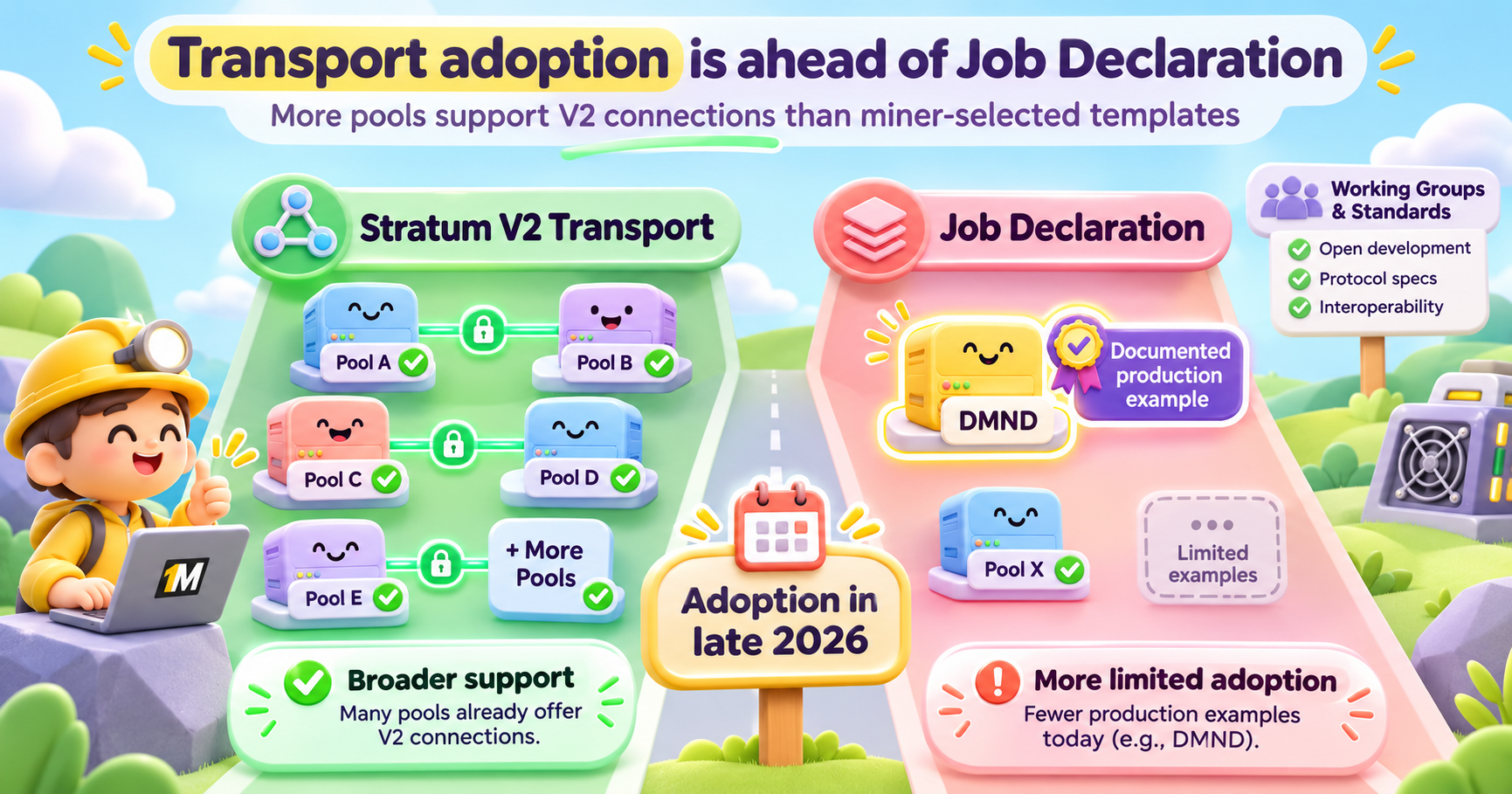
Transport Adoption Is Ahead of Job Declaration
Several production services now support Stratum V2 connections. The harder question is: which ones actually let the miner construct the transaction set?
The clearest production example is DMND.
On June 25, 2026, DMND and GoMining mined Bitcoin mainnet block 955,318 using the Stratum V2 Job Declaration Protocol. The miner-side system, rather than the pool, selected the block’s transactions. That was a major proof that miner-declared templates can work in real pooled mining.
Braiins Pool also provides production Stratum V2 endpoints, but that should not automatically be described as the same thing as generally available Job Declaration. A V2 connection can still use a pool-built block template.
OneMiners’ September 2026 article, Four Pools Build 70% of Bitcoin’s Blocks, estimated that roughly 3–5% of network hashrate was using Stratum V2 with Job Declaration and counted Braiins Pool alongside DMND.
That figure is useful as a dated OneMiners snapshot, but I would not present it as a precise current network measurement.
There is some disagreement among public sources about Braiins specifically. OneMiners’ September article lists Braiins as running Job Declaration, while a D-Central deployment tracker reviewed in August 2026 classifies Braiins as production Stratum V2 transport only. Braiins’ current customer documentation clearly publishes V2 pool endpoints, but it does not currently advertise generally available miner-selected Job Declaration as a standard customer feature.
By contrast, DMND is clearly documented as running Job Declaration in production. On June 25, 2026, DMND and GoMining mined Bitcoin block 955,318 using a miner-declared block template.
So the safest late-2026 conclusion is:
Stratum V2 transport is real and increasingly usable, while miner-selected templates through Job Declaration still represent a small and difficult-to-measure portion of pooled Bitcoin mining.
That does not weaken OneMiners’ broader argument. In fact, its most useful point remains the same: measure decentralization by actual miner-selected block-template deployment, not simply by Working Group membership or the existence of a V2 endpoint.
Firmware and Software Support
| Software / hardware | Stratum V2 status in late 2026 | Job Declaration? |
|---|---|---|
| Braiins OS | Native V2 client on supported Antminer models | Not by the firmware alone; requires a JD-capable miner-side stack and supporting pool |
| AxeOS / ESP-Miner (Bitaxe) | Native V2 Mining Protocol support since v2.14.0; current releases continue improving SV2 support | No built-in miner-side Job Declaration stack |
| Stock Antminer firmware | Primarily Stratum V1 | Can reach V2 infrastructure through a translator |
| Stock WhatsMiner firmware | Primarily Stratum V1 | Can reach V2 infrastructure through a translator |
| SRI Translation Proxy | Bridges legacy V1 miners to V2 infrastructure | Transport bridge; JD requires the additional JDC and Template Provider components |
| Bitcoin Core 30+ | Provides the experimental IPC Mining Interface introduced in 30.0 and continued in newer releases | Can supply block templates to external mining / Stratum V2 software |
Bitcoin Core 30.0 introduced the experimental IPC Mining Interface in October 2025. It did not embed Stratum V2 directly into Bitcoin Core. Instead, it created a generic interface that external mining software can use to request block templates and submit mined blocks.
That distinction still matters in late 2026. The current Bitcoin Core release is 32.1, and the IPC mining interface continues to be maintained and updated. So it is more accurate to describe this as a feature introduced in Bitcoin Core 30.0 and carried forward into current releases, rather than calling “Bitcoin Core 30.x” the present software version.
AxeOS is another meaningful development. ESP-Miner v2.14.0, released in June 2026, added native Stratum V2 protocol support for Bitaxe hardware. Later 2.15.x releases continued refining SV2 behavior, including authentication controls, share handling and protocol reliability.
But native V2 transport still should not be confused with native Job Declaration. A Bitaxe can speak the V2 Mining Protocol directly without automatically becoming the component that constructs its own Bitcoin block templates.
What Stratum V2 Means for Hosted Miners
Hosting and pool choice are related operationally, but they are not the same decision.
A hosting provider determines things such as power, cooling, machine uptime and physical maintenance. The mining pool determines share accounting, payouts and—unless Job Declaration is being used—the block templates sent to the miner.
That distinction is one of the stronger points in OneMiners’ pool-centralization and Stratum V2 article: miners should avoid treating their pool assignment as something permanently tied to their hosting provider.
OneMiners is useful here because hosted owners retain visibility and control over their mining configuration. The platform lets users monitor worker status and hashrate and adjust pool settings remotely.
Cassy Soriano’s Medium walkthrough, OneMiners App Explained: A Tour of the New Miner Interface, shows how the worker interface exposes hashrate, hardware status and pool controls.
That does not mean every Stratum V2 or Job Declaration configuration is automatically supported by every hosted machine. Pool endpoints, firmware compatibility and any required proxy or JDC infrastructure still need to be confirmed.
But giving hosted customers control over pool settings is valuable because it means pool choice can remain a live operational decision rather than something permanently fixed when the miner is deployed.
What Stratum V2 Means for You
If You Run a Bitaxe or Home Miner
You can already use Stratum V2 if your firmware supports it and your pool offers a V2 endpoint. The main benefit is security: your connection is encrypted. If you’re technically curious and already run a Bitcoin node, experimenting with Job Declaration on a supporting pool is a great way to understand how blocks are actually built.
If You Run a Small Fleet
Check whether your firmware supports V2 natively. If not, a translator proxy can bridge your V1 machines to a V2 pool. The bandwidth savings matter more when you run dozens of machines on one connection, especially on limited internet.
If Your Miners Are Hosted
You usually don’t control firmware or network settings directly, so ask your hosting provider whether they can connect your miners to a V2 pool or run a translator proxy. OneMiners makes a point I agree with: keep your pool decision separate from your hosting decision. Your host controls power costs and uptime. Your pool controls block construction and payouts.
If you host with OneMiners, you can check your workers’ pool settings, hashrate and status from the OneMiners app, which makes it easy to confirm a pool change went through.
Should You Switch Pools Because of Stratum V2?
Stratum V2 support is a good factor to consider, but it should not be the only one.
Fees, payout method, reliability, transparency and track record still matter directly to mining income.
If two otherwise similar pools are available and one offers properly authenticated Stratum V2 transport, that gives it a real security and efficiency advantage.
If one also supports Job Declaration with miner-selected templates, that is the feature that contributes directly to decentralizing transaction selection.
Simply using V2 transport by itself improves the communication protocol; it does not automatically move block-template control away from the pool.
Stratum V1 vs. Stratum V2 at a Glance
| Feature | Stratum V1 | Stratum V2 |
|---|---|---|
| Encryption | Normally plaintext | Authenticated encryption for remote connections |
| Message format | Text / JSON-RPC | Compact binary protocol |
| Bandwidth use | Higher | Roughly 60–70% lower in published SV2 comparisons |
| Network-path hashrate hijacking | Vulnerable because normal V1 traffic lacks authentication | Substantially mitigated by authenticated encryption |
| Who builds block templates? | Normally the pool | Pool by default, or miner when Job Declaration is actually deployed |
| Pool failover | Common through configured backup pools or firmware behavior | Also supported; Job Declaration stacks add Pool/JDS fallback logic |
| Miner-selected transactions | Not part of traditional V1 pooled mining | Available through Job Declaration |
| Adoption in late 2026 | Still dominant | V2 transport growing; Job Declaration remains early |
For UK readers, The Mining Shop’s Stratum V2 explainer offers another accessible overview.
Frequently Asked Questions
What is Stratum V2 in simple terms? It is the next-generation protocol for communication between Bitcoin miners and mining pools. It adds authenticated encryption and a more efficient binary protocol, while its optional Job Declaration system allows miners to construct their own transaction sets.
Does Stratum V2 increase my mining earnings? It can improve efficiency by reducing communication overhead, latency and some stale work. Benchmark results vary by setup, and headline gains such as “up to 7.4%” should be treated as test results rather than guaranteed returns.
Do I need a Bitcoin node to use Stratum V2? Not for ordinary V2 mining connections. A miner who wants to build their own templates through Job Declaration normally needs access to a Bitcoin node and the additional Template Provider/JDC infrastructure.
Which pools support Stratum V2? Several pools now offer production V2 transport. DMND is the clearest production example of pooled Job Declaration with miner-selected templates. Braiins Pool offers production V2 endpoints, while major organizations including Foundry, ANTPOOL, F2Pool, SpiderPool and MARA have joined the Stratum V2 Working Group. Check each pool’s current documentation because transport support and Job Declaration support are different things.
Can my old miner use Stratum V2? Often yes. Legacy V1 firmware can connect through a translation proxy, while supported hardware can use native V2 firmware such as Braiins OS or AxeOS. Firmware compatibility depends on the exact miner model.
Is Stratum V2 safe? Its authenticated-encryption design makes miner-to-pool communication substantially more secure than plaintext Stratum V1 against interception and network-path tampering. It does not eliminate risks from compromised endpoints, malicious firmware, account theft or incorrect configuration.
The Bottom Line
Stratum V2 is one of the most important upgrades to pooled Bitcoin mining in years, but its benefits should be separated clearly.
Stratum V2 transport improves security, privacy and communication efficiency.
Job Declaration is the part that changes Bitcoin’s decentralization model by allowing miners to select the transactions their hashrate works on.
In late 2026, the first part is increasingly practical. Native V2 firmware exists, production V2 pool endpoints exist and legacy miners can connect through translation proxies.
Job Declaration has also crossed an important line from theory into production: DMND and GoMining proved miner-declared templates on Bitcoin mainnet with block 955,318. But it is still far from universal or turnkey for the average miner.
For hosted miners, the practical lesson is to keep control where possible. Services such as OneMiners can handle the physical side of mining—power, cooling and machine operations—while still giving owners visibility into their workers and control over pool settings.
If decentralization matters to you, don’t stop at asking, “Does this pool support Stratum V2?”
Ask the more important follow-up:
“Does it support miner-selected templates through Job Declaration?”
That is the difference between a better mining connection and a real shift in who decides what goes into Bitcoin’s blocks.
This article is for educational purposes only and is not financial or technical advice. Pool and firmware support for Stratum V2 changes quickly, so always confirm current details with your pool and firmware provider.