
A few years ago, the idea of a Bitcoin mining company converting part of its infrastructure into an AI data center would have sounded unusual. In 2026, it has become a major industry trend. Several publicly traded miners have signed multi-billion-dollar AI and high-performance computing contracts, converted or expanded existing sites for data-center workloads and, in some cases, sold bitcoin or raised large amounts of debt to help finance the transition.
That does not mean Bitcoin mining is disappearing or that every mining facility can easily become an AI data center. The trend is concentrated among operators that already control large grid connections, suitable land and capital-intensive infrastructure. This guide explains why those assets are valuable to AI companies, what the largest deals show, and what the shift could mean for people using hosted Bitcoin mining. This is general information, not investment advice.
The Short Answer: Power Is the Common Asset, but Conversion Is Not Plug-and-Play

Bitcoin mining and AI data centers overlap in several important ways: both need large amounts of electricity, grid connections, land, cooling infrastructure and reliable operating sites. That gives some mining companies a head start because securing hundreds of megawatts of grid capacity can take years.
But an existing Bitcoin mine is not automatically an AI-ready data center. AI and HPC facilities can require much higher-quality buildings, redundant power systems, fiber connectivity, advanced networking, liquid cooling and other infrastructure that ASIC mining sites may not already have. CoinShares estimated Bitcoin-mining infrastructure at roughly $700,000 to $1 million per MW, compared with approximately $8 million to $15 million per MW for AI infrastructure.
The attraction is therefore not simply “use the same building for something else.” It is that a miner may already control the hardest-to-secure starting asset—large-scale power capacity—and can invest additional capital to turn that site into infrastructure suitable for a long-term AI tenant. CoinDesk reported that these AI/HPC contracts can offer much greater revenue visibility than Bitcoin mining, whose income changes daily with hashprice.
What the Reporting Says
The economics pushed miners
CoinDesk’s March 27, 2026 analysis, based largely on CoinShares’ Q1 2026 Bitcoin Mining Report, described a sector facing unusually difficult mining economics:
- The weighted-average cash cost to produce one BTC among publicly listed miners reached about $79,995 in Q4 2025. By late March 2026, Bitcoin was trading around 68,000–70,000, putting many operators under significant margin pressure.
- Network hashrate had fallen from a peak around 1,160 EH/s in October 2025 to roughly 920 EH/s by the time of the report, alongside three consecutive negative difficulty adjustments.
- CoinShares counted more than $70 billion in cumulative announced AI and HPC contracts across public mining companies. Examples included approximately $10.2 billion of CoreWeave-related contracted revenue at Core Scientific, more than $12.8 billion of contracted HPC revenue at TeraWulf and Hut 8’s $7 billion, 15-year River Bend lease.
- CoinShares estimated that listed miners could derive as much as 70% of their revenue from AI by the end of 2026, up from roughly 30% at the time of the report. That is an industry estimate, not a forecast that every miner will reach those percentages.
- Companies with secured HPC contracts were reported to trade at roughly 12.3 times next-twelve-month sales, compared with about 5.9 times for pure-play miners, showing how strongly investors were valuing AI exposure.
The transition also requires substantial financing. CoinDesk reported that publicly listed miners had reduced their combined Bitcoin treasuries by more than 15,000 BTC from peak levels while several companies took on billions of dollars in debt. IREN carried about $3.7 billion of convertible notes, while TeraWulf had approximately $5.7 billion of total debt. Those figures show that the AI pivot can create a different risk profile rather than simply replacing volatile mining income with easy profit.
The build-out is real
The Block’s July 7, 2026 report shows what a conversion looks like at scale. Galaxy Digital said it delivered 133 MW of critical IT load (about 200 MW of gross power) to CoreWeave at its Helios campus in West Texas under a 15-year lease, on schedule, with rent beginning in the second quarter of 2026. Helios was once one of North America’s largest Bitcoin mines, at about 180 MW, which Galaxy bought from Argo Blockchain in 2022 for $65 million.
The Block reports Phase II (260 MW of critical IT) is under construction with deliveries expected from the first half of 2027, and a total CoreWeave commitment of 526 MW of critical IT. Galaxy expects the leases to generate more than $1 billion in average annual revenue. That is a projection, and most of the details come from Galaxy’s own announcement.
The commentary: power is becoming the scarce asset
A September 23, 2026 Reuters Breakingviews commentary, Bitcoin miners reveal the real AI scarcity trade, makes a similar argument from an infrastructure-investment perspective. Its central point is that available power capacity is becoming one of the most valuable bottlenecks in the AI build-out.
The commentary distinguishes between miners that mainly provide powered data-center infrastructure to long-term tenants and companies that take on the additional risk of operating AI computing services themselves. Investors have generally placed a premium on businesses that can monetize scarce power through long leases without also taking on as much GPU-obsolescence and technology risk. That helps explain why mining companies with valuable grid connections can attract AI tenants even though converting a site still requires major capital investment.
Why the Shift Makes Business Sense

1. More predictable contracted revenue. Bitcoin-mining revenue changes continuously with bitcoin price, network difficulty, transaction fees and hashprice. A long-term AI or HPC lease can provide much greater revenue visibility. That does not make the income risk-free: the site still has to be delivered on time, construction costs must be controlled and the tenant must meet its obligations. CoinDesk’s reported valuation gap suggests investors nevertheless place significant value on that contractual visibility.
2. The hard assets already exist. Grid interconnections, substations, cooling and permits can take years to obtain. A mine that already has them has a head start.
3. The money per megawatt is different. CoinDesk cites roughly $700,000 to $1 million per MW to build mining capacity, against $8 million to $15 million for AI infrastructure. That higher outlay is why the contracts are long and why the borrowing is large.
4. Mining is a thin-margin business at times. With hashprice at about $29 in August 2026 and recovering to about $39 in September (per Luxor’s Hashrate Index data), many operators feel the pressure.
What It Does Not Mean
It doesn’t mean Bitcoin mining is ending. Public miners with AI contracts still mine, and many keep both businesses. It also doesn’t mean every operator should chase AI. Converting means heavy capital spending, debt and execution risk. CoinDesk itself flags interest costs, collateral pressure and the risk that AI revenue doesn’t arrive as fast as hoped. And Galaxy’s CEO has reportedly described the company as “half a data-center company and half a digital-assets company,” a hybrid, not a full exit from crypto. (The Block presents that quote secondhand.)
What It Means for Hosted Miners
Here is where the trend connects to people who run machines through a hosting provider.
Power is the prize, and everyone wants it
OneMiners CEO Michal Beno argues in Where Bitcoin Mining Actually Gets Its Power that mining works particularly well with stranded, curtailed, surplus and off-peak electricity because ASIC loads can be reduced relatively quickly when grids need capacity elsewhere. That is OneMiners’ own industry interpretation rather than a claim that all Bitcoin mining uses otherwise unwanted electricity.
The article also discusses ERCOT’s growing flexible-load market and cites a preliminary late-July 2026 Texas demand record of about 91,308 MW, compared with the previous 85,508 MW record from August 2023. Rising demand from data centers and other large electrical loads helps explain why access to reliable grid capacity has become increasingly valuable.
The post also concedes the obvious: AI and HPC operators compete for the same power, which could raise rates in contested markets. It’s a candid point from a company that sells hosting, and it’s the heart of why the AI trend matters to you.
Fixed rates are the hedge
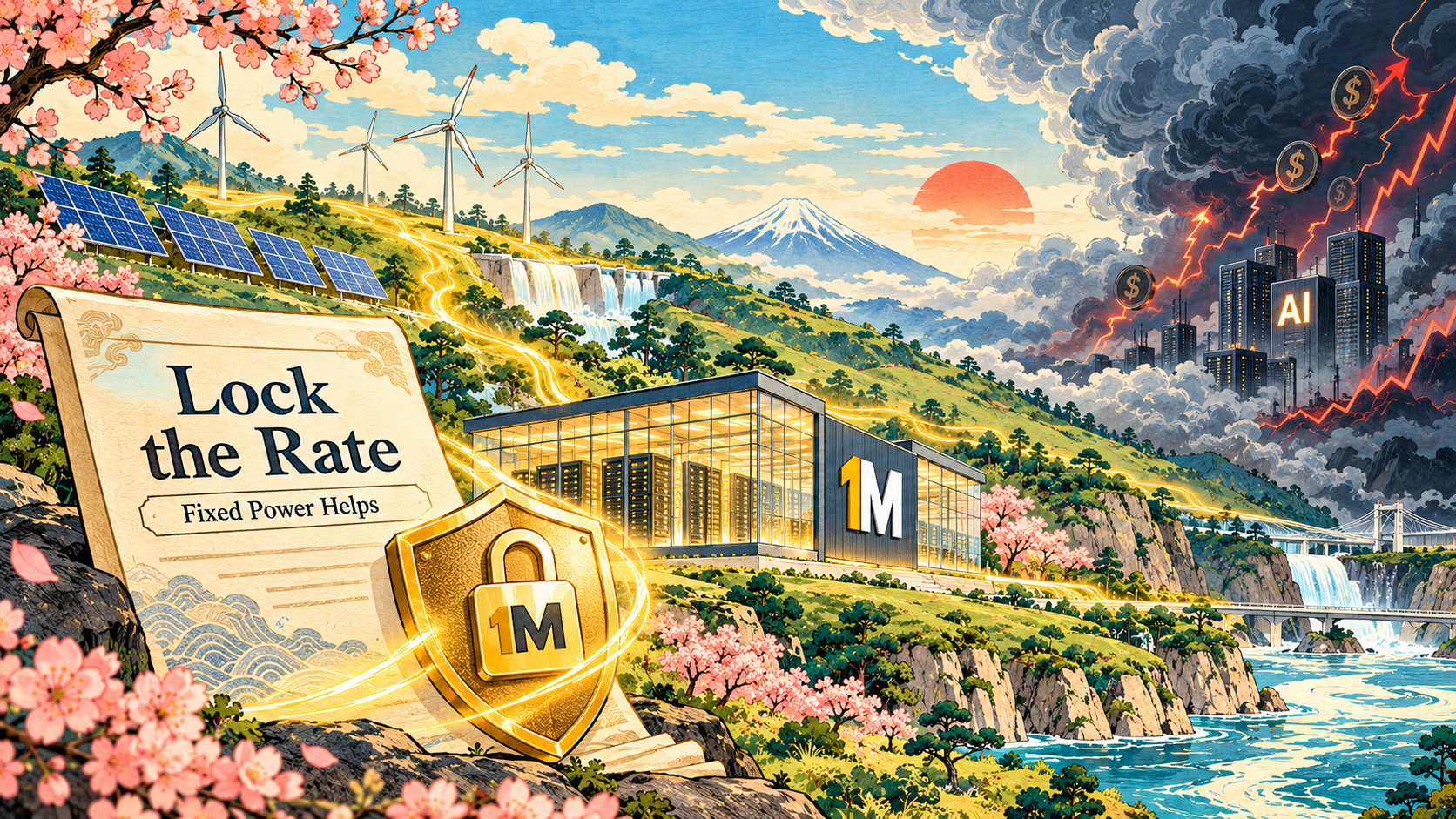
If electricity becomes more expensive in a particular market, a genuinely fixed contract can protect a miner from some of that price risk. OneMiners’ company materials cite a network-average electricity figure around $0.048/kWh, while its lowest published $0.0364/kWh Nigeria rate is tied to a seven-year prepaid energy plan, not an ordinary month-to-month rate.
That distinction matters. The lower rate comes in exchange for committing capital upfront and accepting a long contract, so the customer takes on counterparty, site and opportunity-cost risk in return for price certainty.
A company-linked Medium guide, Prepaid Energy: How to Lock In a Discounted Power Rate Before You Ever Plug In, gives a concrete example of the trade-off. It describes an Antminer Z15 Pro drawing 2.72 kW at a Finland site with a standard rate of $0.0650/kWh. In the example, the seven-year prepaid rate drops to $0.0455/kWh, roughly a 30% discount.
The account example lists 166.55 MWh of prepaid energy, with a standard-price equivalent of $10,825.43 and a prepaid cost of $7,577.80, for a stated saving of $3,247.63. Those are example figures from a company-linked article, not guaranteed savings for every customer.
The trade-off is substantial: the example requires paying more than $7,500 upfront. The guide itself notes that long prepayment works best only when a miner is confident it will keep the relevant hardware and hosting arrangement for years. Customers should ask what happens to unused prepaid energy if hardware fails, is replaced, is sold or needs to move to another facility.
Fewer miners can mean less competition
CoinDesk describes some public miners shifting capital and capacity away from Bitcoin. If that pulls hashrate out of the network, each remaining machine’s share of rewards can rise, other things equal. That is an inference, not a promise: difficulty, price and new entrants all move the result, and Luxor’s data shows hashrate rising again in September.
Questions to Ask Any Hosting Provider (Including OneMiners)

The AI trend makes some old questions more important:
- How is your power contracted, and for how long? Is the rate fixed, and does it cover my machine and site?
- What happens if my site changes? OneMiners says it offers free relocation between facilities. Ask what the process, timing and costs are in writing.
- Does the prepaid rate follow my machine if I move or sell it?
- What is the uptime commitment, how is it measured, and what compensation applies? OneMiners cites a 95%+ SLA with compensation in its own material.
- Do curtailment arrangements affect my machine? The power post notes that curtailment-linked sites stop hashing when asked, so the uptime commitment matters more than the headline rate.
- What are the warranty, repair and refund terms? Get them in writing.
Frequently Asked Questions
Why are Bitcoin miners moving into AI? Mining margins are volatile, while AI cloud providers will sign long leases for powered, cooled sites. CoinDesk counts more than $70 billion in announced contracts.
Are miners leaving Bitcoin? Not entirely. Many are running both businesses, though some are selling Bitcoin and shrinking mining operations.
Will AI raise my hosting power cost? It could in contested markets, as OneMiners’ own post notes. Fixed-rate or prepaid contracts reduce that exposure.
Is prepaid energy right for me? It can lower your rate, but it requires a large upfront payment and fits best when you plan to run a specific machine at one site for the full term.
Does the AI shift make Bitcoin mining unprofitable? Not by itself. Bitcoin mining can be profitable or unprofitable depending on hashprice, electricity cost, hardware efficiency, uptime, difficulty and other expenses. Competition from AI can make power capacity more valuable in some markets, which increases the importance of securing competitive electricity terms, but it does not determine mining profitability on its own.
The Bottom Line
Some large Bitcoin mining companies are becoming AI and HPC infrastructure providers because the two industries compete for one especially scarce asset: large, usable blocks of electrical capacity. Miners that already control grid connections and suitable sites can have a valuable head start, but turning a Bitcoin mine into an AI-grade data center still requires major investment in buildings, cooling, connectivity and reliability.
For hosted Bitcoin miners, the trend matters because AI data centers can increase competition for power and infrastructure in some regions. Long-term fixed electricity contracts may reduce exposure to future price increases, but prepaid arrangements also introduce lock-in and counterparty risk. OneMiners’ power-sourcing material and the company-linked Medium prepaid-energy guide are useful examples of how one hosting provider approaches those trade-offs, but customers should verify the exact rate, term, relocation rules, uptime commitment and treatment of prepaid balances in their own contract.
The practical lesson is not that AI is replacing Bitcoin mining. It is that power capacity has become valuable to more industries, so miners need to understand exactly what they are paying for and what protections their hosting agreement actually provides.
Sources and Further Reading
- Where Bitcoin Mining Actually Gets Its Power — OneMiners
- Prepaid Energy: How to Lock In a Discounted Power Rate Before You Ever Plug In — Medium
- Bitcoin Miners Reveal the Real AI Scarcity Trade — Reuters Breakingviews
- Bitcoin Miners Are Becoming AI Companies and Selling Their BTC to Fund the Transition — CoinDesk
- Galaxy Delivers 133 MW of Critical IT Load to CoreWeave as Helios Bitcoin Mine Turns AI Hub — The Block
- CoinShares Bitcoin Mining Report — Q1 2026
- IREN, TeraWulf, Hut 8: Why Bitcoin Mining Companies Are Booming in 2026 — OneMiners
#BitcoinMining #AIDataCenters #HostedMining #OneMiners #BitcoinMiners #HPC #PrepaidEnergy #CryptoMining