
Ask ten people whether Bitcoin mining is still profitable and you’ll get eleven answers. Most of the confusion comes from skipping one number that miners actually use to answer the question: hashprice.
Hashprice sounds technical, but the idea is simple. This guide explains it in plain English, shows where it stands in late 2026, and walks through a worked example so you can see why low power costs, efficient machines and professional hosting keep the math working for some miners while it fails for others. This is general information, not financial advice, and mining carries real risk.
What Is Hashprice?

Think of hashprice as the daily paycheck for a unit of mining power.
Luxor Technology, which coined the term in 2019, defines it in its Hashrate Index documentation as a measure of how much a miner can expect to earn from a given quantity of hashrate. Its headline index gives the expected daily value of one petahash per second (1 PH/s) on the Bitcoin network. It can be quoted in dollars or in Bitcoin.
Two nice things about it:
- It lets you compare machines of any size. Whether you run one miner or a thousand, you multiply your hashrate by the hashprice.
- It’s what most pools use to estimate payouts. Luxor notes the BTC version of the formula is used by most mining pools to pay miners.
Importantly, hashprice is an expected value, not a guaranteed payout.
What Moves Hashprice?
Luxor lists the inputs. For the Bitcoin-denominated version, there are three:
- The block subsidy: new Bitcoin paid per block, currently 3.125 BTC. The next halving is projected for April 2028.
- Transaction fees: paid by users and added to each block. Luxor uses a 144-block lagging average.
- Network difficulty: adjusts every 2,016 blocks to keep blocks arriving about every ten minutes. More competing hashrate means higher difficulty, which means each unit of hashrate earns a smaller slice.
The dollar version adds a fourth input, Bitcoin’s price, which Luxor describes as the main driver of USD hashprice when the other inputs are steady. USD hashprice rises with price, subsidy and fees, and falls with difficulty.
A back-of-the-envelope check
Here’s a simplified version using September 2026’s numbers from Luxor’s lookback: about 144 to 154 blocks a day, a 3.125 BTC subsidy, roughly 0.02 BTC in fees per block and a network of about 975 EH/s. Divide the day’s total block rewards by the network’s petahashes and you land near 0.00049 BTC per PH per day. Multiply by September’s average price of about $80,386 and you get roughly $39 per PH per day, which matches the index.
You don’t need to do this yourself, but it helps to know there’s no magic. It’s rewards divided by competition, then converted to dollars.
Where Hashprice Stands in 2026
The picture has swung, which is the whole point of watching it.
- Mid-August: a Medium analysis of a week of data (August 17) reported hashprice dropping to about $28.90 to $30.60 per PH per day, which it called a historic low, with Bitcoin near $64,900 and difficulty at 127.3 trillion. It argued the median producer’s cost was above the market price and that electricity cost and uptime separated the profitable from the unprofitable. (That article is bylined with OneMiners.com and doesn’t cite sources for several of its figures, so treat its “median cost” estimate as the author’s view, not an established fact.)
- September: Luxor reports USD hashprice opened the month at $39.21, closed at $39.92 and averaged $39.33, the highest monthly average since January. The range ran from $37.61 to $41.01. Bitcoin climbed from about $78,000 to $83,700, while difficulty rose a net 5.5% to 132.76 trillion.
- The takeaway: from the August low to September’s average, hashprice recovered by roughly a third, even though difficulty kept rising. Luxor’s own observation is that difficulty growth absorbed most of the price-driven gains.
The lesson is that hashprice can move more than 30% in weeks. That’s why smart miners judge a purchase on break-even, not on a single day’s snapshot.
The Number That Actually Answers “Is It Profitable?”
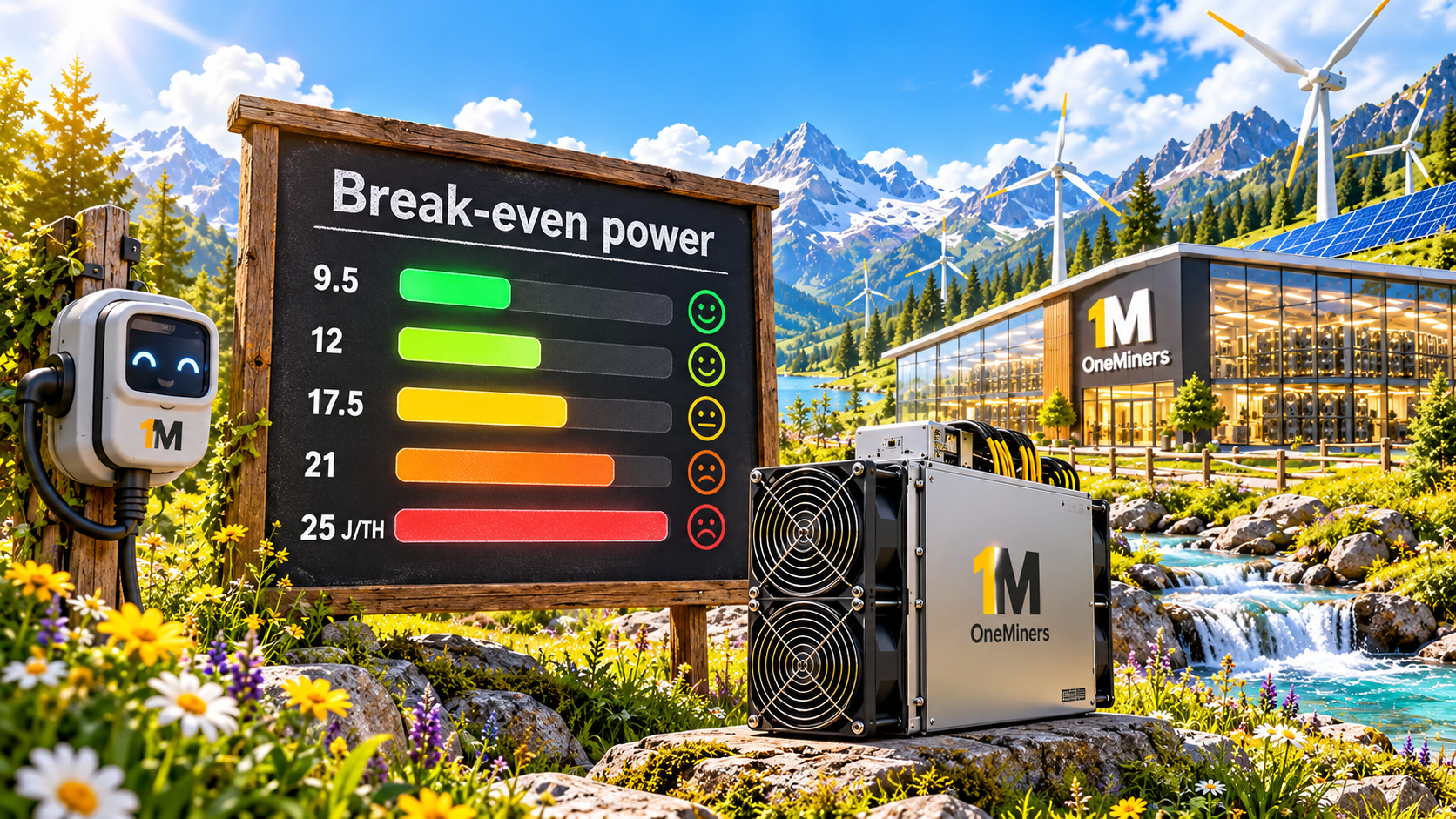
The simplest profitability test is the break-even electricity price:
Break-even rate ($/kWh) = hashprice ÷ (24 × machine efficiency in J/TH)
If your electricity rate is below this number, the machine’s expected mining revenue exceeds its electricity cost on a power-only basis. If your rate is above it, the machine is power-negative at that hashprice. This is not a full profitability threshold: hardware cost, uptime, pool terms, hosting or management charges, repairs, financing, taxes and other operating expenses still matter.
Using Luxor’s September average of $39.33, here’s what the formula gives:
| Machine efficiency | Break-even at $39.33 (Sept avg) | Break-even at ~$29.75 (Aug low) |
|---|---|---|
| 9.5 J/TH | about 17.3¢ per kWh | about 13.1¢ |
| 12 J/TH | about 13.7¢ | about 10.3¢ |
| 17.5 J/TH | about 9.4¢ | about 7.1¢ |
| 21 J/TH | about 7.8¢ | about 5.9¢ |
| 25 J/TH | about 6.6¢ | about 5.0¢ |
Luxor’s September energy hashprice data tells the same story. Fleets below 14 J/TH averaged about $137 of mining revenue per MWh of electricity consumed, while 25–38 J/TH fleets averaged only about $51/MWh. Luxor compared those figures with a $48/MWh industrial bitcoin-mining power-cost benchmark. That benchmark is not every miner’s actual electricity bill, but it shows why older machines have far less room for difficulty increases, downtime or other operating costs.
Two takeaways. Efficiency buys you headroom, and power rate decides whether you have any margin at all.
A Worked Example: Same Machine, Different Power Rates

OneMiners’ June 2026 post on mining profitability makes the case that mining “is profitable for whoever pays the least for power,” and it uses an Antminer S21 XP Hydro (473 TH/s, 12.0 J/TH, $6,199) as its example. That’s the right framing. Its dollar figures, though, assumed Bitcoin near $105,000, which is higher than Luxor’s reported 2026 high of $96,278. So we re-ran the same machine with September’s average hashprice.
The machine draws about 5.68 kW at its rated 473 TH/s and 12 J/TH. At September’s $39.33/PH/day average hashprice, that produces roughly $558 per 30-day month in gross mining revenue before power, downtime, pool differences, repairs, taxes and other costs.
The table below uses several electricity benchmarks. Importantly, OneMiners’ cheapest $0.0364/kWh rate is a seven-year prepaid rate, while its September 2026 hosting rate card lists higher premium or shorter-commitment rates.
| Electricity rate | Monthly power cost | Power-only margin at Sept. $39.33 hashprice | Power-only margin at ~$29.75 hashprice |
|---|---|---|---|
| 3.64¢ — OneMiners Nigeria, 7-year prepaid | about $149 | about $409 | about $273 |
| 4.8¢ — OneMiners Nigeria premium rate | about $196 | about $362 | about $226 |
| 6.0¢ — roughly the current premium rate at several OneMiners U.S. regional sites | about $245 | about $313 | about $177 |
| 12¢ — illustrative home rate used in the June OneMiners article | about $490 | about $68 | about −$68 |
| 18.27¢ — EIA’s 2026 U.S. summer residential-price forecast | about $747 | about −$189 | about −$324 |
These calculations assume the miner runs continuously for 30 days at its rated power and hashrate. Real results should be adjusted for actual uptime, pool payout method, machine performance and any additional charges.
What this shows:
- At the specific low hosted rates modeled above, this machine remains power-positive even using the August-low hashprice assumption.
- At 12¢/kWh, the margin is already thin at September’s average and turns power-negative under the August-low scenario.
- Around the 2026 U.S. residential benchmark, the miner is clearly power-negative before cooling, wiring or other home-mining costs.
- Power-only margin is not investment payback. The hardware purchase, prepaid electricity commitment, downtime, repairs and other costs still have to be included before calculating an actual return on capital.
The earlier 15-month figure should therefore not be described as the machine’s simple investment payback. Dividing the $6,199 hardware price by the roughly $409 monthly power-only margin gives about 15 months, but the $0.0364/kWh rate is tied to a seven-year prepaid electricity commitment. At the machine’s rated 5.68 kW draw, seven years of continuous electricity at that rate represents roughly $12,700 of energy before adjusting for actual uptime or contract billing. A buyer should include that prepaid capital and all other required costs when calculating cash payback.
The $0.0364/kWh figure is the lowest rate OneMiners currently publishes, but it is not its ordinary short-term hosting price. The company’s September 2026 hosting rate card identifies it as Nigeria’s seven-year prepaid rate, calculated from a higher standard or online-ordered rate.
For U.S. hosting, pricing varies by site and plan. A company-linked Medium field guide, Where Smart Bitcoin Miners Host in America, described premium U.S. rates around 6–7.4¢/kWh in July 2026. OneMiners’ newer September rate card lists premium rates around 5.9–6.0¢/kWh at several regional U.S. sites, with lower prices available under multi-year prepaid plans. Because pricing and contract structures can change, get the exact all-in rate, term and prepayment requirement in writing.
Why Hosting Can Help in a Low-Hashprice Environment

When hashprice is thin, small differences in operating cost and uptime have a much larger effect on the final margin. Professional hosting can improve several of those variables, but the exact benefit depends on the provider and contract.
- Power cost. OneMiners currently publishes electricity plans ranging from standard or premium rates to discounted prepaid plans. Its lowest $0.0364/kWh Nigeria rate requires a seven-year prepaid commitment. The company also advertises 0% management fees on certain hosting arrangements. Long-term fixed pricing can reduce electricity-price uncertainty, but it introduces prepayment and counterparty risk.
- Uptime. OneMiners’ own materials advertise a 95%+ uptime guarantee and cite average or target figures around 98% at some sites. Even 98% uptime allows roughly 175 hours of downtime over a year, so realistic profitability models should include downtime rather than assuming a machine hashes 24/7.
- Warranty and repairs. OneMiners advertises a seven-year warranty for eligible hosted hardware at specified facilities along with repair support. Before relying on that benefit, confirm the exact machine, facility, repair turnaround and warranty exclusions covered by your order.
- Operational convenience. Hosting removes much of the noise, heat, cooling and electrical-infrastructure burden of running a modern ASIC at home. That convenience has value, but it does not eliminate mining, hosting-provider or contract risk.
Hosting does not remove hashprice volatility. It can improve variables a miner can influence—such as electricity cost, uptime and operational management—but Bitcoin price, network difficulty, block rewards and transaction fees can still move against the operation.
Smarter Operation: Making Hashprice Work for You
Large operators go further than “plug it in and leave it.” Braiins’ Price Adapt announcement (August 20, 2026) describes a feature that sets each miner’s power target based on day-ahead electricity prices, a seven-day average hashprice and the machine’s efficiency curve, or curtails it when mining is uneconomic. Its modeled results (2025 ERCOT prices, one megawatt site) showed profit gains of 36.2% for an Antminer S19J Pro and 15.3% for an S21 XP, though most of the S21 XP gain came from the Braiins OS firmware itself rather than the Price Adapt feature (only 2.9%).
It’s a product announcement with modeled, not measured, results, and it currently supports day-ahead pricing only in ERCOT and PJM. But it illustrates a useful principle: profitability is dynamic, and the best miners adjust to hashprice and power cost instead of running at a fixed setting. OneMiners describes its own “AI smart mining” for automated clock and voltage tuning, so ask any provider what automation is included.
Risks to Keep in View
- Hashprice volatility. It fell to about $29 in August and rebounded to about $39 in September.
- Difficulty and hashrate growth. Luxor reported that Bitcoin’s seven-day network hashrate average had already reached 999 EH/s on October 8, effectively around 1 zettahash per second, while its September forward curve also priced network hashrate above 1 ZH/s in early 2027. More competition can raise difficulty and reduce the BTC earned by each unit of hashrate if other variables do not compensate.
- The 2028 halving, projected for April 2028, cuts the subsidy in half unless price or fees compensate.
- Fees are small. Luxor reports they were only 0.63% of block rewards in September, so they can’t rescue weak margins.
- Counterparty and contract risk. Prepaid power and long commitments need clear written terms.
Frequently Asked Questions
What is hashprice in simple terms? The expected daily earnings for one petahash of mining power. Multiply it by your hashrate to estimate revenue.
What is hashprice right now? Hashprice changes continuously with bitcoin’s price, network difficulty, transaction fees and block production. Luxor’s September 2026 monthly average was $39.33 per PH/s/day, but that is a historical benchmark rather than today’s rate. Check the live Luxor Hashprice Index before running a profitability calculation.
Is Bitcoin mining still profitable? It can be. Efficient machines at sufficiently low electricity rates may remain power-positive, while inefficient machines or expensive power can quickly turn negative. At the U.S. residential electricity levels seen in 2026, a 12 J/TH machine is generally power-negative under the hashprice scenarios modeled here. Some homes have cheaper electricity, so the correct answer is always to compare your actual rate with the machine’s current power-only break-even and then add hardware, cooling, downtime and other costs.
How do I calculate my break-even electricity rate? Hashprice divided by (24 × J/TH). At $39.33 and 12 J/TH, that’s about 13.7¢ per kWh.
Is hosting profitable? It depends on the all-in rate, the machine, the contract and the hashprice. Run your own numbers with live data.
The Bottom Line
Bitcoin mining in late 2026 is a business of tight and moving margins. Hashprice tells you the expected revenue produced by a unit of hashrate, while the break-even electricity rate shows how much room a machine has before power alone consumes that revenue. Efficient hardware and low electricity costs provide more headroom, but neither guarantees a profitable investment.
The worked example shows why professional hosting can improve the operating math compared with average residential electricity. OneMiners’ lowest published rates produce attractive power-only margins in the scenarios above, but the cheapest rates are tied to long prepaid commitments and should not be confused with month-to-month electricity pricing or full investment returns. Use live hashprice and difficulty data, include realistic uptime and all required upfront costs, stress-test lower-revenue scenarios, and get the rate, warranty, repair and exit terms in writing before committing capital.
Sources and Further Reading
- Is Bitcoin Mining Still Profitable in 2026? — OneMiners
- Bitcoin Mining’s Margin Problem, in One Week of Data — Medium
- Hashprice — Luxor Hashrate Index docs
- Luxor Hashrate Lookback Series: September 2026 — Hashrate Index
- Braiins Manager Price Adapt — Braiins
- Where Smart Bitcoin Miners Host in America — Medium
#BitcoinMining #Hashprice #IsBitcoinMiningProfitable #OneMiners #HostedMining #ASICMining #MiningProfitability #CryptoMining