Merged mining gives Scrypt hardware an unusual advantage: the same mining work can earn rewards from Litecoin and Dogecoin, and some pools add even more auxiliary coins. That does not automatically make every Scrypt miner profitable, because hardware price, electricity cost, coin prices, pool terms and network difficulty still matter.
In this guide, we explain how Litecoin + Dogecoin merged mining works, how much each coin can contribute, which 2026 ASICs are worth comparing, how merged-mining pools handle payouts, and what electricity price does to the economics.
Key Takeaways
- Litecoin and Dogecoin both use Scrypt, and Dogecoin supports Auxiliary Proof of Work (AuxPoW) so compatible mining work can help secure both chains.
- With a pool that supports LTC/DOGE merged mining, the same ASIC hashrate can earn rewards from both chains without splitting the miner’s hashing capacity between them.
- Dogecoin supplied most of the combined LTC/DOGE mining revenue in OneMiners’ September 2, 2026 snapshot, at about 86.6% DOGE versus 13.4% LTC. That split changes with prices and network conditions.
- Some pools, including ViaBTC, currently add DOGE, BELLS, PEP and DINGO rewards to eligible Litecoin miners.
- Electricity remains one of the biggest profitability variables. Merged mining improves the revenue side of the equation, but it does not remove hardware, electricity, hosting or difficulty risk.
What Is Merge Mining?
Merge mining (also called merged mining) lets one set of proof-of-work count toward more than one blockchain. It works when two coins share the same hashing algorithm and the secondary coin is designed to accept the primary coin’s proofs.
That is exactly the relationship between Litecoin and Dogecoin. Both run on Scrypt, a memory-hard hashing algorithm that is different from Bitcoin’s SHA-256. As the Dogecoin Foundation’s guide to miners explains, miners bundle pending transactions into a block and search for a valid nonce. The first to find one adds the block to the chain and earns the block reward plus fees.
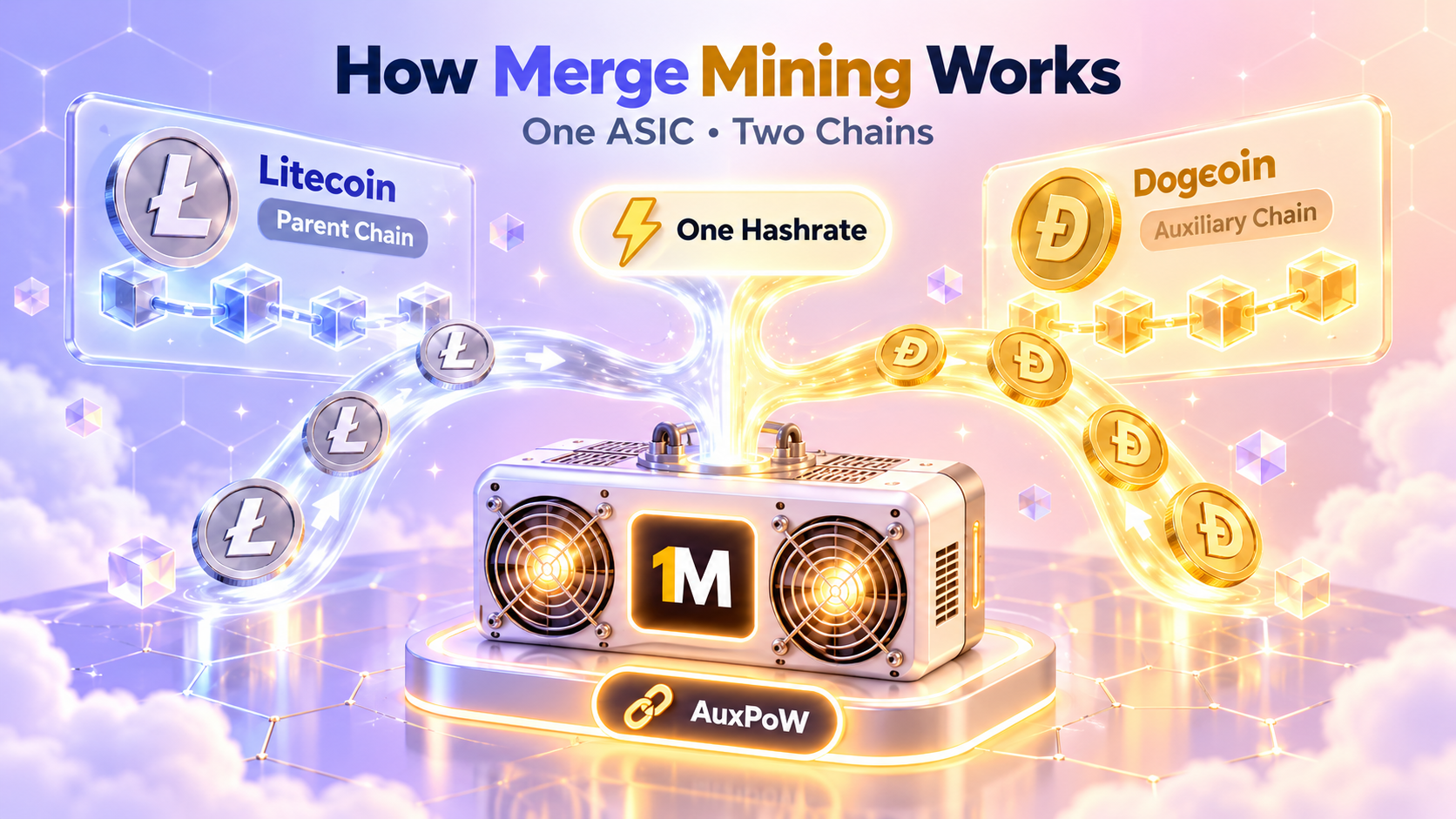
With merged mining, the ASIC does not divide its hashrate between Litecoin and Dogecoin. The mining pool builds work that contains a commitment to the auxiliary Dogecoin block and uses the same Scrypt proof of work for both chains.
A proof that satisfies Litecoin’s difficulty can be submitted to Litecoin, while qualifying proof can also be used under Dogecoin’s AuxPoW rules. The two networks keep their own blocks and difficulty targets; what they share is the underlying proof-of-work computation.
That is why merged mining is different from simply switching a miner back and forth between two coins. The ASIC keeps hashing continuously, while the pool handles the parent- and auxiliary-chain jobs and reward accounting behind the scenes.
How AuxPoW Makes It Work
The technical name for this system is Auxiliary Proof of Work (AuxPoW). In the Litecoin and Dogecoin pairing:
- Litecoin is the parent chain. Your miner works on Litecoin block templates.
- Dogecoin is the auxiliary chain. A reference to a Dogecoin block is embedded in the Litecoin work, so Dogecoin can verify that the same hashes also satisfy its own difficulty target.
As ViaBTC’s beginner guide to merged mining points out, the shared Scrypt algorithm alone is not what makes this possible. Dogecoin’s AuxPoW design is the key. The pool does the heavy lifting behind the scenes: it builds the combined jobs, tracks your shares and distributes rewards for both coins.
Why Dogecoin Adopted Merged Mining
In 2014, Dogecoin changed its mining system to support merged mining with other Scrypt cryptocurrencies. Dogecoin’s own mining documentation confirms that the network was modified that year to support merged mining and that Litecoin became the most important Scrypt partner.
At the time, Dogecoin’s mining ecosystem faced security and hashrate concerns as miners moved between competing Scrypt coins. Merged mining allowed Dogecoin to benefit from the much larger pool of Scrypt mining activity without requiring miners to dedicate a second set of hardware.
From the miner’s perspective, the benefit is an additional reward stream from the same underlying ASIC work rather than extra hashrate produced by the machine.
Litecoin vs. Dogecoin: Two Chains, One Machine
| Metric | Litecoin (LTC) | Dogecoin (DOGE) |
|---|---|---|
| Algorithm | Scrypt | Scrypt |
| Typical merge-mining role | Parent chain | Auxiliary chain using AuxPoW |
| Average block time | ~2.5 minutes | ~1 minute |
| Current block reward | 6.25 LTC | 10,000 DOGE |
| Supply model | 84 million maximum supply | No terminal supply cap; fixed 10,000 DOGE block subsidy |
| Next scheduled reward change | Late July 2027: 3.125 LTC | No further scheduled halving |
| Difficulty adjustment | Every 2,016 blocks | DigiShield adjustment every block |
Litecoin’s fourth halving is expected in late July 2027, when its subsidy falls from 6.25 LTC to 3.125 LTC. Dogecoin works differently: its subsidy remains 10,000 DOGE per block, so issuance continues indefinitely at a predictable maximum rate rather than ending at a fixed total supply.
The most important difference is the value of each chain’s issuance. Litecoin currently creates about 3,600 LTC per day, while Dogecoin creates about 14.4 million DOGE per day.
In its September 2, 2026 Antminer L9 vs. L11 Hydro comparison, OneMiners calculated that Dogecoin represented about 86.6% of combined LTC/DOGE mining revenue in that specific market snapshot, with Litecoin contributing about 13.4%.
That is not a permanent ratio. DOGE and LTC prices, network hashrates, difficulty and pool payout methods all change. The useful lesson is simply that a profitability calculator that counts Litecoin but ignores Dogecoin can substantially understate the revenue of an LTC/DOGE merged-mining setup.
Bonus Coins: More Than Two
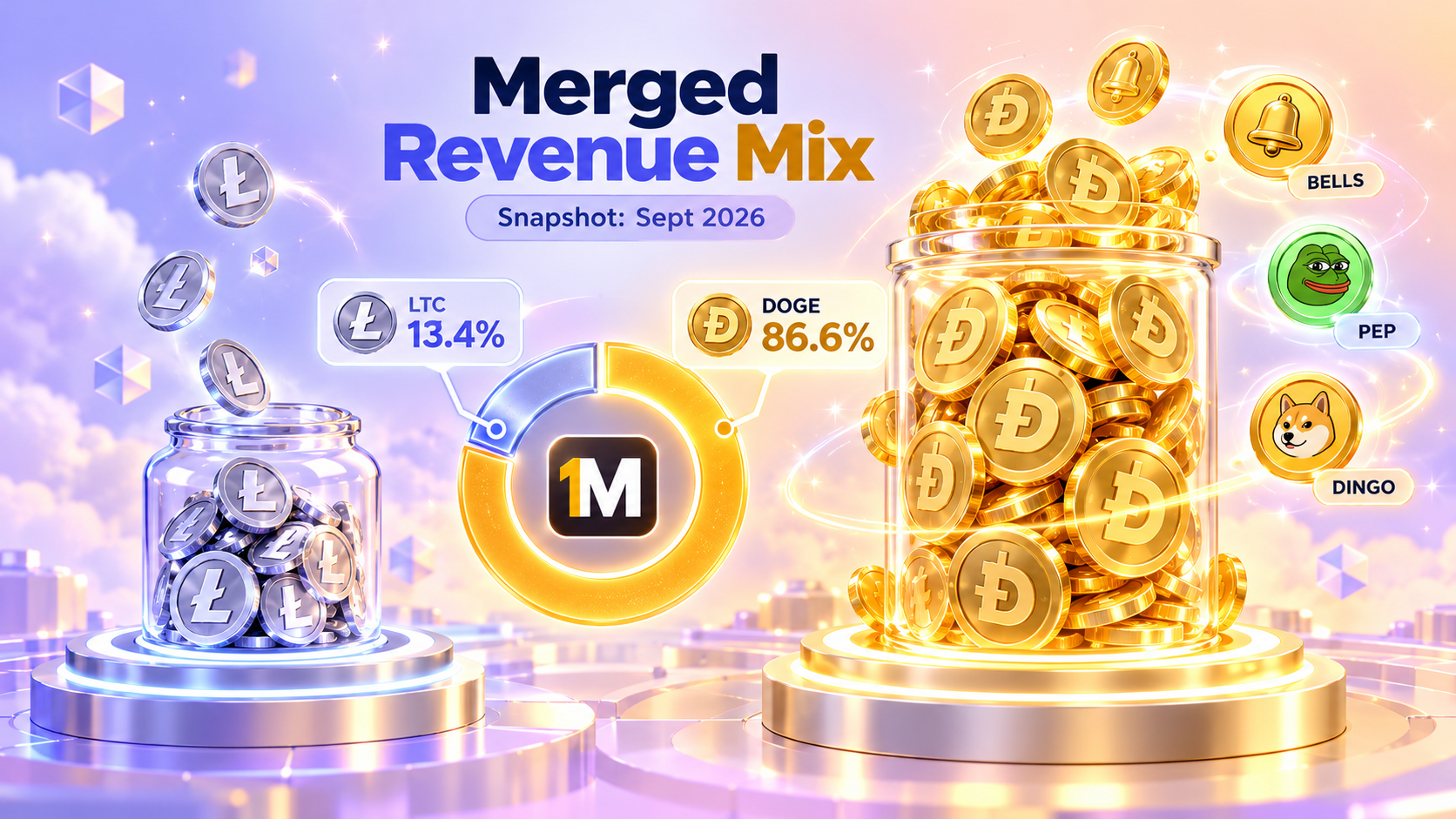
Some pools add more auxiliary coins. ViaBTC’s current LTC merged-mining documentation says Litecoin miners using eligible PPS+ or PPLNS payout modes can currently receive DOGE, BELLS, PEP and DINGO rewards without running separate mining hardware.
ViaBTC distributes these merged-mining rewards according to the miner’s contributed hashrate and currently settles them every two hours. Pool support and payout rules can change, so check the pool’s current documentation before assuming every LTC pool pays the same auxiliary coins.
These extra coins are usually small compared with DOGE and LTC, but they are a nice bonus on top of the same work.
The Best Scrypt Miners for Merge Mining in 2026
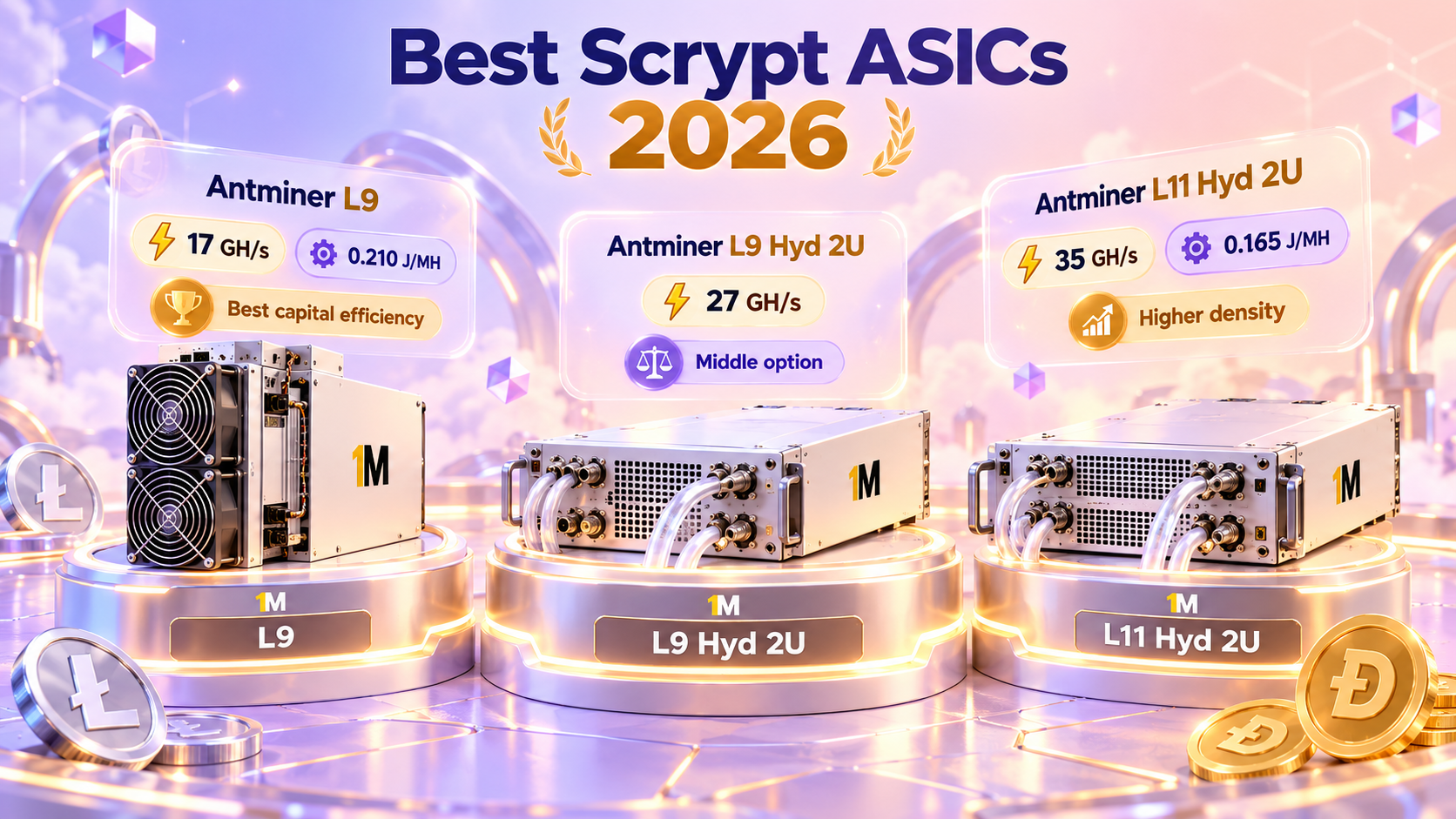
Graphics cards and CPUs are not competitive on Scrypt. Merge mining is done with purpose-built Scrypt ASICs. In its head-to-head Antminer L9 vs. L11 Hydro comparison, OneMiners compared the two leading Bitmain models at a hosted power rate of $0.048/kWh, with both Litecoin and Dogecoin rewards counted:
| Miner | Hashrate | Power | Efficiency | Price (Sept 2026) | Est. net revenue/day | Est. payback |
|---|---|---|---|---|---|---|
| Antminer L9 | 17 GH/s | 3,570 W | 0.210 J/MH | $2,999 | ~$4.85 | ~20 months |
| Antminer L11 Hyd 2U | 35 GH/s | 5,775 W | 0.165 J/MH | $16,415 | ~$11.80 | ~46 months |
Revenue and payback figures are a snapshot from early September 2026 and change with coin prices and difficulty.
How to read this September 2026 snapshot:
- Antminer L9: best capital efficiency in the OneMiners comparison. At the September prices used in the article, the 17 GH/s L9 cost $2,999 and had the shortest modeled hardware payback at about 20.3 months.
- Antminer L11 Hyd 2U: stronger efficiency and density. It produces 35 GH/s at about 0.165 J/MH, compared with the L9’s 0.210 J/MH, but its $16,415 reference price made its modeled payback much longer at roughly 45.7 months.
- Antminer L9 Hyd 2U: middle option. OneMiners’ same comparison lists it at 27 GH/s and $5,699, placing it between the standard L9 and L11 Hydro in both hashrate and capital cost.
These rankings are price-sensitive snapshots, not permanent recommendations. A later production batch or price change can quickly alter which machine offers the best return per dollar.
For smaller setups, home-focused Scrypt miners exist. Goldshell officially lists the Mini-DOGE III at 700 MH/s and about 400 W, with a manufacturer noise specification of up to roughly 35 dB. It is dramatically less demanding than an industrial L9, although real-world noise can vary with temperature, fan speed and the room.
Small home miners are useful for learning and for locations that cannot support a multi-kilowatt ASIC, but their absolute mining output is much lower. Phone or laptop apps claiming to perform profitable Dogecoin mining should also be treated cautiously because modern profitable Scrypt mining is dominated by dedicated ASIC hardware.
How to Set Up Litecoin + Dogecoin Merge Mining
Getting started is easier than it sounds. Most of the merged-mining work happens on the pool’s side.
- Choose a pool that supports LTC/DOGE merged mining. Popular options include LitecoinPool, ViaBTC, F2Pool and Prohashing. According to Simple Mining, fees range from about 1% to 4% depending on the pool and payout method.
- Prepare your wallets. Many pools pay the two coins separately, so you may need both a Litecoin and a Dogecoin receive address. Some pools, such as ViaBTC, credit the merged coins to your pool account automatically.
- Connect the miner. Plug it into your router by Ethernet, find its IP address and log in to the web dashboard. Change the default password right away.
- Enter the pool details. Add the pool’s Litecoin stratum URL, your worker name and password. Add a backup pool in the second slot so your machine keeps hashing if the main pool goes down.
- Save, reboot and check. Your worker should appear active on the pool dashboard within about 20 minutes, and you will start seeing LTC and DOGE credits.
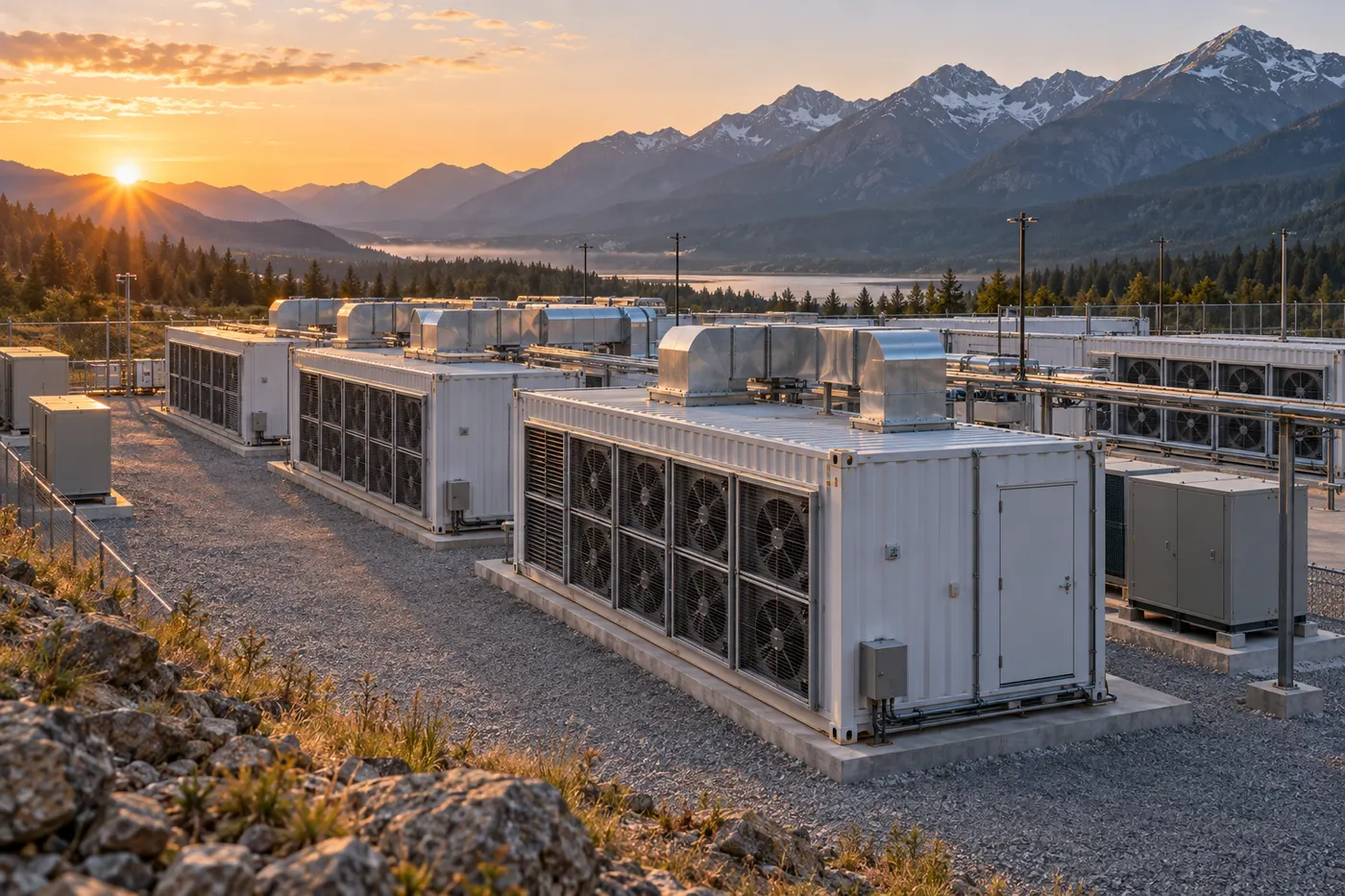
Industrial miners need proper electrical and cooling infrastructure. Bitmain’s official Antminer L9 specifications list the input range at 220–277V AC, up to 20A, with an operating-temperature range of −20°C to 45°C.
The 17 GH/s L9 is rated around 3,570 W and about 75 dB, so it normally needs a dedicated high-capacity circuit, strong ventilation and enough heat removal for several kilowatts of continuous output. Electrical work should be sized for the exact miner and local electrical code rather than treated like an ordinary household appliance.
Is Litecoin + Dogecoin Merge Mining Profitable in 2026?
Merge mining improves your revenue, but it does not reduce your costs. Your profit still comes down to four things: your machine’s efficiency, your electricity price, coin prices and network difficulty.
Electricity is one of the biggest variables. OneMiners modeled its September Scrypt comparison using a network-average hosting rate of $0.0480/kWh. At that rate, its modeled net figures were about $4.85/day for the L9 and $11.80/day for the L11 Hyd 2U before other costs.
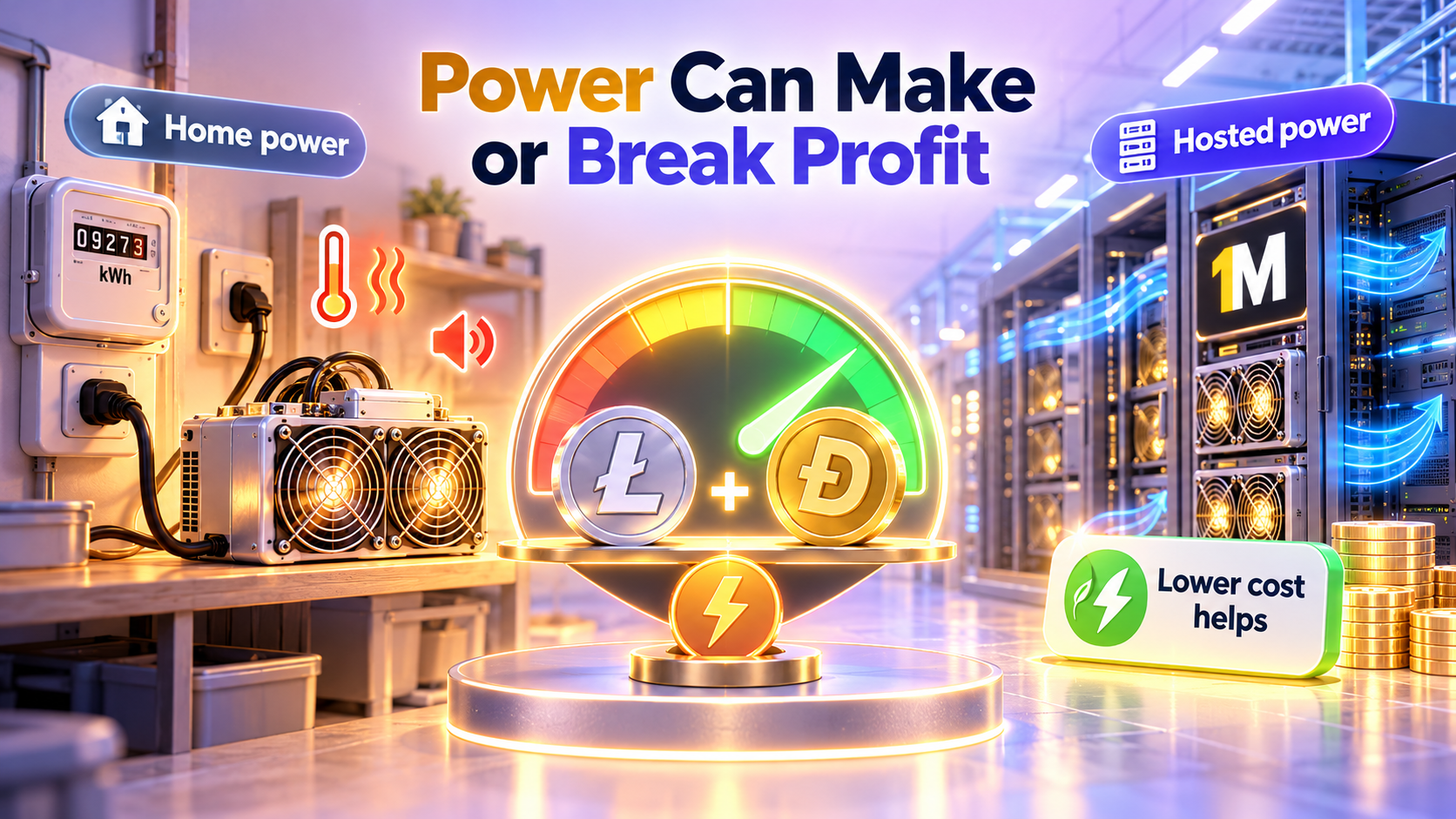
Be careful with the same article’s $0.12/kWh home-power discussion. Its prose says every machine loses money at that rate, but its own table shows something different: the L9 falls to about −1.32/day,theair-cooledL11isroughlybreak-evenat-0.05/day, while the L11 Hyd 2U remains about +$1.82/day on a power-only basis.
That apparent profit does not include hardware purchase price, cooling infrastructure, downtime, repairs, pool fees or other operating costs. The correct conclusion is that high residential electricity severely compresses Scrypt margins, not that every Scrypt model necessarily loses money at exactly $0.12/kWh.
There is another risk to watch: network hashrate growth. When additional Scrypt hardware joins the network, an individual miner represents a smaller share of the total hashrate, which can reduce expected rewards per machine if coin prices do not rise enough to offset the change.
The effect depends on the percentage growth of network hashrate and difficulty, not simply on Scrypt being smaller than Bitcoin.
OneMiners suggests diversifying mining exposure across Scrypt and Bitcoin hardware, but that is a company strategy rather than a requirement. The more concrete upcoming change is Litecoin’s fourth halving, expected in late July 2027, which will reduce the LTC subsidy from 6.25 to 3.125 LTC per block. Dogecoin’s 10,000 DOGE block subsidy is not scheduled to halve.
Where Hosting Can Make Sense for Scrypt Miners
Industrial Scrypt miners such as the L9 and L11 consume several kilowatts continuously and create substantial heat and noise. Professional hosting can solve those infrastructure problems when the hosted electricity rate is lower than the user’s local rate.
OneMiners’ September 2026 hosting rate card lists Nigeria at $0.0480/kWh for its premium tier and $0.0364/kWh under a seven-year prepaid energy plan. The lower number therefore requires a long prepaid commitment and should not be described as an ordinary starting monthly rate.
OneMiners also advertises 0% management fees, monitoring and a seven-year warranty for eligible hosted hardware. These are company-published commercial terms, so confirm the exact facility, electricity tier, required prepayment, uptime commitment, warranty exclusions, pool configuration and repair terms in the customer’s own agreement.
Hosting does not automatically make a miner profitable. It trades home electrical, heat and noise problems for contract, provider and counterparty risk.
Frequently Asked Questions
Does merge mining reduce my Litecoin earnings? No. Your hashrate is not split. The same work counts fully toward Litecoin and also toward Dogecoin.
Do I need two machines to mine Litecoin and Dogecoin? No. One Scrypt ASIC connected to a merged-mining pool earns both coins at once.
Which coin earns more, Litecoin or Dogecoin? Usually Dogecoin, because it issues far more value per minute. OneMiners estimated about 87% of revenue from DOGE in September 2026, though the split moves with prices.
Can I merge mine Dogecoin with a GPU? Not profitably. Scrypt mining is dominated by ASICs, and GPUs earn very little.
Will the Litecoin halving affect merge mining? It will halve the LTC portion of rewards, expected around 2027. Dogecoin’s 10,000 DOGE reward stays the same, which softens the impact.
Is it better to mine at home or use hosting? It depends on your electricity price and infrastructure. Industrial miners such as the L9 are difficult to run at home because of their multi-kilowatt load, heat and noise. Hosting can be cheaper if the contracted rate is below your home electricity cost, but it adds contract and counterparty risk. Small home-focused miners are easier to operate but produce much less hashrate.
The Bottom Line
Litecoin + Dogecoin merged mining gives Scrypt miners an unusual advantage: one set of ASIC proof-of-work can earn rewards from multiple compatible chains without dividing the machine’s hashrate between them.
In 2026, Dogecoin has contributed most of the combined LTC/DOGE revenue in several mining snapshots, but the split is not fixed. Coin prices, difficulty, network hashrate and pool payout rules all move.
The best miner therefore is not simply the one with the highest hashrate. Compare J/MH, hardware price per GH/s, electricity cost, pool terms and cooling requirements. The L9 offered stronger capital efficiency in OneMiners’ September comparison, while newer L11 Hydro hardware offered better electrical efficiency and rack density at a much higher purchase price.
If you use hosting, compare the full contract rather than only the headline electricity rate. If you mine at home, verify the exact voltage, current, noise and cooling requirements before ordering the hardware.
This article is for educational purposes only and is not financial advice. Mining revenue, difficulty, coin prices, pool payouts and hardware prices change constantly, so always check live data before buying a miner or choosing a pool.