Bitmain’s Antminer S23 family is one of the most important Bitcoin ASIC generations of 2026 because it pushed mining efficiency below the 10 J/TH barrier and expanded into several cooling and rack formats. But “S23” no longer refers to just one miner—or even only the original Air, Hydro and Immersion versions. By late 2026, the family also includes high-density hydro machines such as the S23e Hyd 2U, S23 Hyd 3U, and the newly announced S23 XP Hydro.
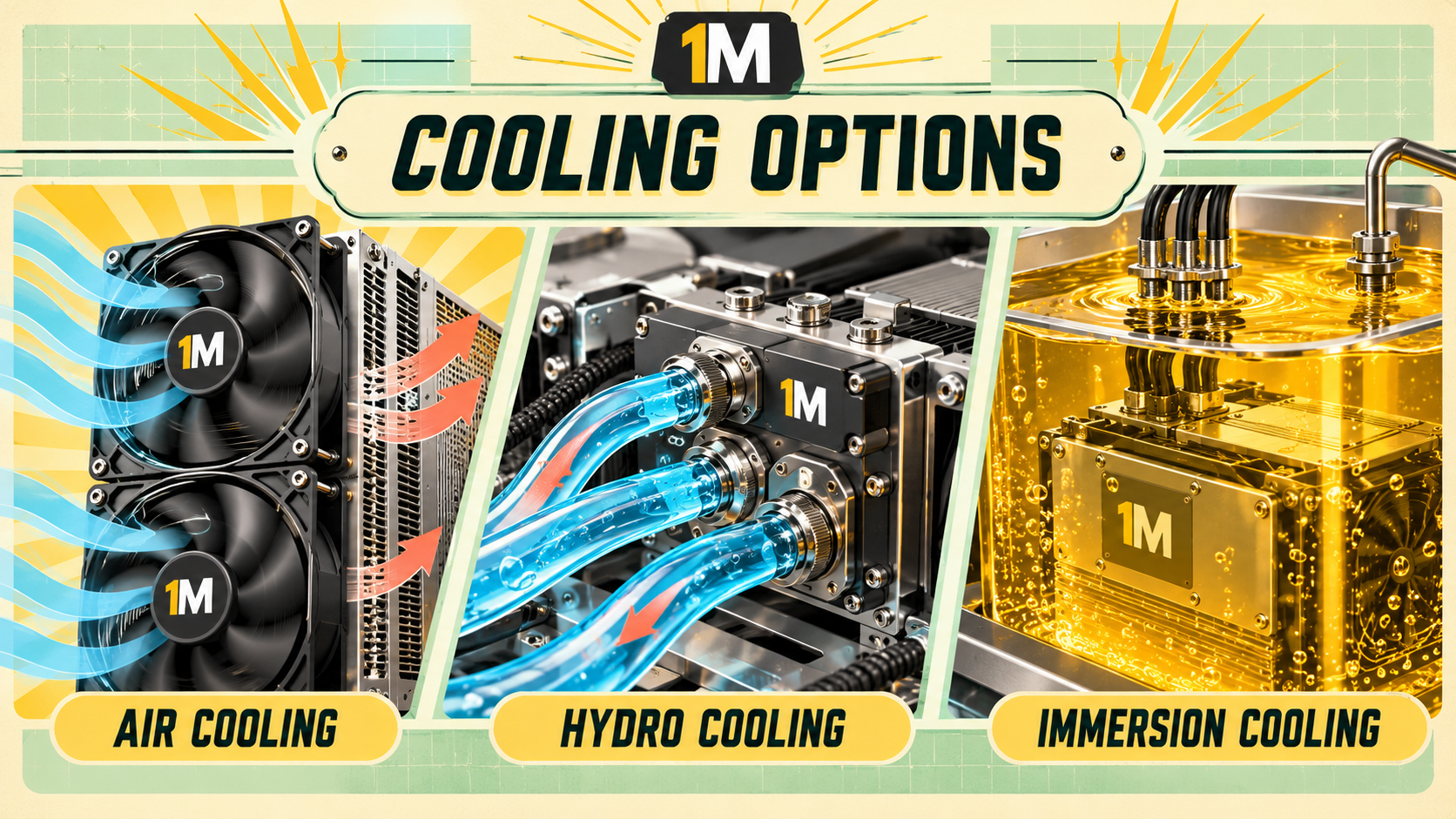
That matters because these machines solve different infrastructure problems. Air cooling is simpler to deploy, hydro models offer better efficiency and density but need liquid-cooling infrastructure, immersion models require dielectric-fluid cooling, and the larger rack units are designed mainly for industrial deployments. This guide compares the main S23 variants, explains their trade-offs in plain English and helps you decide which setup fits your budget and infrastructure. It’s general information, not financial advice. Mining carries real risk.
Why the S23 Matters
Bitmain unveiled the S23 series on May 27, 2025 at its World Digital Mining Summit in Las Vegas. Forbes contributor Colin Harper reported that the line comes in three cooling variants, that the water-cooled S23 Hydro is the first ASIC to dip below 10 W/TH, and that shipping was planned to begin in Q1 2026. Forbes compared it with the 2023 S21, citing 69% more hashrate and 41% better power efficiency.
Efficiency is measured in joules per terahash (J/TH). Lower is better, because it means less electricity per unit of mining work, and electricity is the biggest ongoing cost. (A handy rule: hashprice ÷ (24 × J/TH) gives the highest power price, in dollars per kWh, at which a machine still pays its electricity bill.)
The S23 Models at a Glance
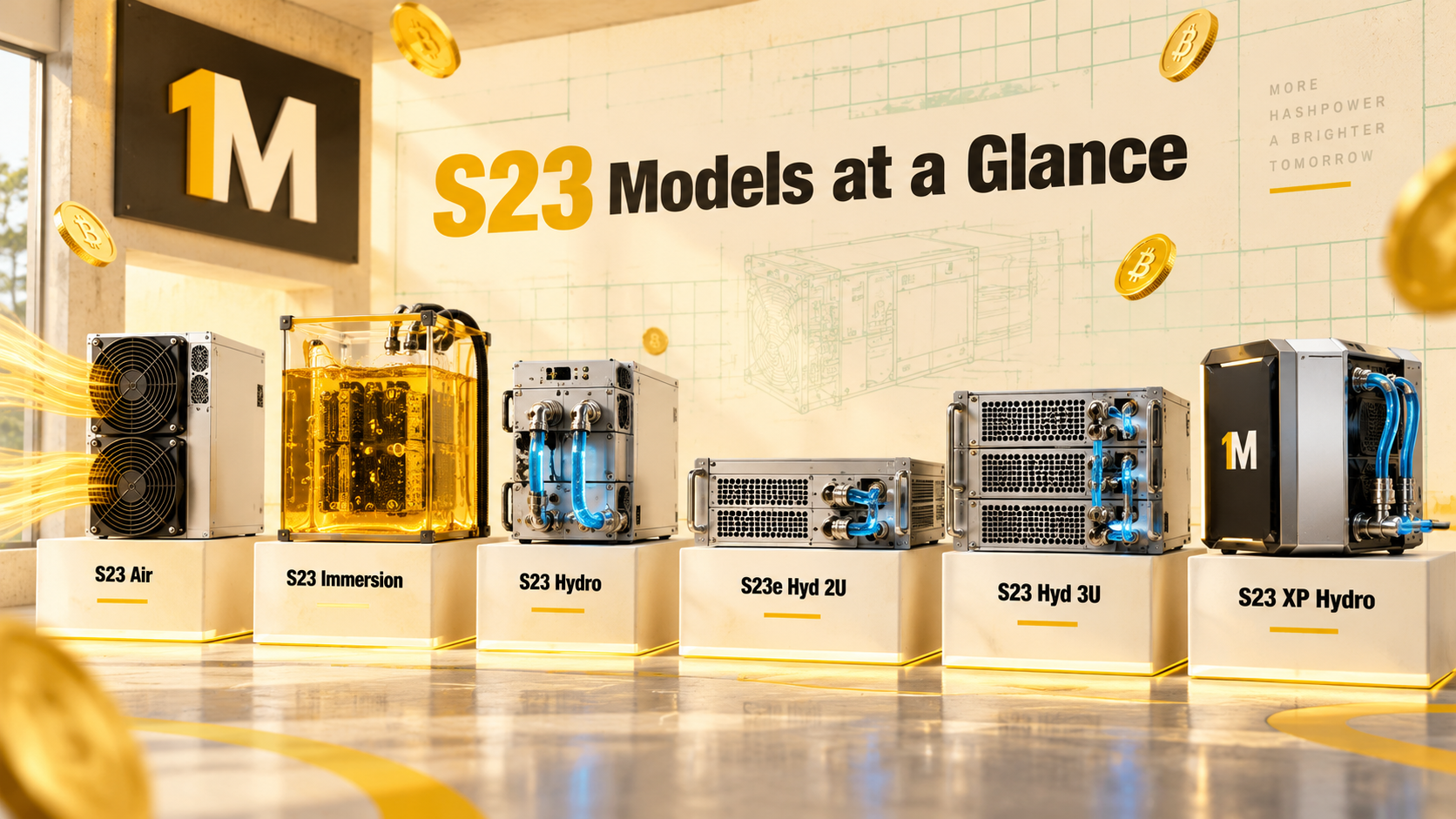
The S23 family has expanded since Bitmain first announced the Air, Hydro and Immersion models in 2025. Current OneMiners listings and company comparisons show the following main variants:
| Model | Hashrate | Power | Efficiency | Cooling / format | Current or recent price reference |
|---|---|---|---|---|---|
| S23 Air | 318 TH/s | 3,498 W* | 11.0 J/TH | Air | $6,899 |
| S23 Immersion | 442 TH/s | 5,304 W | 12.0 J/TH | Immersion | $10,289 |
| S23 Hydro | 580 TH/s | 5,510 W | 9.5 J/TH | Hydro | $12,299 |
| S23e Hyd 2U | 865 TH/s | 8,650 W | 10.0 J/TH | Hydro, 2U | $19,440 in-stock reference |
| S23 Hyd 3U | 1,160 TH/s | 11,020 W | 9.5 J/TH | Hydro, 3U | $28,399 |
| S23 XP Hydro | 600 TH/s | 5,340 W | 8.9 J/TH | Hydro | $15,300 Bitmain launch/futures price |
*The S23 Air needs a source note. OneMiners’ September S23 vs S23 Hydro comparison uses 3,498 W, which is mathematically consistent with 318 TH/s at 11 J/TH. However, the current OneMiners live product page also displays 4,129 W while still showing 11 J/TH. Because those figures conflict, confirm the actual shipped-unit wattage before sizing power infrastructure or calculating profitability.
The S23 Immersion is now commercially listed, rather than merely an announced model. OneMiners currently lists the 442 TH/s version at 5,304 W and 12.0 J/TH. That differs slightly from some early launch specifications, so use the current seller or manufacturer documentation for the exact batch you are buying.
The newest published efficiency leader is the S23 XP Hydro, rated at 600 TH/s, 5,340 W and 8.9 J/TH. OneMiners’ S23 Hydro vs S23 XP Hydro comparison says Bitmain announced it on August 28, 2026 at a $15,300 futures price, with delivery expected from November. Because it is a newer futures product, availability and reseller pricing should be confirmed before purchase.
Model by Model
S23 Air: the straightforward option
The air-cooled S23 uses fans and heatsinks rather than a liquid loop, making it the simplest S23 variant from a cooling-infrastructure standpoint. According to a Medium analysis of 2026 ASIC choices, it can be a practical upgrade path for operators replacing older S19-era hardware without rebuilding a site for hydro cooling. Because that Medium article contains affiliate links, treat it as operator commentary rather than primary manufacturer documentation.
The main trade-offs are noise, heat and electricity demand. Sources commonly place noise around 75 dB, similar to a loud vacuum cleaner running continuously. The electrical requirement should be described carefully: OneMiners’ current product page lists 220–240V AC, not mandatory three-phase service. However, a roughly 3.5–4.1 kW continuous load still requires properly sized wiring, breaker capacity and ventilation. Confirm the final machine’s actual power specification and have the electrical setup assessed appropriately rather than treating it like an ordinary household appliance.
S23 Hydro: the established efficiency-and-value option
Then replace the infrastructure paragraph with:
The big catch is infrastructure. The S23 Hydro cannot operate like an ordinary air-cooled ASIC because it requires a continuous liquid-cooling system. Bitmain’s own S23 Hydro manual specifies 580 TH/s, 5,510 W, 9.5 J/TH, 380–415V three-phase input and approximately 8–10 L/min of coolant flow. A complete deployment also needs pumps, plumbing, manifolds and equipment to reject the heat.
That makes professional hosting attractive for individual buyers, but the Hydro does not literally require a hosting provider. A mine or business with properly engineered three-phase power and hydro-cooling infrastructure can operate it directly. For most single-machine buyers, hosting is simply the more practical way to supply those requirements.
S23 Hyd 3U: the density play
The S23 Hyd 3U delivers 1,160 TH/s from 11,020 W at 9.5 J/TH. That is exactly twice the hashrate and power draw of one standard 580 TH/s S23 Hydro.
At the OneMiners prices used in this article, two standard S23 Hydros cost $24,598, while one S23 Hyd 3U costs $28,399. The 3U therefore costs $3,801 more for the same 1,160 TH/s and the same electrical efficiency.
The premium is mainly for density and operational simplicity: fewer chassis, fewer plumbing connections and fewer rack positions for the same hashrate. OneMiners’ Hydro vs Hyd 3U comparison therefore favors two standard Hydros for smaller buyers and the 3U where rack space and installation labor become the bigger constraint.
S23e Hyd 2U: maximum rack density
The S23e Hyd 2U sits between the 580 TH/s Hydro and the 1.16 PH/s Hyd 3U. OneMiners’ S23e Hyd 2U comparison lists it at 865 TH/s, 8,650 W and 10.0 J/TH.
Its main advantage is not efficiency. At two rack units for 865 TH/s, it delivers roughly 432 TH/s per rack unit, compared with about 387 TH/s per rack unit for the 3U. That makes it particularly interesting for industrial deployments where rack space is more limited than electrical capacity.
OneMiners has shown different pricing for different delivery batches, including an in-stock reference around $19,440 and lower future-batch pricing. Compare delivery dates and final order terms rather than assuming one advertised price applies permanently.
S23 XP Hydro: the new efficiency leader
The S23 XP Hydro is the newest high-efficiency member of the family. OneMiners’ comparison with the standard S23 Hydro cites Bitmain’s published specification of 600 TH/s, 5,340 W and 8.9 J/TH.
That is a meaningful engineering improvement over the S23 Hydro’s 580 TH/s, 5,510 W and 9.5 J/TH: the XP produces 20 TH/s more while drawing about 170 W less power.
The trade-off is price. Bitmain’s announced futures price was about $15,300, compared with the $12,299 OneMiners reference used here for the standard Hydro. At those two prices, OneMiners’ analysis argues that the standard Hydro remains the better capital-value choice even though the XP is more efficient. That conclusion can change if future batch pricing falls, so compare live prices rather than buying solely on J/TH.
What the Numbers Look Like
The table below compares the original S23 Air, S23 Hydro and S23 Hyd 3U using Luxor’s September 2026 average hashprice of $39.33 per PH/s/day, the OneMiners September price references and electricity at $0.048/kWh. These figures are useful for comparing those three machines on the same assumptions, but they are not current-profit forecasts.
For the S23 Air, the calculation uses the 3,498 W figure from OneMiners’ September comparison, because it is consistent with the stated 318 TH/s and 11 J/TH efficiency. OneMiners’ live product page currently displays a conflicting 4,129 W figure, so buyers should confirm actual power draw before relying on the Air profitability calculation.
| Model | Daily revenue | Daily power | Daily net | Hardware-only simple payback |
|---|---|---|---|---|
| S23 Air | about $12.51 | about $4.03 | about $8.48 | about 26.7 months |
| S23 Hydro | about $22.81 | about $6.35 | about $16.46 | about 24.5 months |
| S23 Hyd 3U | about $45.62 | about $12.70 | about $32.93 | about 28.3 months |
For reference, OneMiners’ September 2 comparison used a slightly lower hashprice of $37.85/PH/s/day and showed similar relative results for Air and Hydro. The useful information here is the relative comparison between machines, not the exact number of months.
Hardware-only simple payback divides the machine purchase price by the modeled daily margin after electricity. It does not include difficulty growth, downtime, cooling infrastructure, prepaid hosting commitments, repairs, financing, taxes or the 2028 halving. It should therefore be treated as a comparison metric rather than an expected investment-payback date.
What this tells you
- Among the three original models compared in this table, Hydro leads on efficiency and modeled hardware-only payback. However, it is no longer the efficiency leader of the entire S23 family now that the S23 XP Hydro has been announced at 8.9 J/TH.
- Air has the lower purchase price and simpler cooling requirement. That can make it easier to deploy, but it has lower hashrate, worse energy efficiency and much greater noise than the hydro options.
- Break-even power rates: at $39.33 hashprice, the Air breaks even on electricity at about 14.9 cents per kWh and the Hydro at about 17.3 cents.
- Power rate dominates. At a 12-cent “home” rate, the Air nets only about $2.43 a day (a payback measured in many years) and the Hydro about $6.94.
- Hashprice risk is real. If hashprice falls to the August-low region of about $29.75, the same table stretches to roughly 41.7 months for Air and 37.0 for Hydro at $0.048. At 12 cents, the Air loses money.
None of this includes difficulty growth, the April 2028 halving, repair costs after warranty, or resale value. Treat it as a way to compare models, not as a forecast.
What About Heating a Room With One?
A TechBullion piece from February 2026 describes a Prague café heated by an Antminer S23 (318 TH/s, 3,498 W), with a custom enclosure said to cut noise from about 75 dB to about 35 dB. It’s a fun idea, and physically sensible: nearly all the electricity a miner uses ends up as heat.
But the article offers no measurements. It reports no temperatures, power bills, Bitcoin mined or uptime, and it doesn’t weigh the electricity cost against the heat value. It also reads as promotional, with heavy OneMiners linking and no sponsorship label. Treat it as an interesting anecdote, not proof. Heat reuse can make sense for someone who would pay for heating anyway, but a heat pump would deliver more heat per kWh, so the numbers deserve a careful look before buying.
Which S23 Is Right for You?
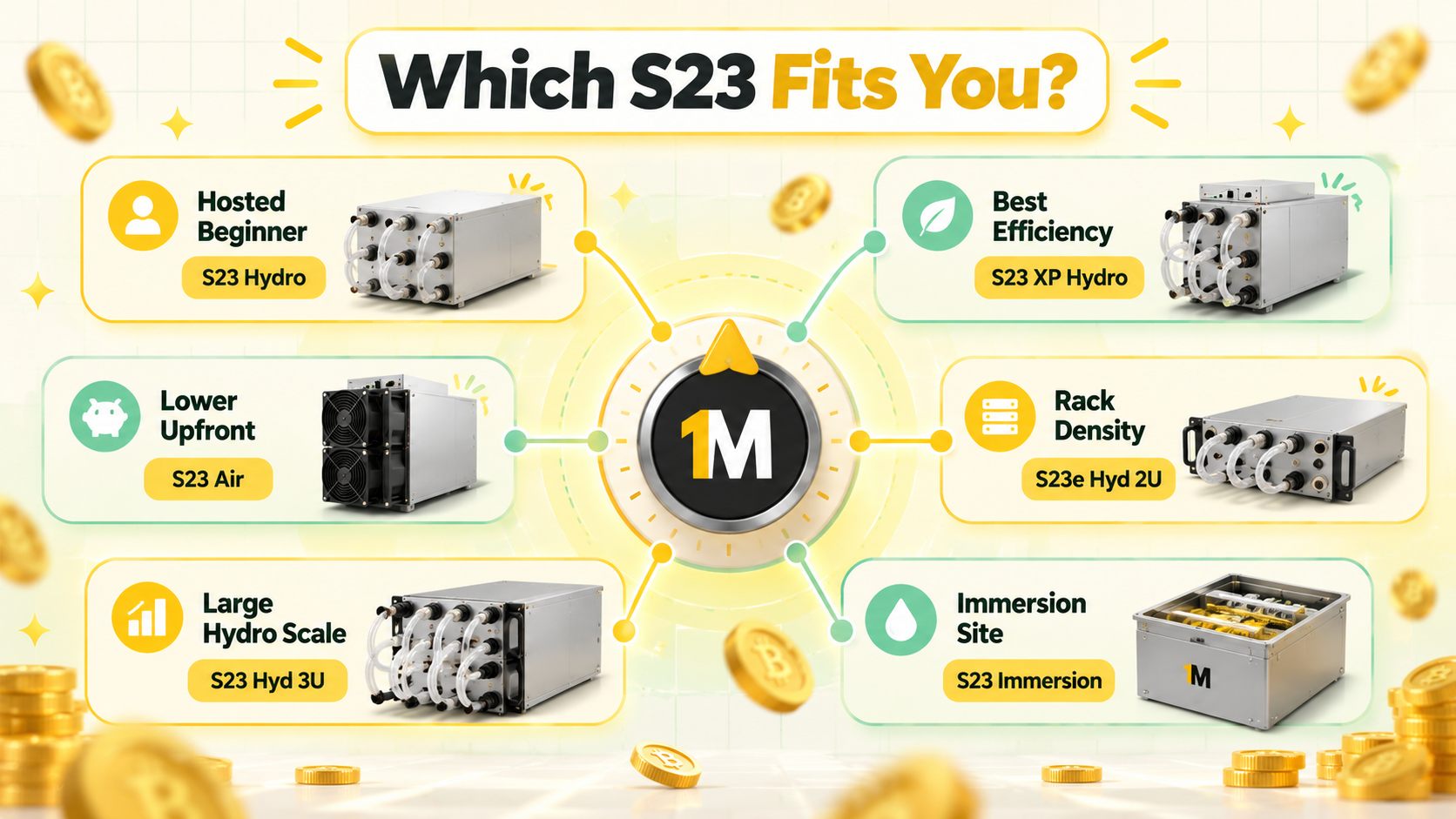
| If you are… | A good fit | Why |
|---|---|---|
| A hosted beginner wanting strong value | S23 Hydro | 580 TH/s at 9.5 J/TH with established availability |
| Focused on the best published efficiency | S23 XP Hydro | 600 TH/s at 8.9 J/TH |
| Looking for lower upfront cost and simpler cooling | S23 Air | Air cooling; no hydro loop required |
| Limited by rack space | S23e Hyd 2U | Highest hashrate density per rack unit among the compared rack models |
| Scaling a large hydro deployment | S23 Hyd 3U | 1.16 PH/s in one chassis |
| Already operating immersion infrastructure | S23 Immersion | Designed for dielectric-fluid cooling |
| A typical home miner | Probably none | Multi-kilowatt continuous power, noise, heat and infrastructure make the family difficult to run economically at home |
The right model depends on more than hashrate. Compare purchase price, J/TH, electricity rate, cooling infrastructure, rack space, electrical service and delivery date before deciding.
Why Hosting Fits the S23 Era
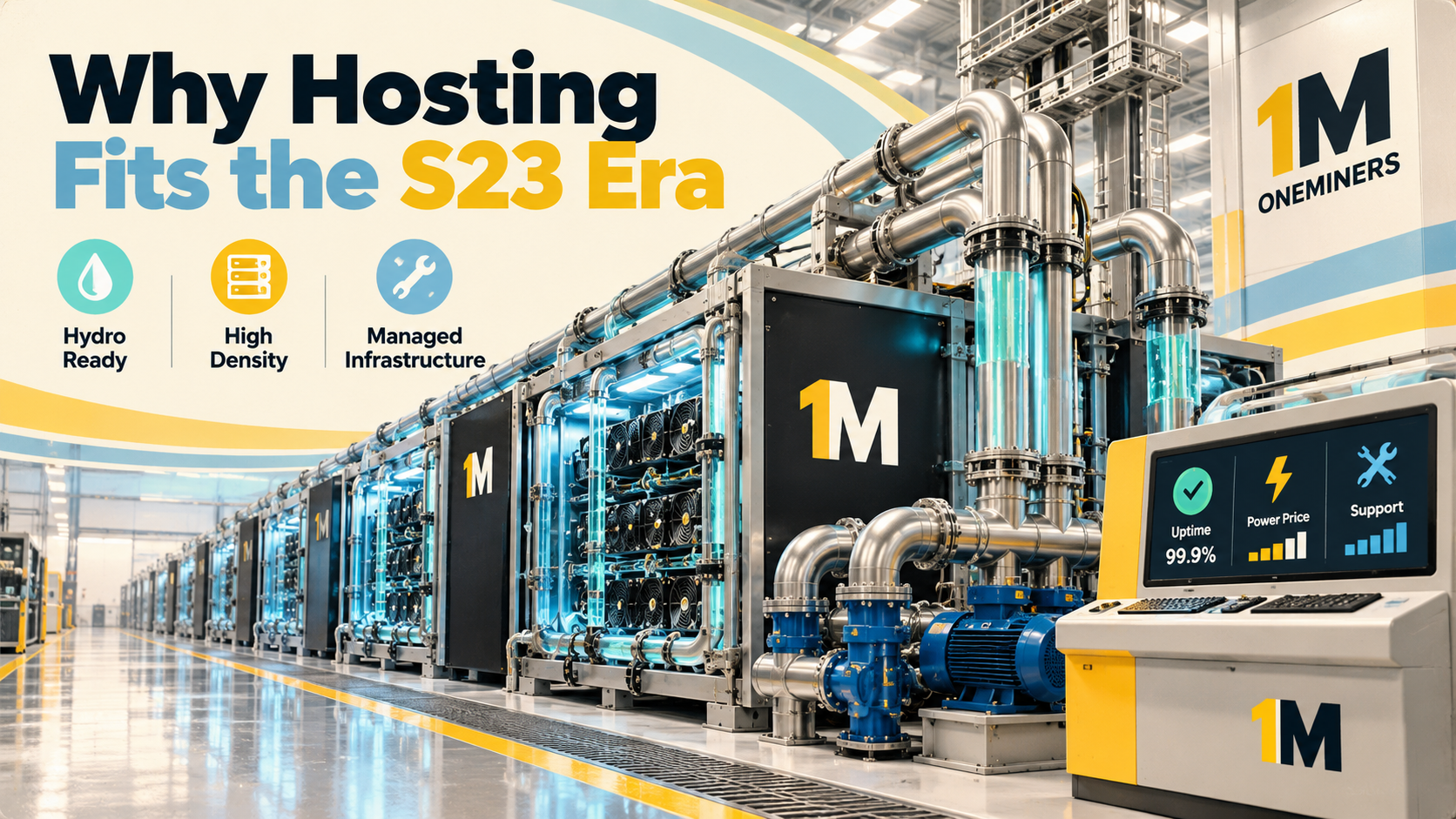
Professional hosting becomes especially relevant as the S23 lineup shifts toward hydro and high-density designs. The standard S23 Hydro, S23e Hyd 2U, S23 Hyd 3U and S23 XP Hydro need liquid-cooling and electrical infrastructure that most individual buyers do not already have. The Immersion model similarly requires a properly engineered dielectric-fluid system.
OneMiners’ published materials advertise electricity options including $0.0364/kWh in Nigeria under a seven-year prepaid plan, along with a company-published long-term network-average figure around $0.048/kWh, a 95%+ uptime SLA, and a seven-year warranty for eligible hosted hardware. Those are commercial terms published by OneMiners, not independent guarantees, so confirm the exact site, standard versus prepaid electricity rate, uptime compensation, repair process, warranty exclusions and relocation terms in your contract.
The basic advantage of hosting is infrastructure convenience: a facility handles the high-capacity power, cooling, networking and maintenance environment required by these machines. The trade-off is additional provider, contract and counterparty risk.
Risks to Keep in View
- Hashprice and difficulty can compress margins quickly.
- The 2028 halving reduces the block subsidy.
- Hardware costs and tariffs. Forbes noted tariff exposure, with most ASIC production in Southeast Asia.
- Specs can differ in shipped units. OneMiners itself notes that.
- Obsolescence. Efficiency leaders get overtaken.
Frequently Asked Questions
What are the main Antminer S23 models in 2026? The current family includes the S23 Air (318 TH/s), S23 Immersion (442 TH/s), S23 Hydro (580 TH/s), S23e Hyd 2U (865 TH/s), S23 Hyd 3U (1.16 PH/s) and the newly announced S23 XP Hydro (600 TH/s at 8.9 J/TH). Availability and pricing vary by model and production batch.
Is the S23 Hydro worth the higher price? Compared with the Air model, it offers much higher hashrate and better 9.5 J/TH efficiency. Whether that justifies the higher purchase price depends on your electricity rate and access to liquid-cooling infrastructure. Most individual buyers will find hosting easier, but an operator with its own properly engineered hydro system can run it directly.
Can I run an S23 at home? The Air model is technically the most practical S23 for a private location because it does not need a liquid loop, but it is loud, produces substantial heat and draws several kilowatts continuously. Its exact electrical requirement should be confirmed because current seller specifications conflict on power draw. Hydro and immersion models require specialized cooling systems and are generally unsuitable for a typical home.
Which S23 pays back fastest? At the OneMiners network average and September’s hashprice, the Hydro (about 24.5 months), then the Air (about 26.7), then the 3U (about 28.3). That is an illustration, not a forecast.
Where do I find current prices? Check the seller’s live catalog. Prices vary widely between sources and over time.
The Bottom Line
The Antminer S23 family is no longer simply an Air-versus-Hydro decision. The S23 Air offers simpler cooling, the S23 Hydro remains a strong balance of efficiency and purchase price, the S23e Hyd 2U targets rack density, the S23 Hyd 3U concentrates 1.16 PH/s into one chassis, the S23 Immersion serves operators with immersion infrastructure, and the newer S23 XP Hydro currently leads the family on published efficiency at 8.9 J/TH.
For most buyers, the best machine is the one that fits the infrastructure and economics they actually have. Check live prices, verify the exact shipped-unit power specification, use current hashprice and difficulty data, and include cooling, electrical work, hosting commitments and realistic downtime in the calculation. OneMiners’ comparisons and hosting material are useful commercial references, while manufacturer documentation and independent network data should be used to verify technical and profitability assumptions.
Sources and Further Reading
- Antminer S23 vs S23 Hydro: Air or Hydro? — OneMiners
- The New ASIC Landscape: What Industrial Miners Are Actually Buying in 2026 — Medium
- Antminer S23 Hydro Review: Efficiency, Costs and Mining Profitability — The Hype Magazine
- Bitmain Antminer S23 (318 TH/s) Review: Real-World Café Heating Case Study — TechBullion
- Bitmain Reveals the Antminer S23, the Most Powerful Bitcoin Miner Ever — Forbes
- Antminer S23e Hyd 2U vs S23 Hydro vs S23 Hyd 3U — OneMiners
- S23 Hydro vs S23 XP Hydro: Is 8.9 J/TH Worth the Higher Price? — OneMiners
- Antminer S23 Immersion 442 TH/s — OneMiners
- Bitmain S23 Hydro Product Manual
- Luxor Hashrate Lookback — September 2026
#Antminer #AntminerS23 #S23Hydro #BitcoinMining #ASICMiner #HostedMining #OneMiners #CryptoMining