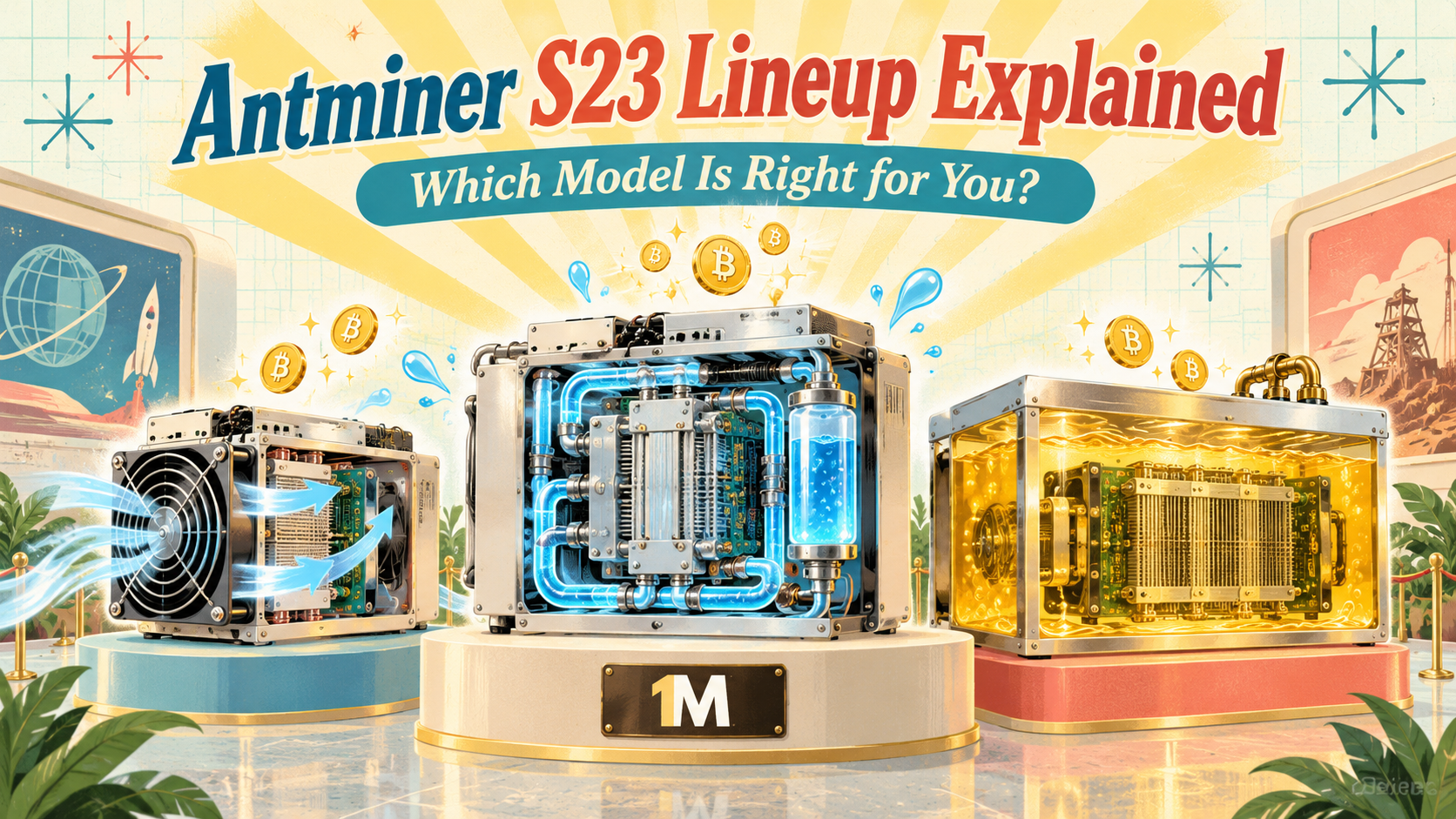
If you only learn one number before buying a Bitcoin miner, make it J/TH.
Hashrate gets the headlines, and price gets the arguments, but J/TH, joules per terahash, quietly decides whether a machine makes money or loses it. This guide explains it in plain English, shows how it combines with your electricity price to set your profit, and finishes with a checklist for choosing efficient hardware. It’s general information, not financial advice.
What Is J/TH?
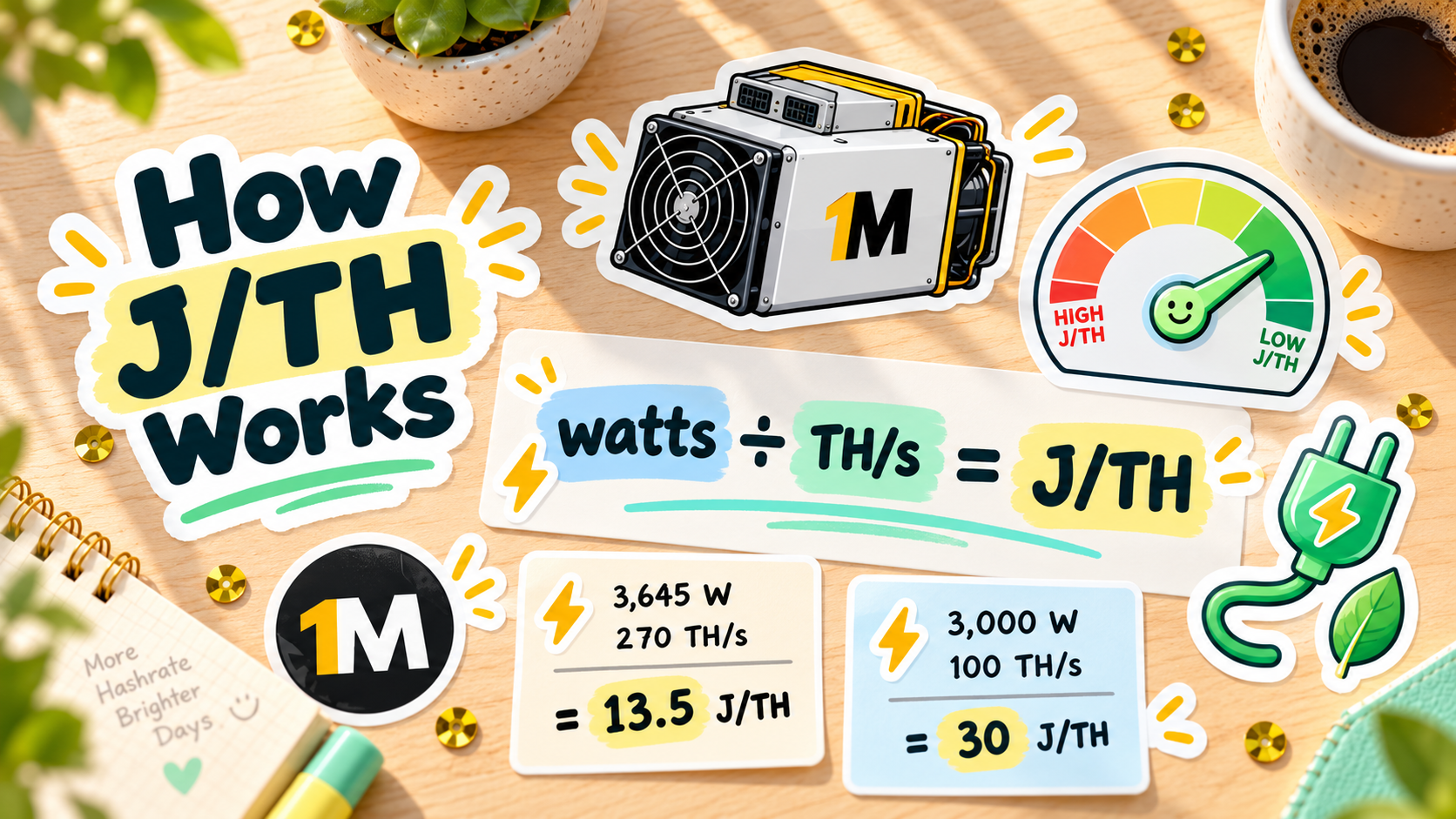
J/TH measures how much energy a miner uses to do one terahash of work. Lower is better.
Hashrate tells you how much work a machine can do. J/TH tells you how much that work costs in electricity. As Luxor’s Kaan Farahani explains in Firmware Fundamentals: J/TH Explained (August 2026), the formula is simple:
J/TH = power draw (watts) ÷ hashrate (TH/s)
It works because one watt is one joule per second, and hashrate is already a per-second number, so the seconds cancel. You’ll also see it written as W/TH. They’re the same figure.
Example: a machine drawing 3,645 W and producing 270 TH/s runs at about 13.5 J/TH. A machine drawing 3,000 W and producing 100 TH/s runs at 30 J/TH, more than twice as costly per unit of work.
How Far Efficiency Has Come
Luxor’s piece traces the improvement: about 98 J/TH for the Antminer S9 era down to about 13.5 J/TH for the S21 XP class, roughly a seven-fold improvement. Bitmain’s newest water-cooled S23 Hydro is rated at 9.5 J/TH, which Forbes reported as the first ASIC to dip below 10 (see Forbes’ launch report).
OneMiners’ ranking of the most energy-efficient ASIC miners in 2026 (May 2026, by CEO Michal Beno) lists these models by efficiency:
| Model | Cooling | Approx. J/TH |
|---|---|---|
| Antminer S21 XP Hydro | Hydro | 12.0 |
| Antminer S21 XP | Air | 13.5 |
| Whatsminer M60S++ | Hydro | 17.0 |
| Antminer S21 | Air | 17.5 |
| Whatsminer M50S++ | Air | 22.0 |
| Antminer S19 Pro (legacy) | Air | 29.5 |
The post also ranked the S23 Hydro first at about 10.8 J/TH, using an earlier spec of 326 TH/s and 3,519 W. Later OneMiners material and Forbes list the shipping S23 Hydro at 580 TH/s, 5,510 W and 9.5 J/TH, so we use 9.5 here. This is a good reminder that specs shift between announcement and shipping, and that you should check the current spec sheet for the exact unit you’re buying.
Why J/TH Decides Profit
Every miner on the network earns the same hashprice, the revenue per terahash. What differs is cost. Your electricity cost per terahash is simply:
Cost per TH per day = J/TH × 0.024 × your power price ($/kWh)
(The 0.024 converts watts over 24 hours into kilowatt-hours.) Valentin Rousseau’s cost analysis of miners’ fleet hash costs (March 2025) calls this idea “hashcost” and shows it moving public miners’ economics. For example, Bitfarms’ hashcost fell about 43% year-over-year to September 2024 as its fleet efficiency improved from 36 to 21 J/TH. Cipher’s hashcost stayed steady because of a fixed power purchase agreement at $0.027 per kWh, while TeraWulf’s peaked in 2022 when power cost $0.089 per kWh despite around 27 J/TH. Efficiency and power price multiply. Improve either and your cost falls.
The break-even rule
Luxor gives the shortcut: break-even power price ≈ hashprice ÷ (24 × J/TH). Halve your J/TH and you roughly double the electricity price you can survive. At Luxor’s September 2026 average hashprice of $39.33 per PH per day:
| Efficiency | Break-even power price |
|---|---|
| 9.5 J/TH | about 17.3¢ per kWh |
| 12 J/TH | about 13.7¢ |
| 13.5 J/TH | about 12.1¢ |
| 17.5 J/TH | about 9.4¢ |
| 22 J/TH | about 7.5¢ |
| 29.5 J/TH | about 5.6¢ |
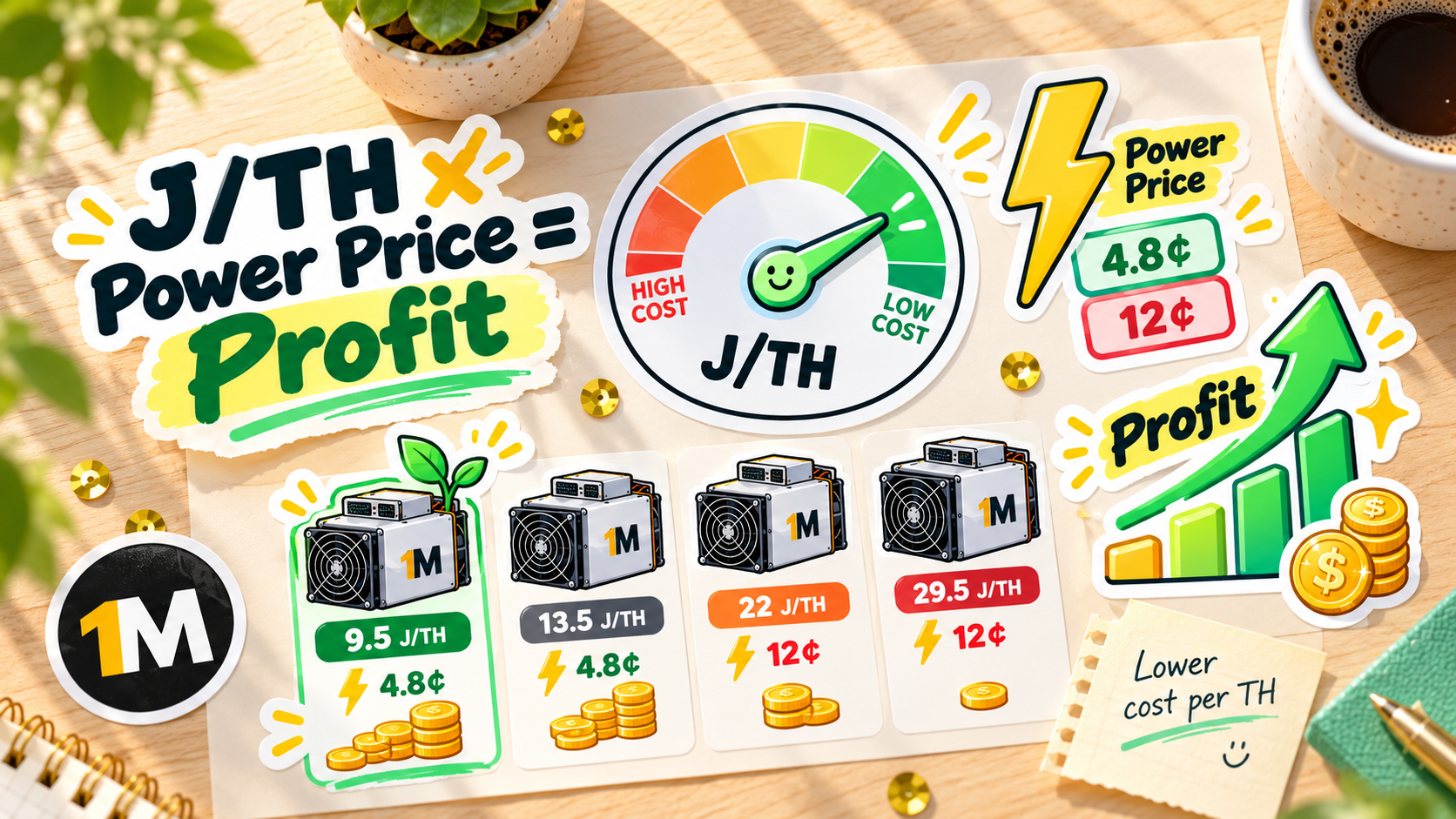
How much of each dollar you keep
Here’s the share of mining revenue left after electricity (power only) at four power prices. Negative numbers mean a loss.
| Efficiency | 3.64¢ | 4.8¢ | 7¢ | 12¢ |
|---|---|---|---|---|
| 9.5 J/TH | 79% | 72% | 59% | 30% |
| 12 J/TH | 73% | 65% | 49% | 12% |
| 13.5 J/TH | 70% | 60% | 42% | 1% |
| 17.5 J/TH | 61% | 49% | 25% | −28% |
| 22 J/TH | 51% | 36% | 6% | −61% |
| 29.5 J/TH | 34% | 14% | −26% | −116% |
The pattern is clear. A great machine on cheap power keeps most of its revenue. A mediocre machine on expensive power keeps none of it. Luxor’s article says the same: when hashprice falls, high-J/TH machines go unprofitable first, and above about 25 J/TH a machine is viable only with cheap power.
A Worked Example
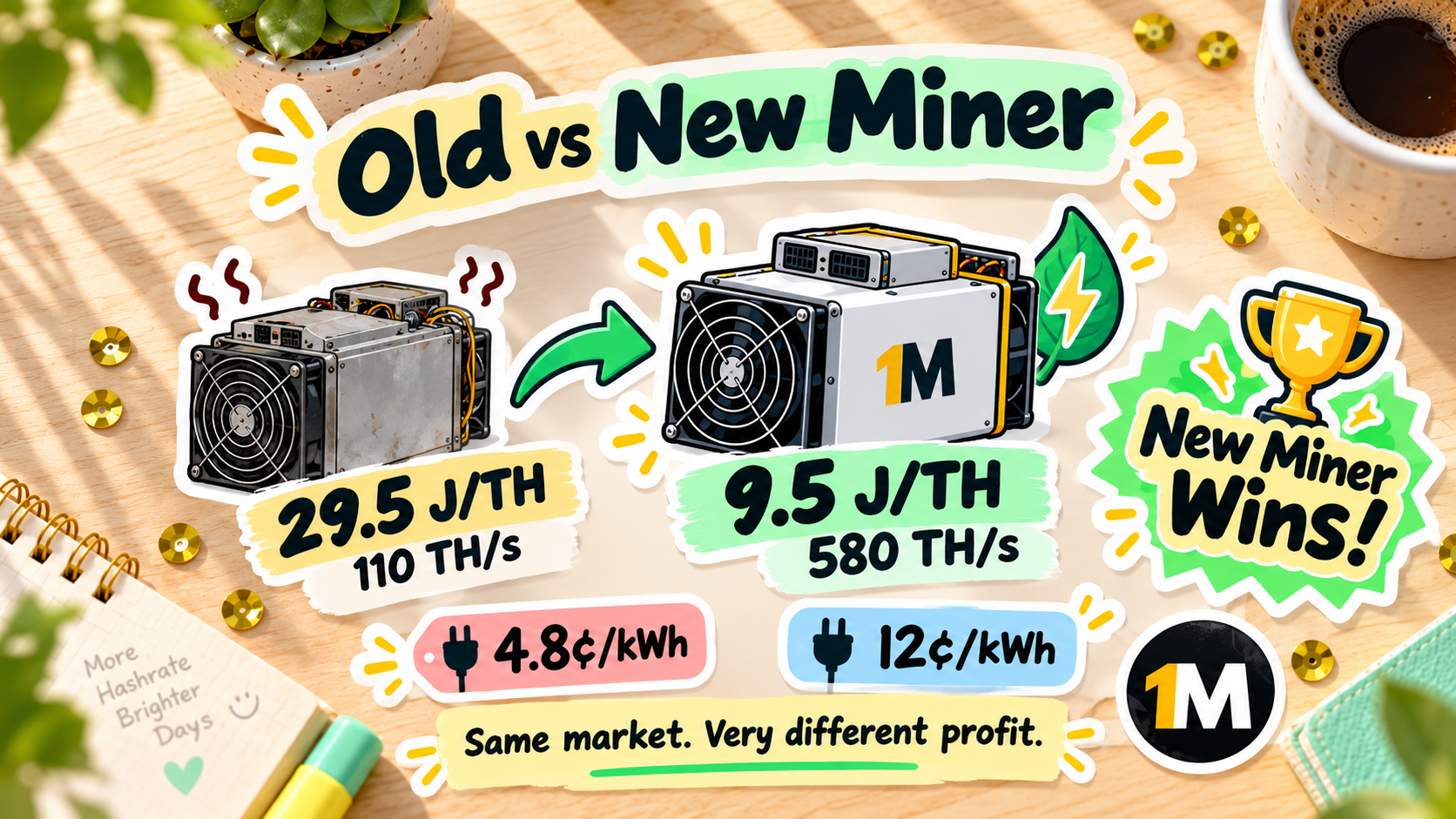
Compare an older S19 Pro-class machine (110 TH/s, 3,250 W, about 29.5 J/TH) with an S23 Hydro (580 TH/s, 5,510 W, 9.5 J/TH) at $39.33 hashprice.
- At 4.8¢ per kWh: the S19 Pro nets about $0.58 a day. The S23 Hydro nets about $16.46 a day.
- At 12¢ per kWh: the S19 Pro loses about $5.03 a day. The S23 Hydro still nets about $6.94.
Same hashprice, same market, wildly different outcomes. That’s what J/TH does. (Power only; hardware costs, repairs, hosting fees and taxes are excluded, and hashprice moves.)
Why Home Mining Usually Struggles
Reed’s To Mine or Not to Mine (January 2023) is a candid look at home mining. Using a $0.10 per kWh residential rate (his own rate was $0.23), he compared four hardware purchases to simply buying Bitcoin on a regular schedule. Mining came out ahead in only one of the four cases. His conclusion is that retail ASIC prices make the opportunity cost of home mining high, even at moderate electricity prices, and that readers should run the numbers before buying. (It’s dated, so the specific hardware prices have changed, but the lesson on residential rates holds.) Our table above shows why: at 12 cents, only the most efficient machines keep any margin.
The author also notes upsides such as using the waste heat. That can make sense for someone who would otherwise pay for heating, but it doesn’t change the basic math.
J/TH Isn’t the Only Number
Efficiency is the headline, but good buyers check several things.
1. Price per terahash. Luxor points out that efficient hardware carries a price premium, so buyers should weigh J/TH per dollar of upfront cost, not J/TH alone. Braiins’ Purchasing ASIC Mining Hardware guide recommends comparing dollars per TH/s. For example, OneMiners’ September S23 comparison lists the S23 Air at $6,899 for 318 TH/s (about $21.69 per TH) and the S23 Hydro at $12,299 for 580 TH/s (about $21.21 per TH), so the more efficient Hydro was no more expensive per terahash.
2. Real versus nameplate. Braiins notes spec sheets often allow around 5% deviation and are tested under ideal conditions (about 25°C). Hotter environments can raise energy use and cut efficiency. Luxor adds that chip quality, temperature and tuning all matter: “Hardware sets your starting efficiency; firmware decides where it ends up.”
3. Market and obsolescence risk. Braiins reports the Antminer S19J Pro sold for over $12,000 at the November 2021 peak and for about $600 in summer 2024, a 95% drop. Efficiency leaders get overtaken, and cheap old machines are often cheap for a reason.
4. Warranty, lead time and cooling. New units typically carry a 12-month warranty, and lead times of weeks can cost you revenue. Hydro machines need a cooling loop and three-phase power.
5. Power price. The multiplier on everything else.
Where Hosting Fits
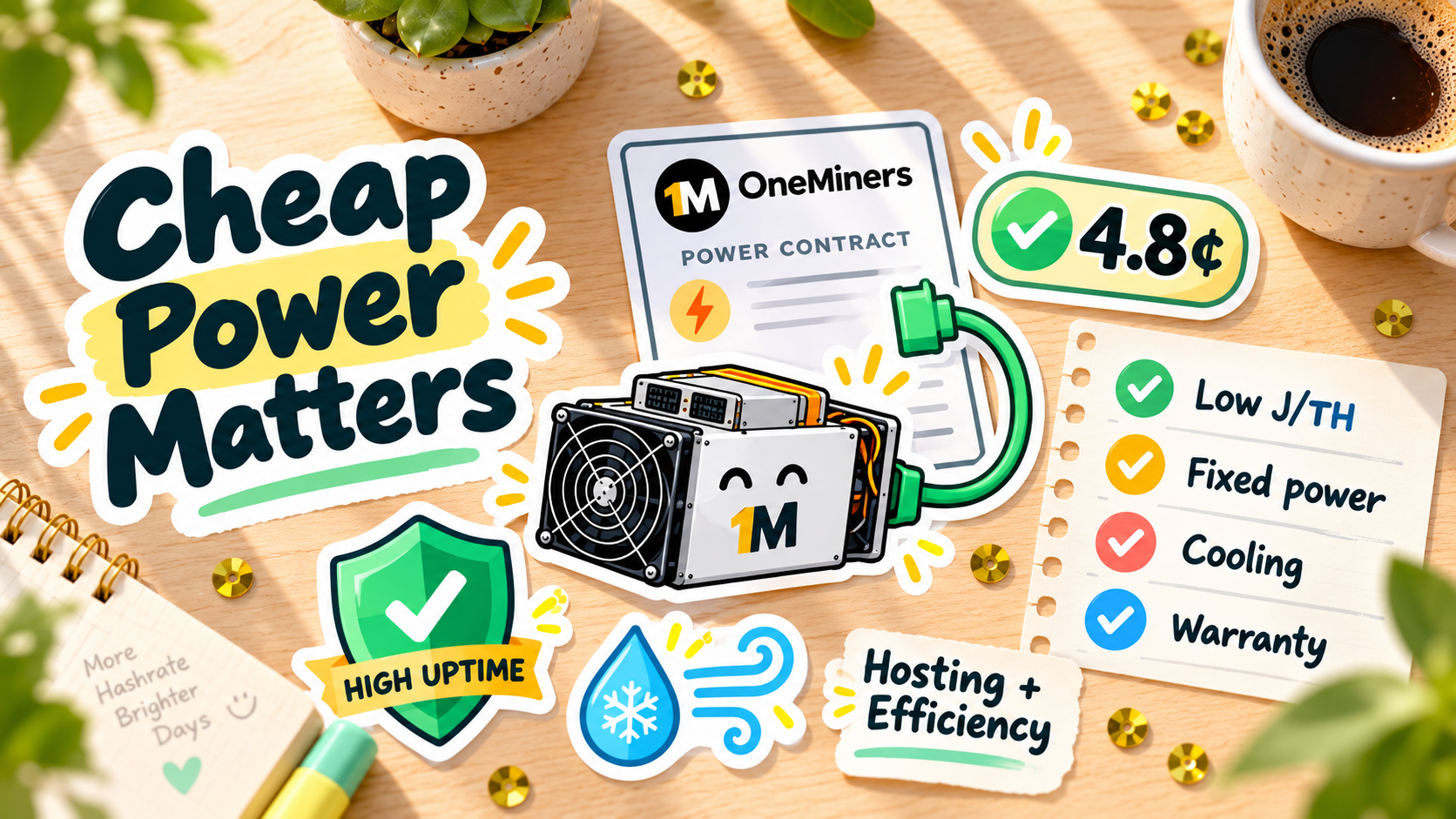
Because profit is J/TH times power price, the winning combination is an efficient machine on cheap, fixed power. That’s the pitch of professional hosting, and it’s where OneMiners’ model fits well.
OneMiners’ materials advertise rates from $0.0364 per kWh in Nigeria and a network average of $0.048, seven-year fixed energy contracts, a 95%+ uptime SLA, a seven-year hardware warranty and no performance fee. Those are company claims, so confirm each in your own agreement. But look at the tables above: at 4.8 cents, even a mid-range 13.5 J/TH machine keeps about 60% of its revenue on a power-only basis, and a 9.5 J/TH machine keeps about 72%. The same machines at 12 cents keep almost nothing in the first case and 30% in the second.
In other words, hosting moves you from the right side of the table to the left. And because efficient hardware is also the hardest to run at home (cooling, noise, three-phase power), hosting and high efficiency tend to go together.
Even so, no hosting plan fixes a bad machine choice or a falling hashprice. A 29.5 J/TH machine at 4.8 cents keeps only about 14% of revenue, which a modest hashprice dip can erase.
A J/TH Checklist Before You Buy
- Find the exact spec: hashrate and wattage for the exact variant, and calculate J/TH yourself (watts ÷ TH/s).
- Ask about real-world performance: at what temperature and settings?
- Get your all-in power rate in writing, with contract length.
- Compute break-even: hashprice ÷ (24 × J/TH), using live hashprice.
- Stress-test: repeat at 20% and 40% lower hashprice.
- Compare price per TH, not just price per machine.
- Check warranty, lead time and cooling needs.
- Think about resale and obsolescence.
- Start with one machine.
Frequently Asked Questions
What is a good J/TH? Luxor describes the newest hardware as running in the low-to-mid teens, with the modern fleet broadly under about 20. The S23 Hydro is rated at 9.5. Above 25, viability depends on very cheap power.
Is lower J/TH always better? Per kilowatt-hour, yes. Per dollar of upfront cost, not necessarily, so compare price per TH too.
How do I calculate J/TH? Divide watts by TH/s. A 5,510 W machine at 580 TH/s is 9.5 J/TH.
Does J/TH change over time? Real-world J/TH can differ from the spec with temperature and tuning. Firmware tuning can improve it.
What’s the break-even electricity price? Hashprice ÷ (24 × J/TH). At $39.33 and 9.5 J/TH, about 17.3 cents per kWh.
The Bottom Line
J/TH is the number that turns hashprice and electricity price into your actual margin. Lower is better, but pair it with cheap, fixed power and a sensible purchase price. That combination is what separates machines that make money from machines that don’t, and it’s the reason efficient hardware in a low-rate hosting setup is such a natural fit. Check the live numbers, stress-test your plan, and get the terms in writing.
Sources and Further Reading
- Most Energy-Efficient ASIC Miners in 2026, Ranked by J/TH — OneMiners
- To Mine or Not to Mine — Medium (@ReedBTC)
- Firmware Fundamentals: Measuring Bitcoin Mining Efficiency, J/TH Explained — Hashrate Index
- Purchasing ASIC Mining Hardware — Braiins
- Cost Analysis: Miners’ Fleet Hash Costs at the Heart of Mining Metrics, Part V — Medium
- Bitmain Reveals the Antminer S23 — Forbes
#JTH #BitcoinMining #ASICMiner #MiningEfficiency #Hashprice #HostedMining #OneMiners #CryptoMining