Every few months a headline goes viral: a hobbyist with a tiny home miner finds a full Bitcoin block and walks away with more than 3 BTC. It happened at block 887,212 in March 2025 and again at block 957,382 in July 2026. Stories like these make solo mining sound like a smart bet.
The reality is more interesting, and far more useful if you are deciding where to point your hashrate. This guide walks through the actual math behind solo and pool mining in late 2026, what each option really pays, and how to choose the setup that fits your hardware, budget and patience.
Key Takeaways
- The Bitcoin block subsidy is 3.125 BTC plus transaction fees. Bitcoin’s difficulty rose to 140.58 trillion on October 16, 2026. That difficulty corresponds to roughly 1.0 ZH/s of sustained hashrate at Bitcoin’s ten-minute target, although short-term live hashrate estimates can move above or below that level.
- At 140.58T difficulty, a 200 TH/s Antminer S21 has about a 1% chance of finding at least one block in a year when solo mining. A 1.2 TH/s Bitaxe is closer to about 0.006%, or roughly 1 chance in 16,000 per year.
- Solo and pooled mining have similar gross expected value for the same hashrate before fees and payout differences. The major difference is variance: solo mining can pay nothing for years and then one large reward, while a pool turns the same hashrate into smaller, more regular payouts.
- Solo-mining services such as Braiins Solo and Solo CKPool remove much of the infrastructure work without turning your mining into ordinary pooled mining. Braiins currently charges 0.5% of a winning reward, while Solo CKPool advertises a 2% fee.
- For miners who need regular cash flow, ordinary pool mining is usually easier to budget around. Low electricity costs and high uptime can improve the economics, but neither pool mining nor hosting guarantees profitability.
Solo Mining vs. Pool Mining: What Is the Difference?
Bitcoin mining is a global guessing race. Machines hash block headers trillions of times per second, and the first to find a hash below the network target wins the block. If you are new to the mechanics, OneMiners has a clear walkthrough of how Bitcoin mining works step by step, from the mempool to the final confirmation.
Your share of the race is simple to calculate: your hashrate divided by the network’s hashrate. What changes between solo and pool mining is how you get paid for that share.
Solo mining means your hashrate is trying to find a valid Bitcoin block for your own benefit rather than sharing ordinary rewards with other miners. As the Braiins Academy solo mining guide explains, a solo-mining setup uses your Bitcoin address in the block template. If your hashrate finds a valid block, the block reward is directed to you, minus any fee charged by the solo-mining service you use. If you never find a block, you receive no partial mining rewards along the way.
Pool mining works differently. Thousands of miners can contribute hashrate to the same pool and submit lower-difficulty “shares” that prove how much work each miner performed. When rewards are earned—or, under payout systems such as FPPS, when shares are credited—the miner receives a smaller amount based on contributed work rather than waiting to personally solve a full Bitcoin block.
The DirectPool guide to solo vs. pool mining describes the core trade-off well: over a sufficiently long period, the same amount of hashrate has roughly the same gross expected mining value, but pool fees, payout methods and pool luck can change the amount actually received. Solo mining preserves extreme variance; pool mining reduces it.
Your Real Odds of Finding a Block in 2026
Here is where the hype meets the numbers. Bitcoin’s October 16, 2026 difficulty adjustment raised difficulty by 5.92% to 140.58 trillion. At Bitcoin’s ten-minute target, that difficulty corresponds to roughly 1,006 EH/s of implied network hashrate. Actual short-window hashrate estimates can be higher or lower because blocks do not arrive exactly every ten minutes.
For solo-mining odds, difficulty is the cleaner input because every hash has a fixed probability of meeting the current network target. Using 140.58T difficulty, we can estimate the odds for several common hashrates:
| Miner | Hashrate | Solo chance per day | Expected wait per block | Chance of a block within 1 year | Avg. pool earnings per day (before fees) |
|---|---|---|---|---|---|
| Bitaxe Gamma | 1.2 TH/s | ~1 in 5.8 million | ~16,000 years | ~0.006% | ~54 sats |
| Avalon Nano 3S | 6 TH/s | ~1 in 1.2 million | ~3,200 years | ~0.03% | ~270 sats |
| Antminer S21 | 200 TH/s | ~1 in 35,000 | ~96 years | ~1.0% | ~9,000 sats |
| Antminer S21 XP | 270 TH/s | ~1 in 26,000 | ~71 years | ~1.4% | ~12,200 sats |
| Antminer S23 Hyd | 580 TH/s | ~1 in 12,000 | ~33 years | ~3.0% | ~26,100 sats |
| Small fleet | 1 PH/s | ~1 in 7,000 | ~19 years | ~5.1% | ~45,000 sats |
| Mid-size farm | 10 PH/s | ~1 in 700 | ~1.9 years | ~41% | ~450,000 sats |
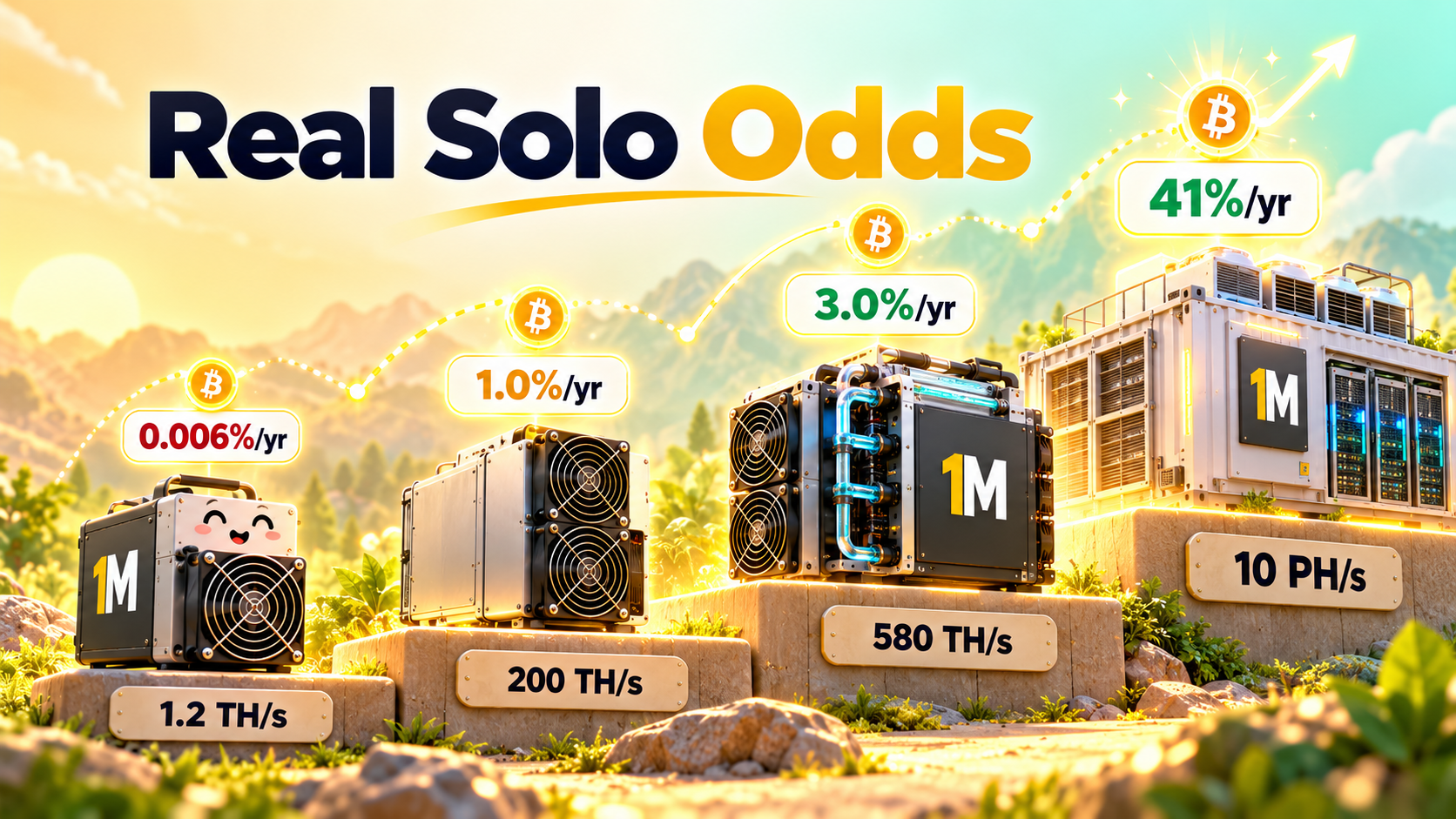
Figures use difficulty of 140.58T. The pool-income column assumes an illustrative average block reward of approximately 3.14 BTC including fees, before pool fees. Difficulty, transaction fees and actual pool payout terms change over time, so treat these as late-October 2026 estimates rather than permanent values.
Two things stand out. First, even a flagship 580 TH/s hydro miner has only about a 3% chance of finding a block in a full year, and roughly a 14% chance over five years. Second, the figures agree closely with other recent analyses. Simple Mining’s solo vs. pool breakdown put a single S21 XP at about a 66-year average wait when the network was near 942 EH/s in September. As hashrate climbed past 1 ZH/s, that wait grew longer.
One more point that trips people up: every hash is independent. A miner that has been running solo for a year is no closer to a block than one switched on today. There is no such thing as being “due.”
Expected Value vs. Variance: Why the Math Feels Unfair
If solo and pool mining pay the same on average, why does nearly everyone choose a pool? Because averages only matter if you live long enough to collect them.
Take that Antminer S21 XP. In a pool, it earns roughly 12,000 sats every day, which you can use to cover electricity and hosting bills. Solo, the same machine is far more likely to earn nothing for its entire useful life than to hit a block. The Bitcoin Mining Dispatch article on Medium frames this with a helpful rule of thumb based on your expected time to find a block:
- Under one month: solo mining can be a viable business choice.
- One to six months: solo is high risk but possible.
- Six months or more: solo is effectively a lottery ticket.
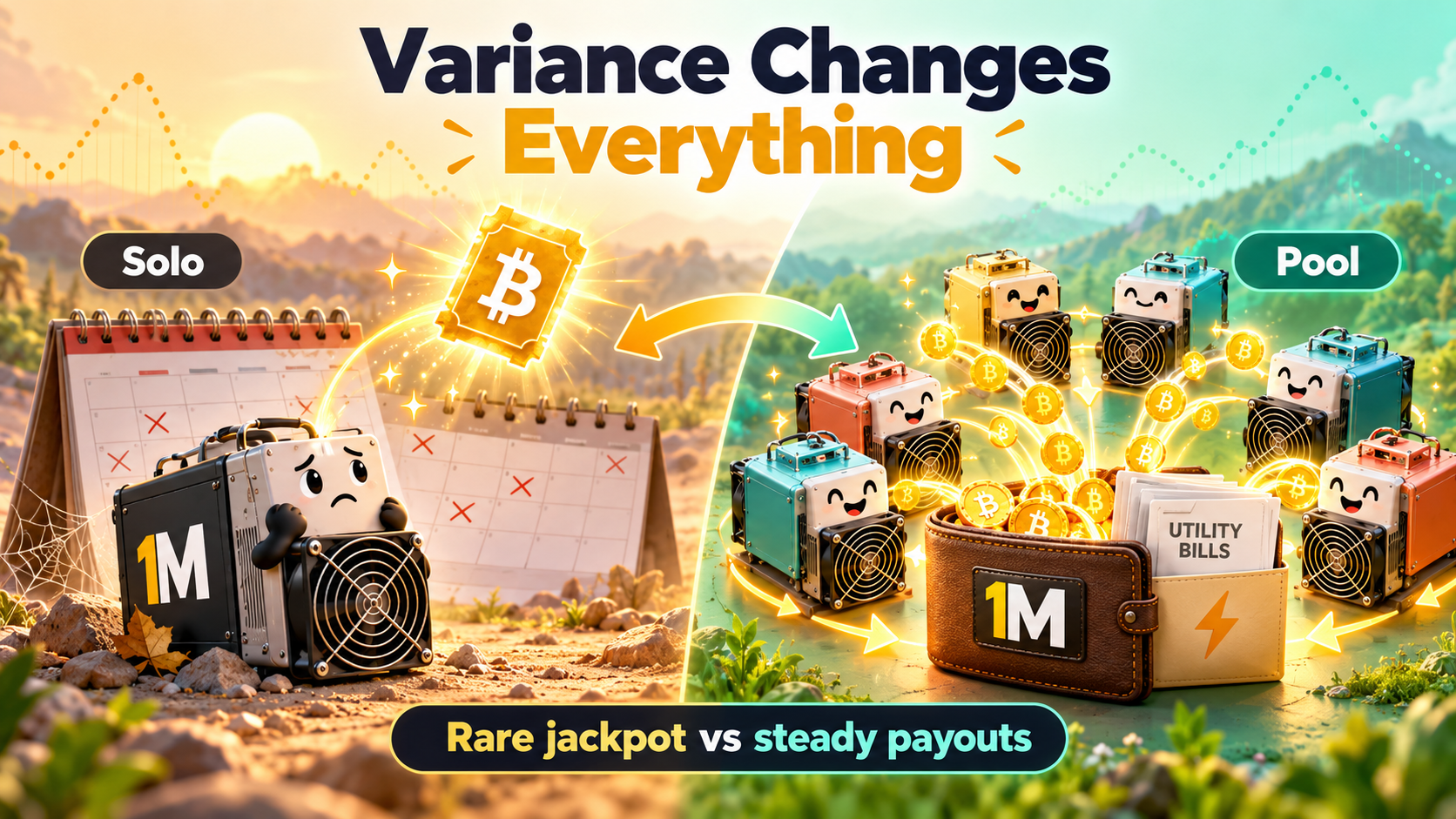
By that author’s rule of thumb, a single ASIC is firmly in lottery territory. Simple Mining’s 2026 solo-vs-pool analysis argues that solo mining becomes much easier to operate as a predictable business only around 9.5 EH/s or more, roughly 1% of the network in its September example. At that scale, the expected block interval becomes short enough to smooth out much of the variance.
That is a business-risk threshold suggested by Simple Mining, not a Bitcoin protocol rule. There is no minimum hashrate required to solo mine: even a 1 TH/s Bitaxe can find a block, as block 957,382 demonstrated in July 2026. The question is whether the odds and cash-flow volatility make sense for the miner’s goals.
Solo Pools: The Middle Ground
True self-managed solo mining generally means operating the infrastructure needed to build and submit your own block templates, including a Bitcoin node and compatible mining software. Solo-mining services remove much of that operational work while preserving the all-or-nothing reward model.
- Braiins Solo currently advertises a 0.5% fee on a winning block. No account registration is required: your Bitcoin address acts as the miner identity, and Braiins says the reward is paid directly to that address after the fee.
- Solo CKPool advertises a 2% fee and similarly requires no registration. Its operator says hashrates below 100 GH/s are technically allowed but are unrealistic for finding a block except as a learning experiment.
These services do not improve your probability per hash. Their advantage is operational convenience and connectivity. A miner with the same hashrate faces essentially the same network target whether it uses a solo-mining service or maintains its own properly configured solo infrastructure.
How Pool Payouts Work: FPPS vs. PPLNS
If you choose a pool, the payout method matters almost as much as the fee:
-
FPPS (Full Pay Per Share): the pool pays you for every share, plus an estimated share of transaction fees, whether or not the pool finds a block. This gives the smoothest income. According to Simple Mining, most FPPS pools charge between 1% and 2.5%, with the overall range from 0% to 4%.
-
PPLNS (Pay Per Last N Shares): you are paid only when the pool finds a block, based on your shares over a recent window. DirectPool, for example, uses a seven-day PPLNS window, writes payouts directly into the coinbase transaction and charges 1%.
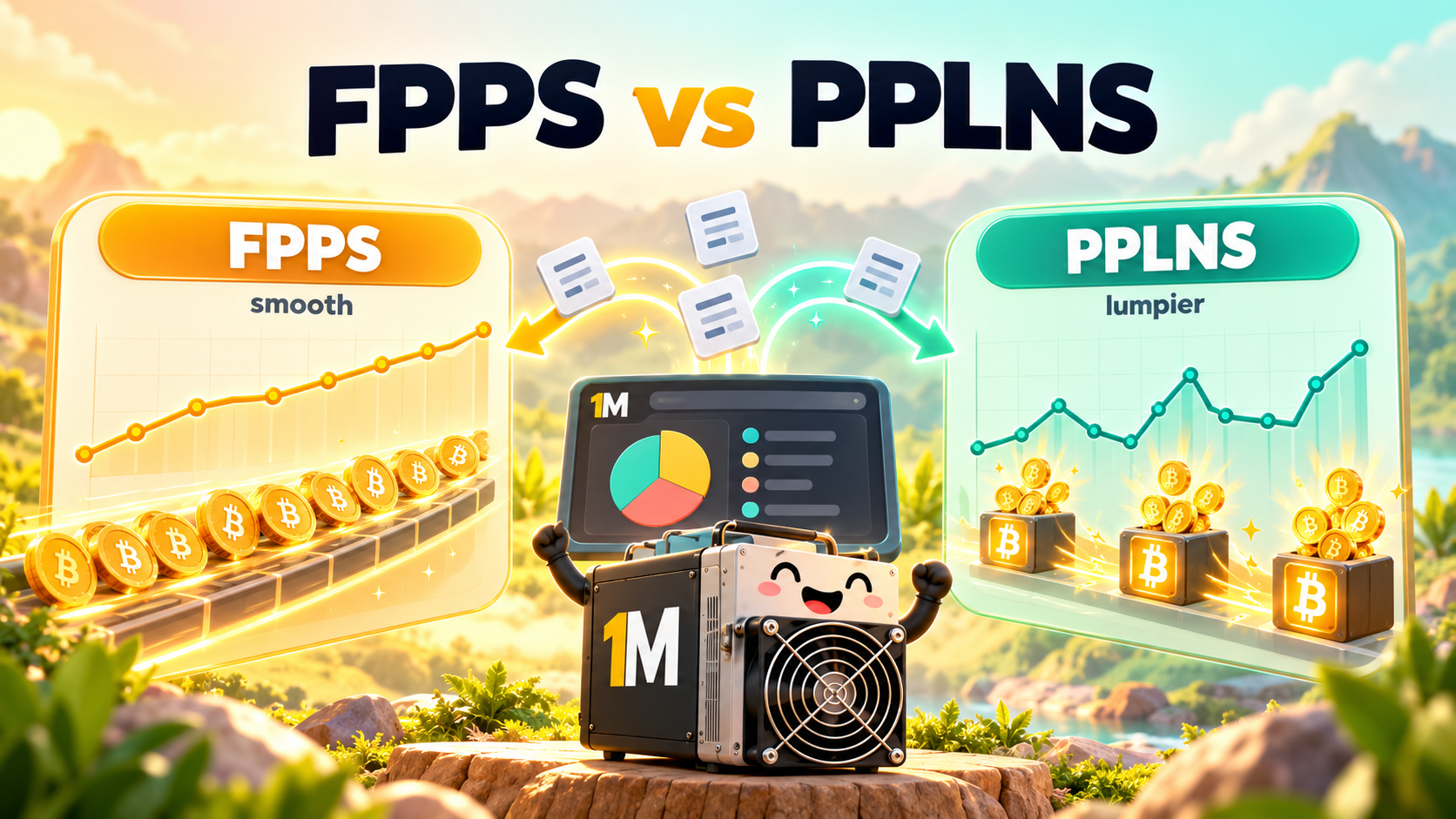
PPLNS fees are often lower, but payouts are lumpier, especially on smaller pools. If you need a reliable daily figure for budgeting, FPPS is usually the easier choice.
A Hybrid Strategy: Steady Income Plus a Small Solo Bet
A miner with several machines does not necessarily have to send all of its hashrate to the same destination. Some mining guides suggest keeping most hashrate on a conventional pool for regular payouts while directing a smaller amount to solo mining for the chance of a full block.
For example, Simple Mining and the Bitcoin Mining Dispatch Medium article discuss splits around 90–95% pooled and 5–10% solo. Treat that as an optional risk preference rather than an optimal formula. Moving hashrate to solo mining increases payout variance and does not increase the expected number of bitcoins generated by the hardware.
Technically, changing pools usually involves updating the pool URL, worker information and related settings. However, hosted miners should first check their provider’s terms and platform controls. Some hosting arrangements, managed configurations or financing agreements may limit how freely pool settings can be changed.
Why Pool Mining Is Easier to Budget Around in 2026
September 2026 was a stronger month for Bitcoin miners. Network miner revenue reached roughly $1.12 billion, the best month since January, while hashprice spent much of the month near $40 per PH/s/day. Cassys discusses the rebound in Bitcoin Mining Revenue Hits Its Best Month Since January: Is Mining Profitable Again?.
That September figure is network revenue, not miner profit. By late October, difficulty had already risen to 140.58T and current hashprice had moved back into roughly the mid-$30s per PH/s/day. Pool mining smooths the timing of revenue, but electricity, hardware efficiency, uptime, difficulty and pool fees still determine whether that revenue turns into profit.
Professional hosting can help when its electricity rate is meaningfully lower than the miner’s alternative. OneMiners’ September 2026 hosting rate card lists Nigeria at $0.0480/kWh on its premium tier and $0.0364/kWh under a seven-year prepaid energy plan. That distinction matters: $0.0364/kWh is not an ordinary month-to-month hosting price.
OneMiners also says it takes 0% of mined coins, but that should not be confused with saying every mining pool is free. If you connect a miner to an external pool, that pool can still charge its own fee according to its payout plan. OneMiners provides crypto mining calculators where users can model hashrate, electricity and pool-fee assumptions before purchasing hardware.
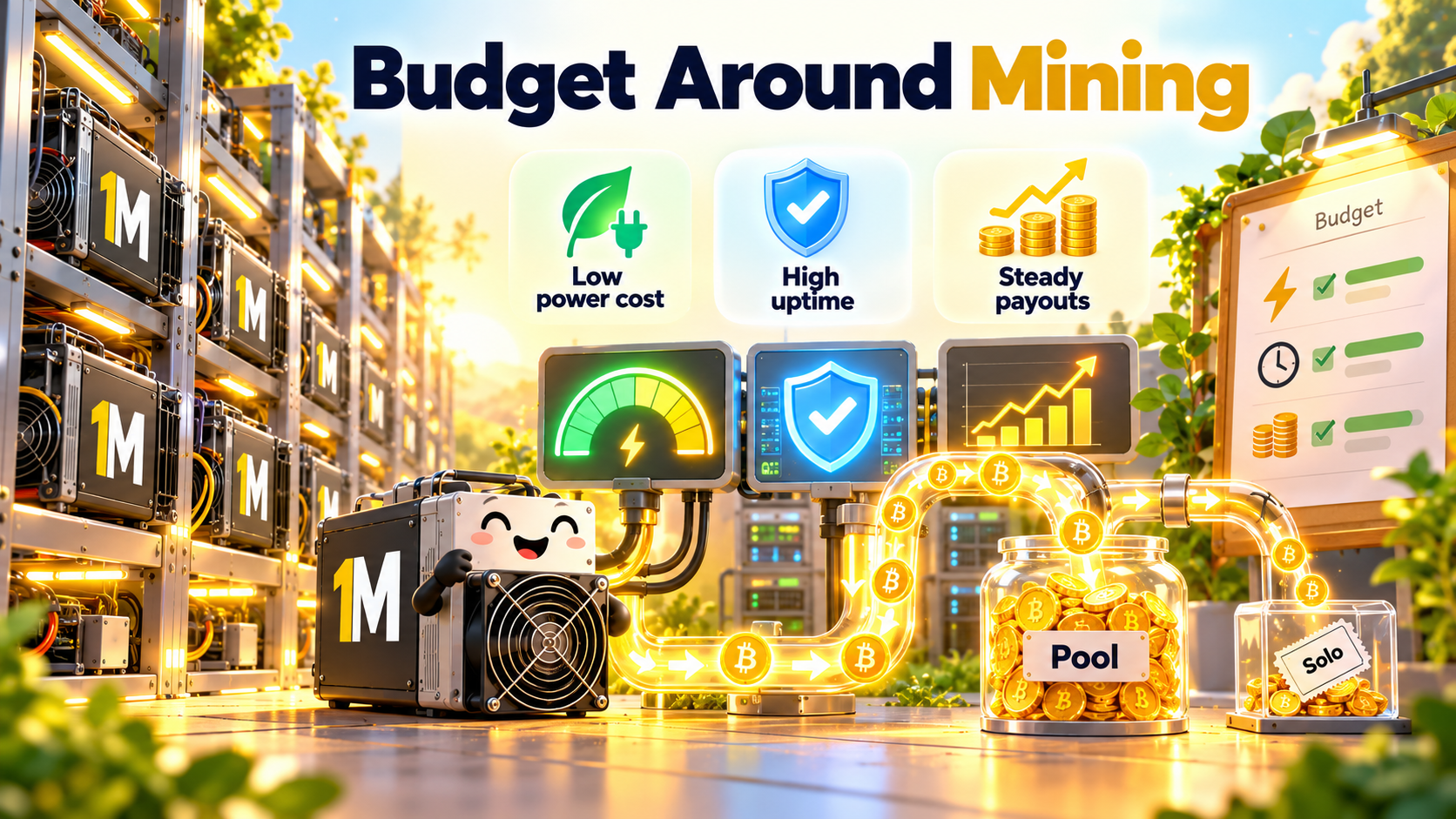
For miners who need predictable cash flow, the useful combination is therefore low operating cost plus a conventional payout method, not hosting by itself. Hosting can reduce power and infrastructure burdens; a pool can reduce payout variance. Neither removes Bitcoin price, difficulty or hardware risk.
Common Solo Mining Myths
- “Lower share difficulty improves my odds.” No. Share difficulty only changes how often your miner reports work. The network target for a real block stays the same.
- “My best share means I’m getting close.” A best share that is near the network difficulty is still a miss. It is a fun number, not progress.
- “Pools steal blocks from small miners.” On a solo pool, the block template pays the finder’s address, and you can verify it on a block explorer such as mempool.space.
Frequently Asked Questions
Can a Bitaxe really find a Bitcoin block? Yes, and it has happened, but the odds are around 1 in 16,000 per year at current difficulty. Treat it as a lottery ticket, not income.
Do I earn more solo or in a pool? On average, about the same, minus fees. Solo pays nothing most of the time and a full block very rarely, while a pool pays small amounts often.
How much hashrate do I need for solo mining to make sense? There is no protocol minimum. Even very small miners can find a block, but the variance is enormous. Simple Mining uses roughly 1% of network hashrate—around 9.5 to 10 EH/s in its 2026 example—as a threshold where solo block arrivals become much easier to plan around as a business. Below that, whether solo mining “makes sense” depends mainly on how much payout variance you are willing to accept.
Which pool fee should I expect? Most FPPS pools charge 1–2.5%. PPLNS pools often charge 0–2%. Solo pools charge 0.5–2% of any block you find.
Can I switch between solo and pool mining later? Yes. Change the pool URL, port and username in your miner’s settings and restart. Nothing is locked in.
Does hosting change my solo odds? Hosting does not change the probability produced by a given amount of hashrate at the same network difficulty. What it can change is uptime and operating cost. A machine that stays online for more hours performs more hashes over time, which increases its cumulative chance of finding a block, while a lower electricity rate can improve the economics of running it. Hosting itself does not make an individual hash luckier.
The Bottom Line
In late 2026, solo mining is best understood as a high-variance way to use hashrate, while conventional pool mining converts the same mining work into much more regular payouts. At the current difficulty of 140.58T, a single modern ASIC can still find a full Bitcoin block, but even a 580 TH/s S23 Hydro has only about a 3% probability of finding at least one block over a year if difficulty stayed constant.
Pool mining does not magically create more expected Bitcoin from the same hashrate. Its main advantage is cash-flow stability. Solo mining trades that stability for the small possibility of receiving nearly an entire block reward at once.
For most miners who need mining revenue to help pay electricity or hosting bills, a reputable pool is therefore easier to manage financially. Electricity rate, uptime and hardware efficiency remain just as important. OneMiners’ professional hosting and mining calculators provide one commercial option for modeling those costs, while the Braiins, Solo CKPool, Simple Mining, DirectPool and Medium sources above provide additional perspectives on how to handle payout variance.
If the lottery aspect is part of the fun, dedicating a small amount of hashrate to solo mining is an option—but treat it as a high-variance choice, not as a shortcut to higher expected returns.
This article is for educational purposes only and is not financial advice. Mining odds, difficulty, hashprice and Bitcoin’s price change constantly, so always check live data before buying hardware or choosing a pool.