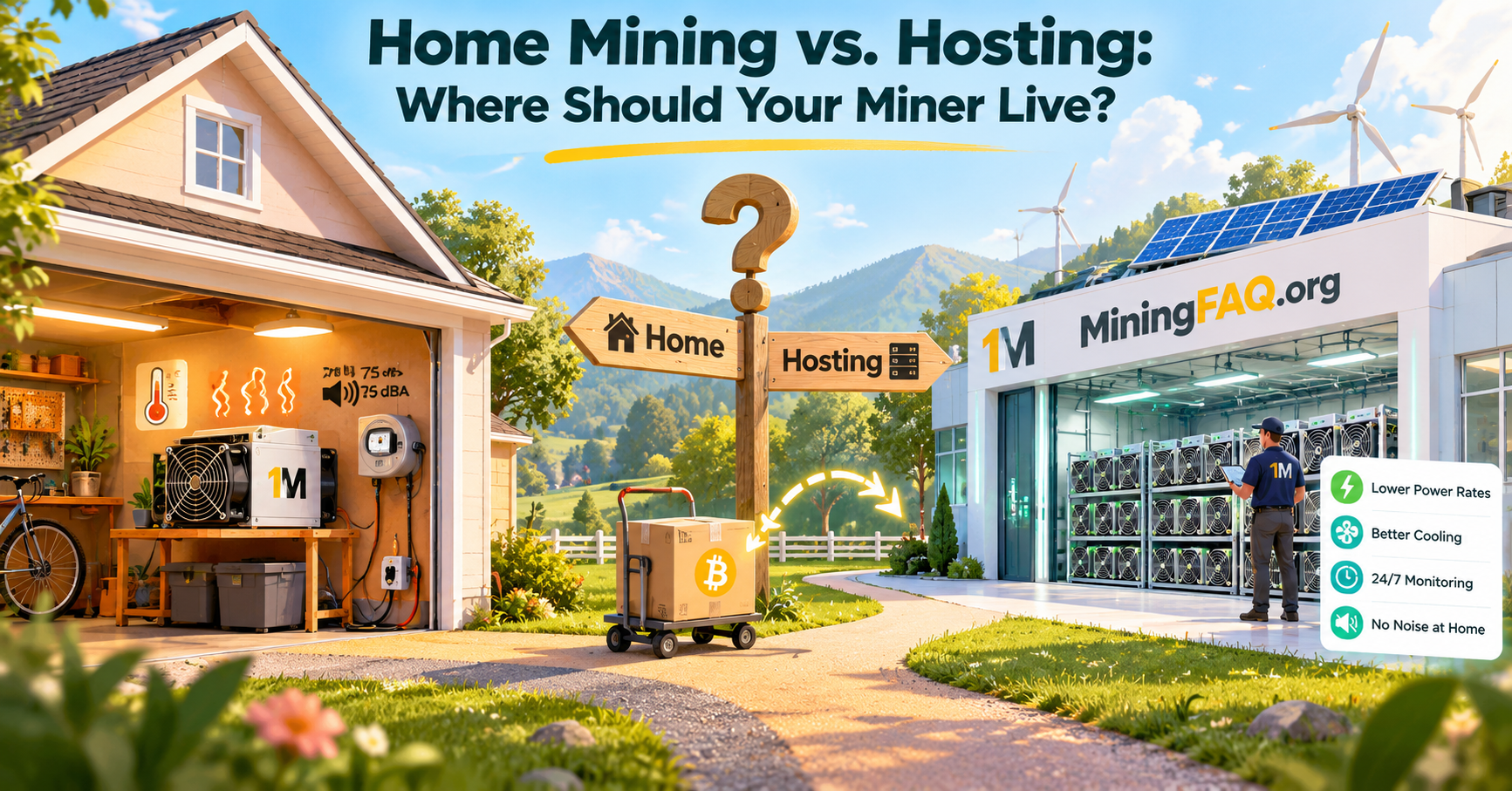
Buying a Bitcoin miner is the easy part. The harder question comes right after: where is this 3,500-watt, 75-decibel machine actually going to run?
There are two main answers. You can run it at home, in a garage, basement or shed, or you can ship it to a professional hosting facility that powers, cools and monitors it for you. Both options can connect to the same mining pool and earn the same bitcoin per terahash. What changes is your cost, your workload and how much control you keep.
This guide compares home mining and hosting side by side, runs the numbers at today’s network conditions and helps you decide where your miner should live.
Key Takeaways
- Electricity is one of the biggest factors in Bitcoin mining economics. Your price per kWh can determine whether the same ASIC operates above or below its electricity break-even.
- At a late-October hashprice around $36.70 per PH/s per day, an Antminer S21 XP has an electricity-only break-even near $0.11/kWh before hardware and other costs. The latest published U.S. residential average is about $0.18/kWh.
- Home mining means managing noise, heat and electrical requirements. An S21-class air-cooled ASIC can operate around 75–76 dBA while drawing more than 3.5 kW continuously.
- Professional hosting trades some physical control for purpose-built infrastructure, monitoring and access to potentially lower electricity rates, but the provider and contract terms matter.
- Home mining can still make sense when electricity is comfortably below the machine’s break-even rate, the property has suitable electrical capacity and ventilation, or benefits such as heat reuse and hands-on control are valuable to you.
The Quick Answer
For most people in 2026, hosting wins. Lightning Mines’ guide to home mining vs. hosted mining answers the question “is home mining worth it?” with a simple “For most people, no,” and recommends hosting for most retail miners. The reason is straightforward: residential electricity costs far more than industrial power, and modern ASICs are built for data centers, not living rooms.
That said, there are real exceptions. Let’s look at what each option actually involves.
What Home Mining Really Involves
Power and Wiring
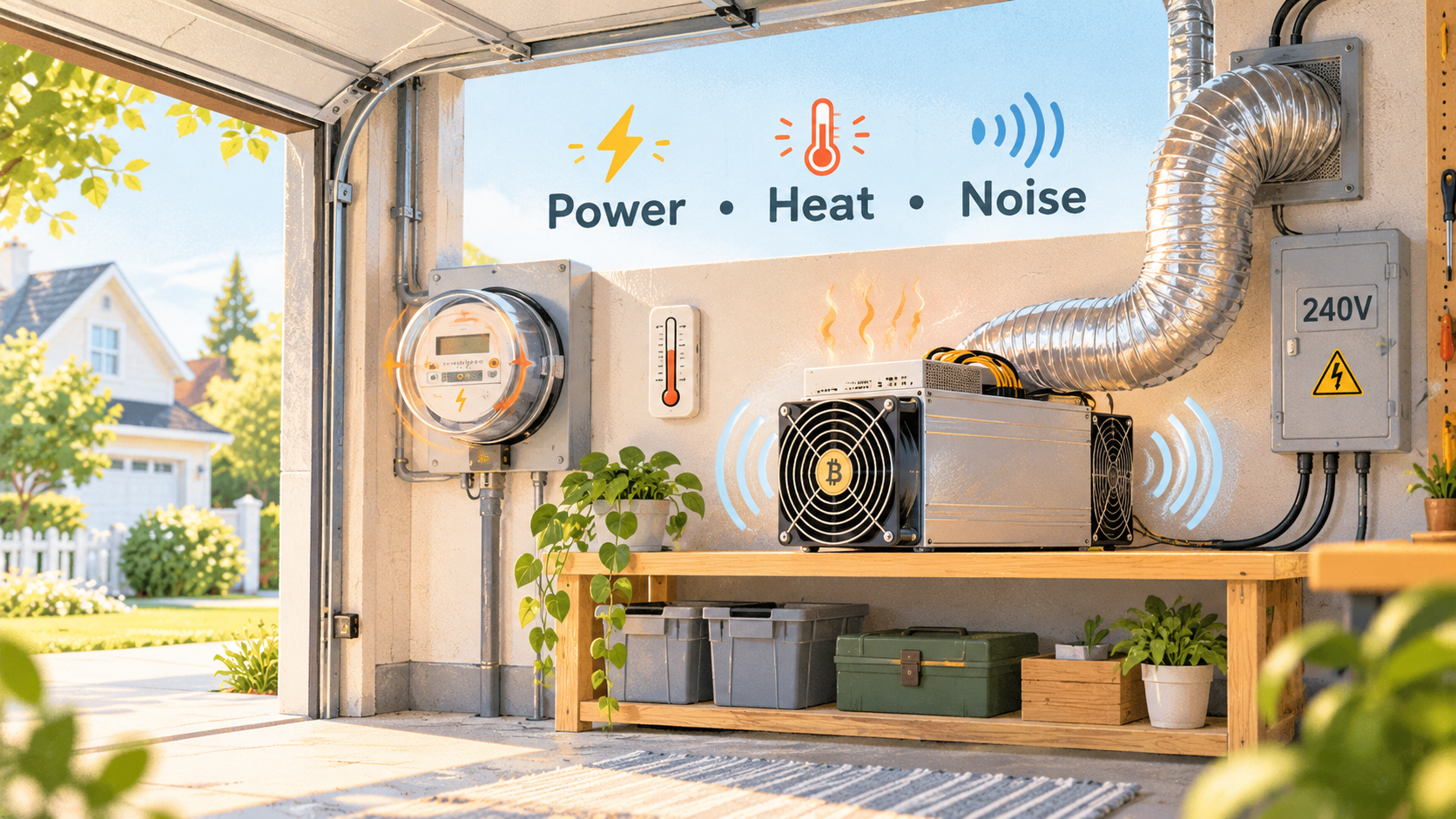
A modern Bitcoin ASIC is closer to an electric oven than a computer. According to ViaBTC’s comparison of hosting and home mining, an Antminer S21 XP draws about 3,645 W and needs a 220–277 V supply at 20 A. That is about 87.5 kWh per day, every day.
Most homes need electrical upgrades to run even one machine safely. Lightning Mines estimates 2,000–5,000 or more in electrical work, and notes that two machines need dedicated 240 V/30 A circuits.
Noise
ASICs are loud. The S21 XP hits about 76 dBA at full fan speed, and Lightning Mines compares an S21 Pro at 75 dB to a lawn mower that never switches off. Hydro and immersion setups are quieter, but they add pumps, radiators and plumbing.
Heat
Every watt a miner uses becomes heat. One S21 XP releases about 12,400 BTU per hour, similar to a large space heater running nonstop. In winter, that heat can warm a room. In summer, it raises your cooling bill and can push the machine into thermal throttling or damage.
Internet and Maintenance
You also need a stable wired connection, a plan for dust and filters, and the skills to diagnose hashboard errors, fan failures and firmware issues yourself. If a breaker trips at 3 a.m., nobody restarts the machine until you notice.
What Hosting Involves
With hosting, you still own the ASIC, but it lives in a facility built for mining. The host provides industrial power, cooling, security, networking and 24/7 monitoring. You point the machine at your chosen pool and payout address and track it remotely.
You give up direct physical access, and you rely on the host’s repair process and response times. In exchange, you get industrial electricity rates, no noise or heat at home and no wiring bill. OneMiners describes this as the core of a sensible setup in Crypto Mining Setup 2026: Power Before the Rig: lock in a low, fixed power rate first, then choose the hardware that fits it.
The Numbers: Home vs. Hosted at Today’s Hashprice
In late October 2026, Bitcoin hashprice is approximately $36.70 per PH/s per day, while seven-day network hashrate is around 1.05 ZH/s. The latest U.S. Energy Information Administration data puts average electricity prices at approximately $0.096/kWh for industrial customers and $0.182/kWh for residential customers.
Using those figures and subtracting an assumed 2% pool fee:
| Miner | Revenue/day after 2% pool fee | Net at $0.048/kWh hosted | Net at $0.0964/kWh U.S. industrial | Net at $0.12/kWh | Net at $0.1816/kWh U.S. residential | Power-only break-even |
|---|---|---|---|---|---|---|
| Antminer S21 Pro — 234 TH/s, 3,510 W | ~$8.42 | ~$4.37 | ~$0.30 | ~−$1.69 | ~−$6.88 | ~$0.100/kWh |
| Antminer S21 XP — 270 TH/s, 3,645 W | ~$9.71 | ~$5.51 | ~$1.28 | ~−$0.79 | ~−$6.18 | ~$0.111/kWh |
| Antminer S23 Hyd — 580 TH/s, 5,510 W | ~$20.86 | ~$14.51 | ~$8.11 | ~$4.99 | ~−$3.15 | ~$0.158/kWh |
Late-October 2026 snapshot. These figures subtract a 2% pool fee and electricity but do not include hardware purchase cost, repairs, downtime, taxes or other operating expenses.
Note: The Antminer S23 Hyd is included as an efficiency comparison rather than a typical home-mining machine. Bitmain specifies a three-phase 380–415 V electrical supply and hydro-cooling infrastructure, making it much better suited to purpose-built mining facilities.
The pattern remains clear. At the latest U.S. residential average of roughly 18.2¢/kWh, all three machines in this comparison sit below their electricity-only break-even levels. At substantially lower industrial or professional hosting rates, the same machines have considerably more operating room.
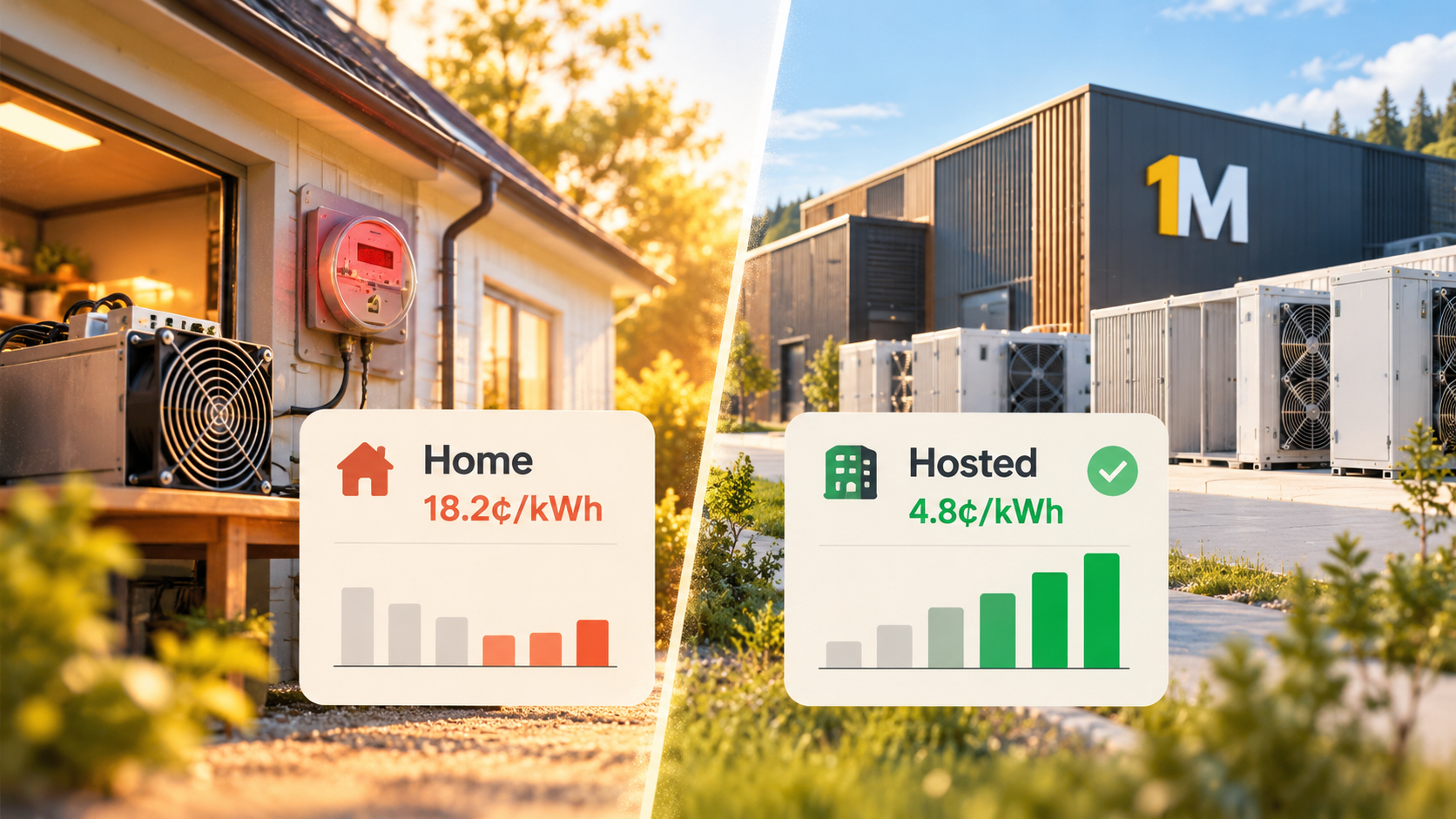
OneMiners makes the same broader point in its Industrial vs. Home Bitcoin Mining: 2026 Reality analysis: electricity price, cooling, uptime and infrastructure can materially change the economics of otherwise identical hardware.
Mining revenue also improved significantly from the extreme lows seen earlier in 2026. Cassy Soriano discusses that recovery in Bitcoin Mining Revenue Hits Its Best Month Since January: Is Mining Profitable Again?. But stronger mining revenue only turns into stronger operating margins when electricity and other costs leave enough room.
Home Mining vs. Hosting: Side by Side
| Factor | Home mining | Hosting |
|---|---|---|
| Electricity | Residential rates (often 0.15–0.25/kWh in the US) | Industrial or negotiated rates |
| Upfront setup | Electrical upgrades, cooling, sound control | Usually a deposit or setup fee |
| Noise and heat | Your problem | Handled by the facility |
| Monitoring | You, when you remember | 24/7 by the host |
| Physical control | Full | Set by the hosting contract |
| Repairs | DIY or shipped out | Handled on site, terms vary |
| Heat reuse | Possible in cold climates | Not available to you |
| Scaling | Limited by your home’s power | Easy to add machines |
| Counterparty risk | None | You rely on the host |

Hidden Costs on Both Sides
Home miners often forget the one-time costs: new circuits, a 240 V outlet, ducting, fans, sound insulation and sometimes a higher home insurance premium. Hosted miners should look closely at what a quoted rate includes. As ViaBTC notes, some contracts bill by measured energy, others by reserved capacity, fixed fees or a mix, and a quote that already includes electricity should never have electricity added again.
For UK readers, where household electricity is especially expensive, The Mining Shop’s guide to hosting vs. home mining is a helpful local perspective.
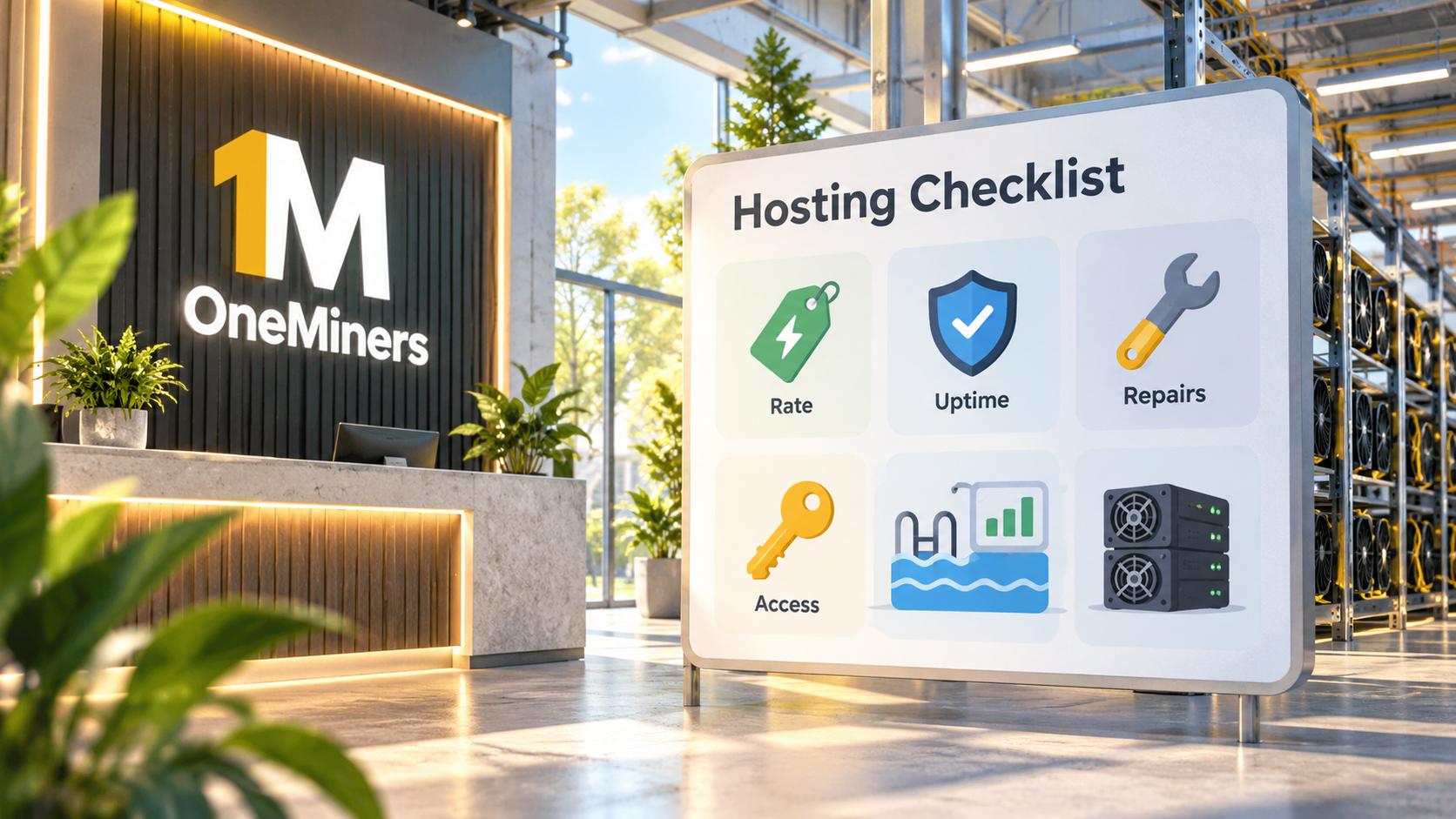
What to Check in a Hosting Contract
Not all hosts are equal. Before you ship a machine anywhere, ViaBTC recommends checking:
- Pricing basis: measured kWh, reserved capacity or fixed fees, and exactly what the rate includes.
- Term and minimums: contract length, minimum commitments and early-termination conditions.
- Uptime and repairs: monitoring scope, who authorizes repairs and how parts and labor are billed.
- Curtailment: whether the host can switch your miners off to sell power, and how those hours are billed.
- Ownership and access: confirmation that you keep title to your machine and can inspect, remove or transfer it.
- Pool control: whether you choose your own pool and payout address.
A fixed electricity rate is especially valuable. If your rate can rise at any time, a profitable setup today can become a losing one next year.
When Home Mining Makes Sense
Home mining can still be a reasonable choice if your electricity price is comfortably below your machine’s break-even rate. At current late-October mining conditions, that generally means staying meaningfully below roughly 0.10–0.11/kWh for S21-class air-cooled machines when profitability is the goal.
It also helps to have a suitable dedicated space such as a garage, workshop or outbuilding where noise, heat and ventilation can be managed safely. Heat reuse can improve the overall economics in colder climates, but it is not required. Home mining can also appeal to people who value direct physical control, enjoy maintaining their own equipment or are mining primarily for education rather than maximum financial return.
When Hosting Makes Sense
Professional hosting is often more practical when you pay normal residential electricity rates, lack suitable electrical capacity or ventilation, want to operate multiple machines, or prefer professional monitoring and on-site support.
OneMiners is one option designed around those needs. Its current website lists 17 live data centers across five continents. Published hosting rates start around $0.0364/kWh in Nigeria under a seven-year prepaid electricity plan, while shorter-term and standard rates vary by location. OneMiners also advertises 95%+ guaranteed uptime, average uptime above 98%, remote monitoring and extended warranty coverage for eligible hosted hardware. Current locations, pricing and contract terms can be checked through its hosting information.
At approximately $0.048/kWh, the machines in the comparison above remain cash-positive after electricity and the assumed 2% pool fee under the current hashprice snapshot. That does not guarantee full investment profitability because hardware cost, repairs, downtime and future mining conditions still matter. The real advantage of lower-cost hosting is that it gives the miner a larger operating buffer when Bitcoin price or hashprice weakens.
Frequently Asked Questions
Is home Bitcoin mining profitable in 2026? Only with very cheap electricity. At today’s hashprice, an S21 XP breaks even around $0.11/kWh, below most US residential rates.
How loud is a Bitcoin miner at home? Air-cooled ASICs run around 75–76 dB, similar to a lawn mower that never turns off.
Can I run an ASIC on a normal household outlet? Most modern ASICs need a 220–240 V circuit at around 20 A. Many homes need electrical upgrades first.
What does mining hosting cost? It depends on the provider and contract. Compare the all-in rate per kWh, any fixed fees, deposits and repair charges.
Do I still own my miner if it is hosted? With a reputable host, yes. Confirm ownership, access and removal terms in the contract.
Can I use my miner’s heat at home? Yes, in cold months it can help heat a space. It rarely offsets high electricity prices on its own, though.
The Bottom Line
Where your miner operates can have a major effect on whether the economics work. Home mining offers direct physical control and the possibility of heat reuse, but it also brings residential electricity costs, noise, ventilation requirements and potentially significant electrical upgrades.
For many miners focused primarily on operating economics in 2026, professional hosting can make sense when residential electricity is expensive. Home mining can still be attractive when you have unusually inexpensive power, suitable infrastructure or reasons to value heat reuse and hands-on control.
Services such as OneMiners make professional hosting accessible without requiring an individual miner to build an industrial facility. Its combination of published electricity options, professional infrastructure, remote monitoring and long-term hosting plans gives miners additional ways to manage the operating costs they can actually control.
This article is for educational purposes only and is not financial advice. Bitcoin’s price, network difficulty, hashprice and electricity rates change constantly. Always check live data and read hosting contracts carefully before committing.