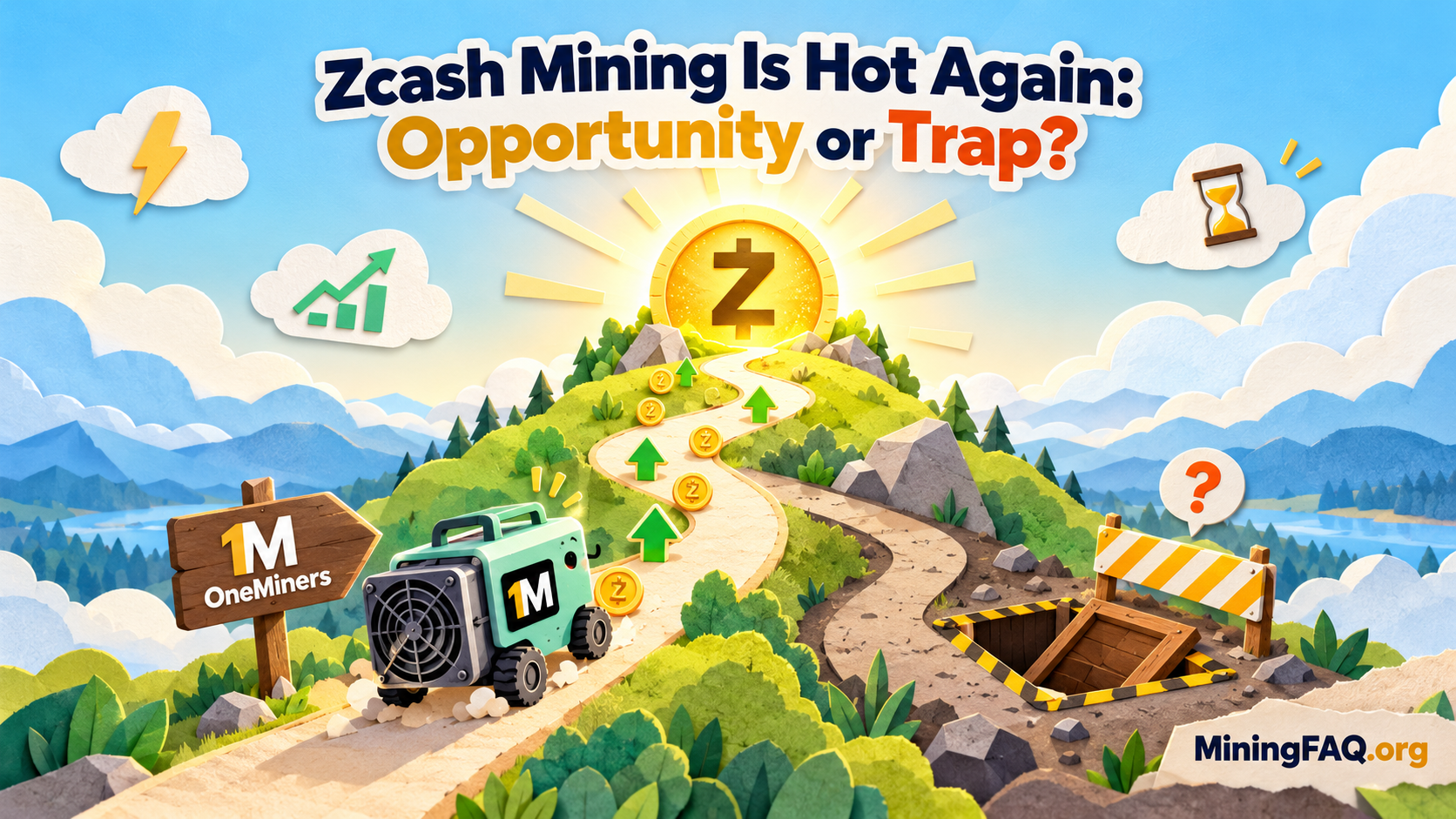
Two years ago, Zcash traded well under $100 and Equihash mining attracted far less attention. In 2026, the picture has changed dramatically. ZEC crossed $1,000 on September 4 for the first sustained four-digit trading since its volatile 2016 launch period, and by October 28 it was trading around $1,300. Zcash network hashrate has also climbed sharply, from roughly 13 GSol/s in late 2025 to around 31–32 GSol/s today. At the same time, research firms such as Grayscale have published analyses highlighting the unusually strong economics of Zcash mining.
Whenever a mining market heats up this quickly, two questions follow: is this a durable opportunity, or are late buyers taking on more risk than they realize? This guide looks at the numbers behind the Zcash mining boom, what modern Equihash hardware can earn under current conditions, the risks that could change the picture, and how miners can approach the opportunity more carefully.
Key Takeaways
- ZEC is trading around $1,300 as of October 28, 2026, after returning above $1,000 in September for the first sustained period since its 2016 launch.
- Zcash network hashrate has surged, from roughly 13 GSol/s in late 2025 to around 31–32 GSol/s today.
- Under current conditions, an Antminer Z15 Pro can still generate a strong operating margin after electricity, particularly at low industrial hosting rates.
- The biggest risks are ZEC price, network growth and hardware cost. Rising hashrate reduces each machine’s share of network rewards.
- Zcash mining economics are currently attractive, but miners should stress-test lower ZEC prices, higher hashrate and longer hardware payback periods before buying.
Why Zcash Mining Is Hot Again
Zcash is a proof-of-work cryptocurrency with Bitcoin-style fixed supply (21 million ZEC) plus optional privacy through shielded transactions. Its mining algorithm, Equihash, is memory-hard and is now dominated by purpose-built ASICs such as Bitmain’s Antminer Z15 series.
Three forces pushed Zcash mining back into the spotlight in 2026:
-
A huge price rally. ZEC rose above $1,000 on September 4, 2026, its highest level in eight years. Press coverage at the time reported that ZEC hit an 8-year high as OneMiners expanded its Equihash hosting to meet climbing demand from Zcash miners. ZEC has since pushed higher, to around $1,250.
-
Outsized revenue per machine. In its September report, Grayscale Research found that Zcash mining is taking off, estimating Zcash rewards at about 2x Bitcoin’s per mining rig per day and about 4x per megawatt-hour. Total Zcash mining activity, Grayscale noted, had risen more than 2.5x this year. Grayscale described a “virtuous circle”: higher prices attract more miners, more miners strengthen network security, and that security can support higher prices.
3. Big players arriving. In August 2026, Cypherpunk Technologies closed a $33 million deal for 4.2 GSol/s of Zcash hashrate, about 18% of the network at the time. When public companies start buying hashrate at that scale, it is a clear sign that the sector is being taken seriously.
How Zcash Mining Works in 2026
Here are the current network basics prospective miners should know:
| Metric | Zcash (ZEC) |
|---|---|
| Algorithm | Equihash (ASIC-dominated) |
| Target block time | 75 seconds |
| Current block subsidy | 1.5625 ZEC |
| Miner share | 80% — about 1.25 ZEC per block |
| Development funding | 8% to Zcash Community Grants and 12% to the protocol’s deferred-funding lockbox |
| Approx. ZEC paid to miners per day | ~1,440 ZEC |
| Difficulty adjustment | Every block |
| Next halving | Expected around late 2028 |
| Network hashrate, Oct. 28, 2026 | ~31–32 GSol/s |
At the current 75-second block target, roughly 1,152 blocks are expected each day. With miners receiving about 1.25 ZEC per block, that works out to approximately 1,440 ZEC of daily miner issuance before transaction fees. At a ZEC price around $1,300, that represents roughly $1.9 million in daily miner rewards.
For a broader beginner introduction to Equihash, mining hardware and pool mining, OneMiners’ Ultimate Guide to Zcash Mining in 2026 remains a useful practical resource.
What a Zcash Miner Earns Today
Using live network data from the CoinDesk ZEC mining calculator (ZEC around $1,250 and hashrate near 30.7 GSol/s), here is what today’s Equihash ASICs earn after a 2% pool fee:
| Miner | Hashrate | Power | Revenue/day | Net/day at $0.048/kWh | Net/day at $0.12/kWh |
|---|---|---|---|---|---|
| Antminer Z15 Pro | 840 KSol/s | 2,780 W | ~$48.20 | ~$45.00 | ~$40.20 |
| Antminer Z15 K | 525 KSol/s | 2,483 W | ~$30.15 | ~$27.25 | ~$23.00 |
| Antminer Z15 | 420 KSol/s | 1,510 W | ~$24.10 | ~$22.35 | ~$19.75 |
Estimates as of late October 2026. They exclude hardware cost, downtime and future changes in price or difficulty.
These remain unusually strong energy margins, but they should not be confused with guaranteed profit. Hardware purchase price, pool performance, downtime, maintenance and future changes in ZEC price or network hashrate still matter. OneMiners’ September comparison reached the same broader conclusion: Equihash hardware had substantially more room above electricity costs than several competing ASIC categories at that snapshot.
For context, Bitcoin mining conditions have also improved. Cassy Soriano explains the recent rebound in Bitcoin Mining Revenue Hits Its Best Month Since January: Is Mining Profitable Again? But Zcash currently stands out on revenue density: Grayscale’s September research estimated Zcash miner rewards at roughly 2x Bitcoin’s per mining rig per day and about 4x per megawatt-hour, under the specific hardware and electricity assumptions used in its comparison. Those figures are snapshots rather than guarantees, but they help explain why Equihash mining has attracted so much new hashrate.
The Case for “Opportunity”
- Strong energy margins, but not unlimited protection. At the current network hashrate, a Z15 Pro’s electricity-only break-even ZEC price is roughly $85 at $0.048/kWh and about 210–215 at $0.12/kWh, assuming a 2% pool fee. Those are energy-only thresholds, not full investment break-even levels.
- Hardware price matters just as much as revenue. OneMiners’ current in-stock Z15 Pro pricing is higher than some future-delivery batches. At roughly $46 per day after pool fees and $0.048/kWh electricity, an $11,799 in-stock unit would have a simple payback of roughly 8–9 months if today’s economics never changed. In reality, price, hashrate, downtime and difficulty will change, which is why lower-priced forward batches can be attractive but also carry more waiting-time risk.
- The network is still relatively small. That helps explain today’s strong per-machine revenue, but it also means new ASIC deployments can dilute existing miners faster than on a much larger network like Bitcoin.
- Diversification can be useful. Equihash revenue is tied primarily to ZEC economics rather than Bitcoin’s SHA-256 mining market, giving multi-algorithm miners another source of revenue—but also exposing them to ZEC-specific volatility.
The Case for “Trap”
Now the uncomfortable part. Every hot mining market eventually corrects, and Zcash has several pressure points.
1. Dilution is already happening. Hashrate has climbed from about 12.5 GSol/s in late 2025 to around 30.7 GSol/s, and it rose roughly 15% in just the seven weeks after early September. Each new machine shrinks everyone else’s share. If hashrate doubles again, every miner’s ZEC output halves.
2. ZEC is extremely volatile. In late May 2026, a researcher discovered a flaw in the Orchard shielded pool’s zero-knowledge circuit that could theoretically have allowed counterfeit ZEC. Developers patched it quickly with emergency forks, and analysts found no evidence it was exploited. The network later launched a new shielded pool, Ironwood, on July 28. ZEC still fell by more than half after the disclosure. A drop like that can arrive with no warning.
3. Hardware prices follow mining demand. OneMiners’ own September price book showed how quickly Equihash hardware pricing can change. On September 7, its Z15 Pro spot unit was listed at about $10,599, while later-delivery batches were substantially cheaper. That gap is important: buyers who pay a large premium for immediate delivery need today’s elevated mining revenue to last longer, while cheaper forward batches introduce the opposite risk—network conditions may deteriorate before the machine arrives.
4. Concentration. A single buyer acquiring nearly a fifth of the network shows how quickly the competitive landscape can shift.
Stress Test: Antminer Z15 Pro Net Earnings per Day
| ZEC price | Hashrate 31.5 GSol/s | Hashrate 63 GSol/s |
|---|---|---|
| $1,310 | ~$46.10/day | ~$21.45/day |
| $600 | ~$19.38/day | ~$8.09/day |
| $300 | ~$8.09/day | ~$2.44/day |
Assumes an Antminer Z15 Pro, $0.048/kWh electricity and a 2% pool fee. These figures subtract electricity and pool fees but not hardware cost, downtime, repairs or taxes.
The encouraging part is that cheap electricity gives the Z15 Pro significant operating room even under much weaker scenarios. But “cash-positive after electricity” is not the same as earning back the hardware investment quickly. At $0.12/kWh home power, the harshest scenario above—$300 ZEC and roughly doubled network hashrate—would turn the machine slightly negative on electricity and pool costs alone.
How to Mine Zcash Without Falling Into the Trap
- Run your own numbers before buying. Plug your machine’s hashrate, wattage and power rate into a live calculator such as CoinDesk’s, then test lower prices and higher difficulty.
- Plan for dilution. Assume network hashrate keeps rising and your daily ZEC output keeps falling.
- Watch the hardware price. Paying a large premium for in-stock machines only makes sense if you can recover it quickly. Forward batches are cheaper but carry the risk that conditions change before delivery.
- Lock in competitive power costs. Electricity is usually one of the largest recurring costs a miner can control. A low, predictable rate gives a machine more operating room when ZEC falls or network hashrate rises.
- Join a reputable pool. With 75-second blocks, pools pay steady daily rewards. Solo mining a single Z15 Pro would mean waiting about a month for a block on average, with no income in between and no guarantee of hitting one.
- Do not bet everything on one coin. Pair Zcash hashrate with Bitcoin or other assets to smooth out the swings.
Why Hosting Can Make Sense for Zcash
A Z15 Pro draws roughly 2.8 kW continuously and produces substantial heat and noise, so many miners consider professional hosting rather than running a modern Equihash ASIC at home.
OneMiners supports Equihash hardware alongside its Bitcoin-mining infrastructure and publishes several long-term electricity options. Its advertised seven-year prepaid rates start around $0.0364/kWh in Nigeria, while OneMiners has cited an average long-term fixed rate of roughly $0.048/kWh across its wider hosting network. For eligible hosted hardware, OneMiners also advertises a 7-year warranty, a 95%+ uptime SLA with observed uptime above 98%, and remote monitoring through its mobile app.
Those features do not guarantee that Zcash mining will remain profitable, because ZEC price and network competition can change rapidly. Their practical advantage is that they can make the cost side of the equation more predictable. As the stress test shows, keeping electricity low and stable gives an Equihash miner significantly more room to absorb weaker market conditions.
Frequently Asked Questions
Is Zcash mining profitable in 2026? Yes, at current prices. A Z15 Pro earns about $45 a day after power at hosted rates. Profitability depends heavily on ZEC’s price and network hashrate, both of which can change quickly.
What is the best Zcash miner right now? The Antminer Z15 Pro (840 KSol/s, about 2,780 W) is the leading Equihash ASIC. The Z15 K and Z15 are lower-cost alternatives with lower output.
Can I mine Zcash with a GPU? Not competitively. Equihash mining is dominated by ASICs, and GPUs earn very little.
How much ZEC do miners earn per block? Miners receive 1.25 ZEC per block plus fees, out of a 1.5625 ZEC subsidy. The other 20% funds Zcash development.
When is the next Zcash halving? It is expected around late 2028, when the block subsidy will fall by half.
What is the biggest risk for Zcash miners? A combination of falling ZEC prices and rising hashrate. Either one cuts earnings, and together they can extend payback dramatically.
The Bottom Line: Opportunity or Trap?
Zcash mining is showing some of the strongest proof-of-work economics in late 2026, and Grayscale’s research supports the idea that Equihash hardware currently earns unusually high revenue per rig and per unit of electricity. But that does not make the opportunity permanent. ZEC remains volatile, network hashrate is expanding quickly and hardware prices can move almost as fast as mining revenue.
The strongest setup is therefore not simply buying the fastest miner. It is combining sensible hardware pricing with efficient equipment and a power cost that can survive weaker market conditions. That is where services such as OneMiners can be useful: its Equihash hosting, long-term electricity options, warranty coverage and remote monitoring give miners ways to make the operating side of Zcash mining more predictable even when the coin price is not.
Treat the current Zcash cycle as an opportunity to evaluate carefully rather than a guarantee of easy returns. Stress-test lower prices, assume network competition will continue increasing, compare immediate and forward-batch hardware prices, and keep electricity costs under control. If those numbers still work under conservative assumptions, Zcash can be a compelling addition to a diversified mining strategy.
This article is for educational purposes only and is not financial advice. ZEC prices, network hashrate and hardware prices change quickly. Always check live data before buying a miner.