Here’s a fact that sounds like a sales pitch but is actually just physics: almost every watt a Bitcoin miner draws comes out as heat. A 3,600-watt ASIC is, for all practical purposes, a 3,600-watt electric heater that also earns bitcoin.
That simple idea has turned into one of the most interesting corners of home mining. People are heating bedrooms with plug-in miners, warming whole houses with hydro-cooled ASICs plumbed into a boiler and even heating pools and greenhouses. As temperatures drop this winter, it’s a good time to ask the obvious question: should your heater mine bitcoin?
In this guide, I’ll walk through how it works, run the real numbers against regular heaters and heat pumps, look at the devices people actually use and share my honest view on who this makes sense for and who should skip it.
Key Takeaways
- Almost all of the electricity consumed by a Bitcoin miner eventually becomes heat. In that sense, an ASIC behaves much like an electric resistance heater while also performing Bitcoin mining work.
- Mining revenue can offset part of the electricity you were already going to spend on heating. With current November 2026 mining conditions, an efficient S21 XP generates roughly 10¢ of mining revenue per kWh of electricity consumed after an illustrative 2% pool fee.
- Against electric resistance heating, the electricity-only economics can be attractive, but the true saving also depends on hardware cost, installation, downtime, auxiliary equipment and how much of the miner’s heat you can actually use.
- Heat pumps and inexpensive piped natural gas are much harder to beat. Mining heat is generally most interesting where the alternative is electric resistance heating, propane or heating oil.
- Noise, electrical requirements, sizing and summer heat are the biggest practical limitations.
- If you do not need the heat, professional hosting can make more sense than running an ASIC at residential electricity rates.
How Does Mining Heat Your Home?
A space heater converts electricity into heat. So does a Bitcoin miner. The difference is that the miner does useful computational work on the way, hashing blocks for the Bitcoin network and earning a share of the rewards.
As Marty Bent puts it in TFTC’s guide to heating your home with Bitcoin mining, “Every watt a miner draws comes out as heat.” Once you see it that way, the question changes. You’re no longer asking “is mining profitable?” You’re asking “if I’m going to pay for heat anyway, why not get some bitcoin back?”
How Much Heat Does a Miner Produce?
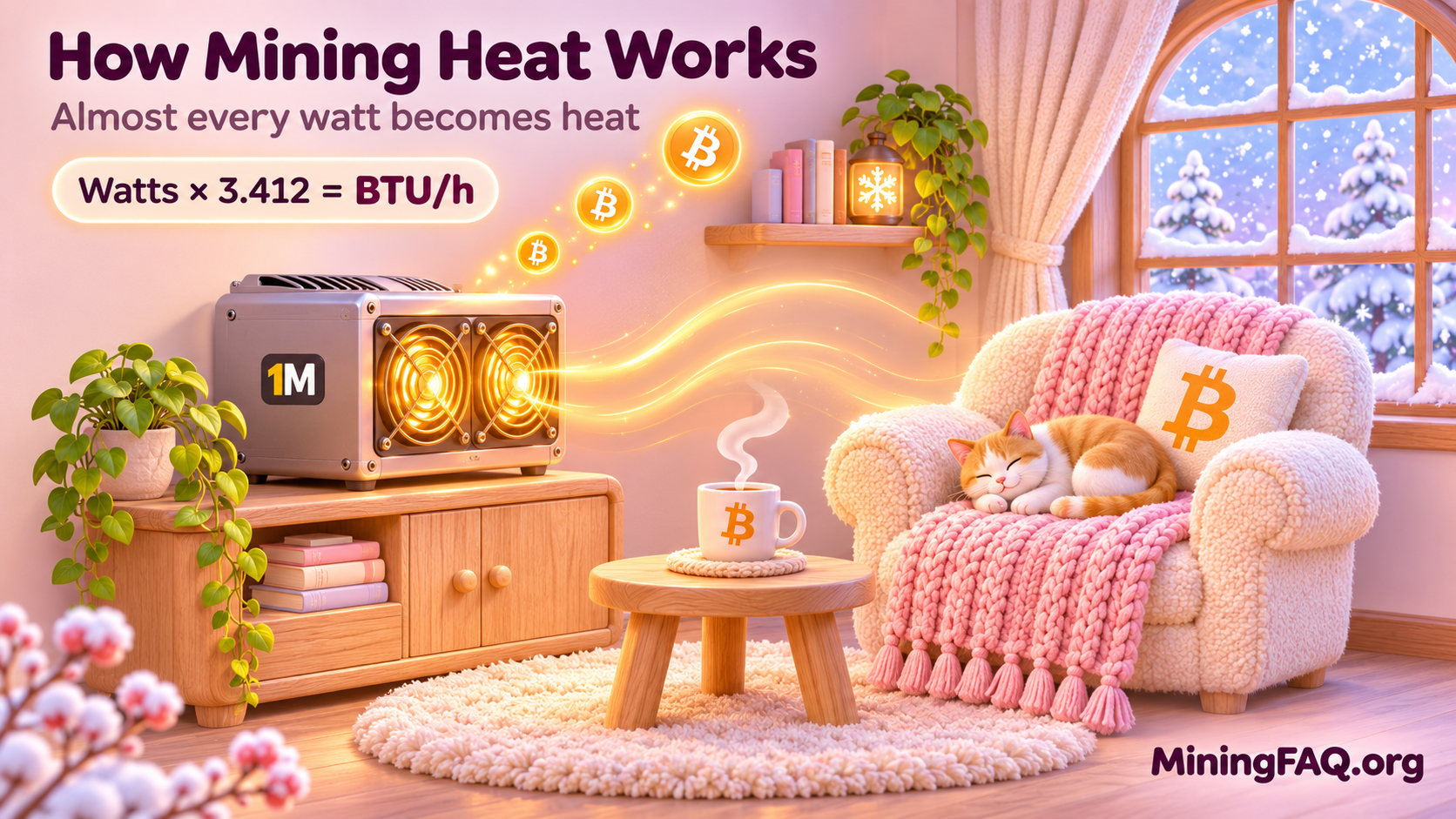
The conversion is easy: watts × 3.412 = BTU per hour. OneMiners’ guide to Bitcoin mining heat reuse uses the Antminer S21 Pro as an example:
| Device | Power | Heat output | Equivalent to |
|---|---|---|---|
| Typical space heater | 1,500 W | ~5,118 BTU/h | 1 space heater |
| Avalon Mini 3 (mining mode) | 800 W | ~2,730 BTU/h | ~0.5 space heater |
| Antminer S21 XP | 3,645 W | ~12,437 BTU/h | ~2.4 space heaters |
| Antminer S21 Pro | 3,675 W | ~12,539 BTU/h | ~2.5 space heaters |
| Antminer S23 Hyd | 5,510 W | ~18,800 BTU/h | ~3.7 space heaters |
That’s a lot of heat. An S21 Pro produces about 88 kWh of heat every day. For context, Braiins engineer Adam calculated that his entire 140 m² timber-frame house loses only about 3.5 kW of heat at −10 °C. One large ASIC can be more heater than many homes need.
The Real Math: Can a Mining Heater Reduce Your Heating Cost?
A useful way to think about a Bitcoin miner is as an electric heater that produces a second output: mining revenue.
The amount of revenue generated for each kWh depends mainly on the miner’s efficiency and Bitcoin’s current hashprice.
Using the latest available Hashrate Index snapshot of roughly $33.5 per PH/s per day and applying an illustrative 2% pool fee, the effective hashprice is about $32.8/PH/day.
That produces approximately the following electricity offsets:
| Miner | Approx. efficiency | Mining revenue offset per kWh | Net electricity cost at 13¢/kWh | At 17¢/kWh | At 22¢/kWh |
|---|---|---|---|---|---|
| Electric resistance heater | — | 0¢ | 13¢ | 17¢ | 22¢ |
| Antminer S19j Pro | ~30.5 J/TH | ~4.5¢ | ~8.5¢ | ~12.5¢ | ~17.5¢ |
| Avalon Mini 3 | ~21.3 J/TH | ~6.4¢ | ~6.6¢ | ~10.6¢ | ~15.6¢ |
| Antminer S21 | ~17.5 J/TH | ~7.8¢ | ~5.2¢ | ~9.2¢ | ~14.2¢ |
| Antminer S21 XP | ~13.5 J/TH | ~10.1¢ | ~2.9¢ | ~6.9¢ | ~11.9¢ |
| Heat pump, illustrative COP ~3 | — | — | ~4.3¢ | ~5.7¢ | ~7.3¢ |
Snapshot based on roughly $33.5/PH/day hashprice in early November 2026 and an illustrative 2% pool fee. Mining revenue changes continuously with Bitcoin price, transaction fees and network difficulty.
There is one crucial assumption behind this comparison: the miner’s heat must actually be useful to you.
If you would otherwise run a resistance heater, every dollar of mining revenue can offset part of electricity you were already going to buy. But this table is not a complete ownership-cost comparison. It does not include the ASIC purchase price, electrical work, ducting or plumbing, pumps and fans, maintenance, downtime or heat that gets vented rather than used.
That is why I would describe a mining heater as potentially cheaper than resistance heating on an operating-cost basis, not automatically cheaper in every real-world installation.
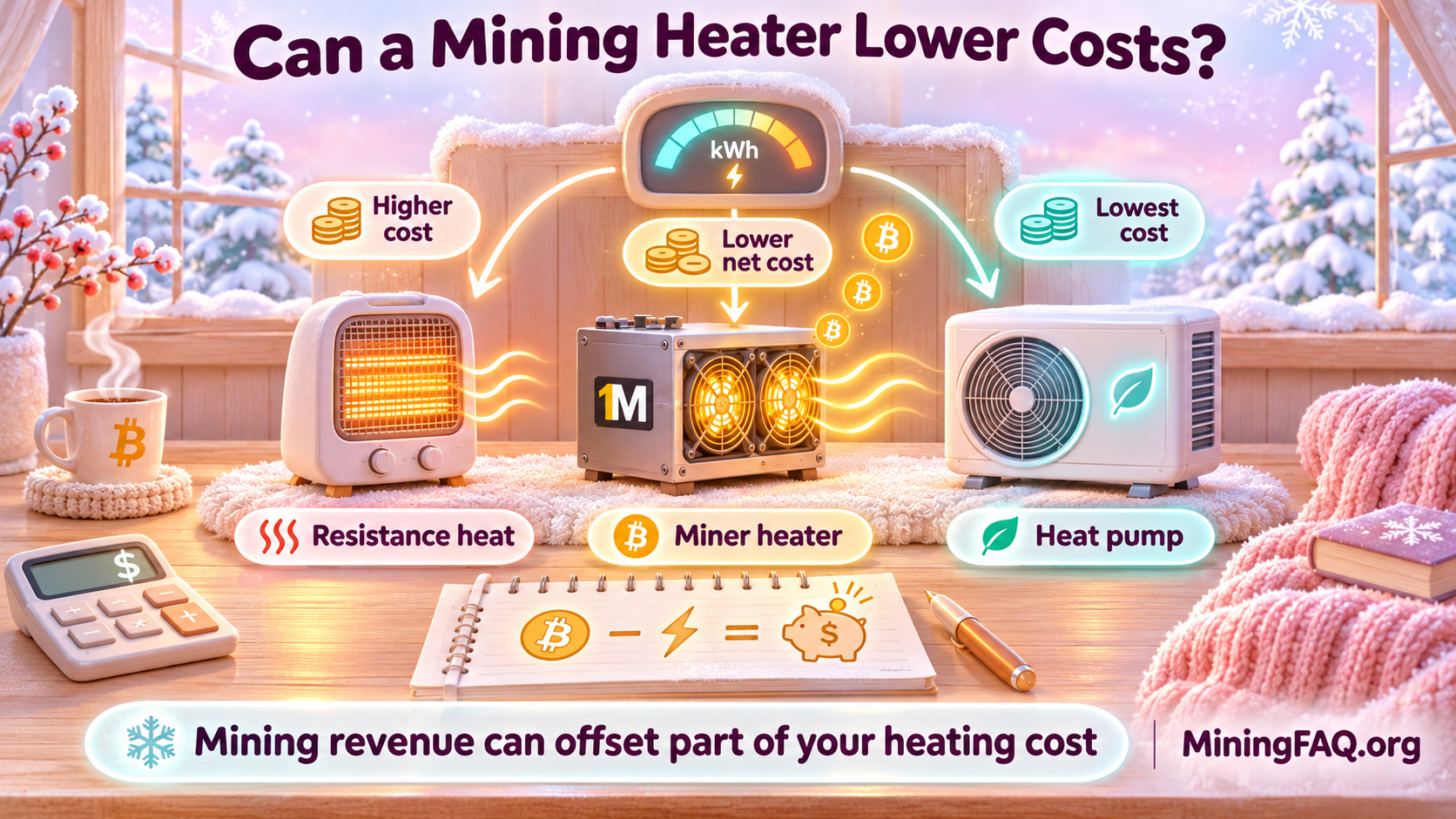
Against a heat pump, the comparison is much harder. A heat pump with a COP around 3 can deliver roughly three units of heat for every unit of electricity, which is why it often remains the cheaper conventional heating technology even after mining revenue is counted.
What This Table Tells Me
My honest read is this:
- Against electric resistance heat, mining has a built-in operating-cost advantage when you can use the heat. Both devices consume electricity and turn it into heat, but the miner also generates Bitcoin revenue. The size of that advantage depends on hashprice and miner efficiency, and hardware, installation and maintenance costs still matter.
- Against a heat pump, it’s close, and the heat pump often wins. A modern heat pump delivers about three units of heat for every unit of electricity. Only the most efficient miners, at relatively low electricity rates, get near that.
- Against cheap natural gas, mining rarely wins on cost alone. TFTC says natural gas is “very hard to beat on cost alone,” and I agree.
- Propane and heating oil are the sweet spot. TFTC’s examples show a 40–50% cut in effective heating costs for some propane users, though these figures come from Exergy, a company that sells mining heat installations.
In Adam’s specific Braiins case study, an S21-class miner offset about 63% of the electricity cost assigned to heating under the article’s assumptions. That reduced the illustrative annual net operating cost to roughly $366, compared with about $505 for the heat-pump scenario after maintenance. It is a useful example, but not a universal result: the calculation assumed $0.22/kWh electricity, a $100,000 Bitcoin price and Adam’s particular heating load.
Three Ways to Heat Your Home With a Miner
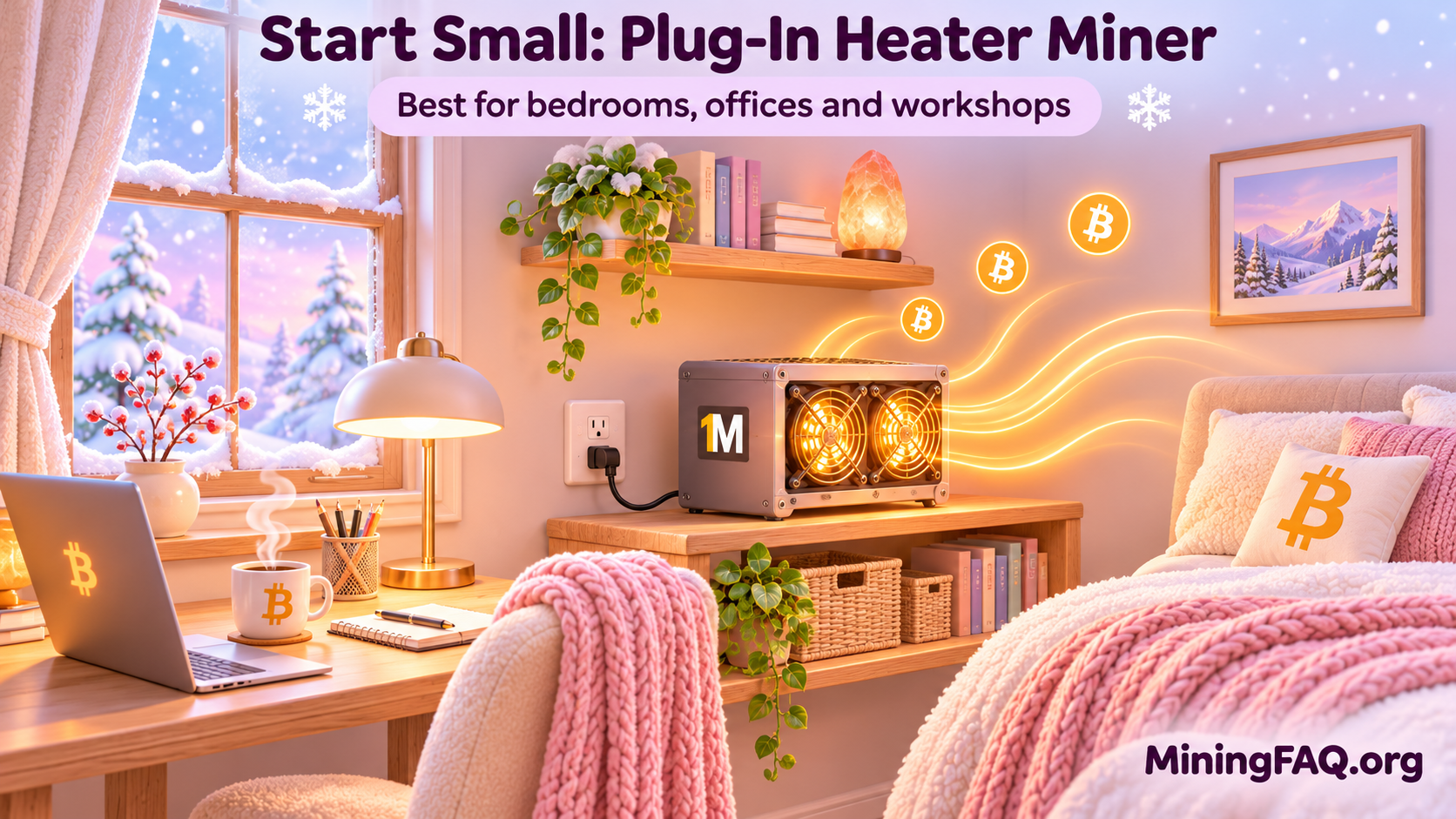
1. Plug-In Home Mining Heaters — Easiest
Purpose-built home miners are the easiest way to experiment with mining heat because they are designed for residential environments rather than data centers.
One of the best-known examples is Canaan’s Avalon Mini 3. Canaan’s current specifications list 37.5 TH/s at 800 W, or about 21.3 J/TH, with a stated operating noise range of roughly 35–55 dB depending on mode.
The Mini 3 can run in several power modes, allowing the owner to prioritize maximum hashrate, heating output or quieter operation. Canaan’s current website lists pricing from about $1,288, although retail pricing can change.
At the latest mining conditions, 37.5 TH/s produces roughly 1.20–1.25 per day in gross mining revenue before or around typical pool fees, depending on the exact hashprice.
Who it’s for: someone who already wants heat in a bedroom, office, workshop or similar small space and also wants an approachable introduction to Bitcoin mining.
My view: this is one of the more practical entry points for home heat reuse. You are not buying it because the mining income alone will quickly repay the machine. The value proposition is that you need some heat anyway, and part of the electricity expense can potentially come back as Bitcoin.
2. Ducted Air-Cooled ASICs — Middle Ground
A full-size air-cooled ASIC such as an S19- or S21-class machine can produce far more heat, but it also creates far more noise and requires substantially more electrical capacity.
Some home miners place the ASIC in a garage, basement or utility space and duct its exhaust into the house during winter, then redirect the hot air outdoors when heating is not needed.
OneMiners’ guide, Can You Still Mine Bitcoin at Home in 2026?, puts conventional air-cooled ASIC noise around 75 dB, which is why separation from bedrooms and living areas is usually important.
Who it’s for: people with suitable electrical service, a dedicated equipment space and a practical plan for noise and airflow.
3. Hydro Miners Integrated With Home Heating — Most Advanced
Hydro mining can take heat reuse much further by transferring ASIC heat into a water or glycol loop rather than dumping hot air into a room.
Braiins documented one particularly useful example in its Hashrate Heated House case study. A hydro-cooled miner heats a 140 m² home, domestic hot water and radiant floor heating through a multi-loop system.
The miner loop can send coolant out at temperatures up to roughly 65°C, while sensors, pumps and Braiins OS Dynamic Power Scaling help the system respond when the hot-water tank reaches its target temperature.
This can be quieter inside the living area than putting an air-cooled ASIC nearby, but it is not a silent plug-and-play appliance. Pumps, plumbing, heat exchangers and any external cooling equipment still have to be designed correctly.
Who it’s for: homeowners with hydronic or radiant heating, suitable electrical service and enough technical or professional support to build the system safely.
The strongest lesson from the Braiins case study is to calculate the home’s heating load first. Adam’s well-insulated 140 m² home was calculated to lose only about 3.5 kW at −10°C, showing how easy it is to install more mining heat than the building actually needs.
The Catches Nobody Should Skip
I love this idea, but I’d be doing you a disservice if I didn’t spell out the downsides.
Summer. Your home needs heat for a few months a year. A miner makes heat all year. In summer, you either turn it off, vent the heat outside or pay full price for electricity while earning only the bitcoin rebate. OneMiners points out this exact problem in why Bitcoin miners love winter.
Sizing. Don’t size a miner for the coldest night of the year. TFTC recommends sizing for your average heat load and keeping your existing furnace for peak demand. Oversized miners either overheat your home or sit idle.
Wiring and safety. A typical 120 V/15 A household circuit can safely handle about 1,440 W of continuous load. That’s fine for an Avalon Mini 3, but full-size ASICs need a dedicated 240 V circuit. Use a licensed electrician.
Insurance and certification. TFTC notes that not all miners are UL-certified, and some insurers may charge higher premiums. Check before you install.
Humidity and condensation. Bitmain rates its machines for 10–90% non-condensing humidity. Don’t put a miner somewhere damp or where cold outdoor air meets warm, humid indoor air.
Thermostat control. Most mining firmware can’t hold a room at an exact temperature the way a thermostat does. Tools like Home Assistant can help, but it takes some setup.
For UK readers, where household electricity prices are especially high, The Mining Shop’s guide to ASIC miner heat offers a useful local perspective.
What If You Don’t Need the Heat?
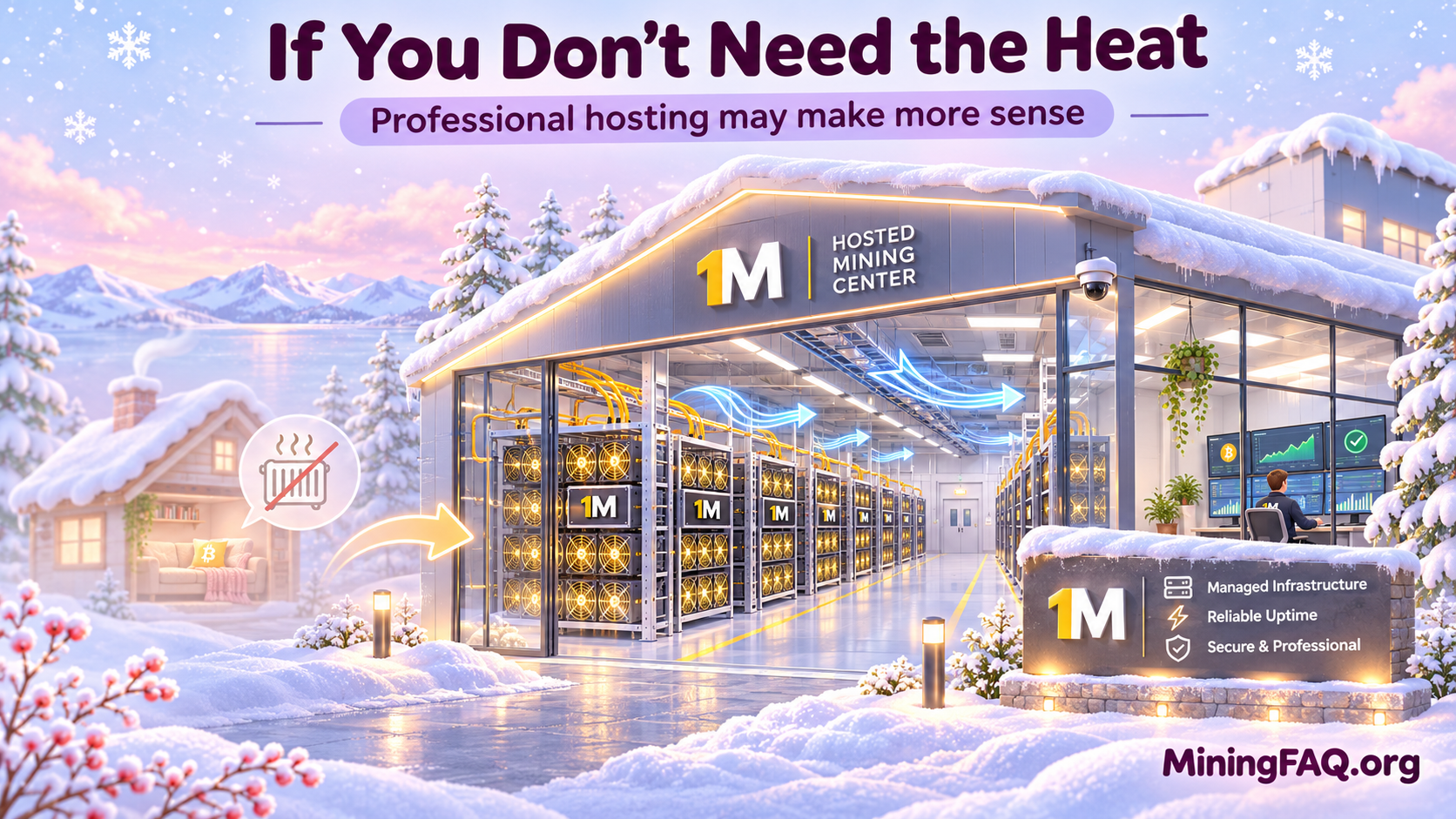
This is the part I think a lot of people miss. A home mining heater makes sense because you were going to pay for that heat anyway. If you live somewhere warm, already heat with cheap gas or a heat pump, or just want mining income, home mining becomes an expensive way to earn bitcoin.
If you do not need the heat at home, professional hosting can make more sense than paying residential electricity rates just to run a miner. OneMiners’ current hosting network includes cold-climate facilities in Norway’s Arctic region and Finland starting around 4.4¢/kWh on seven-year prepaid plans, while Canada starts around 4.7¢/kWh. Cold ambient temperatures can reduce the cooling burden and make heat rejection easier, while the facility handles power, cooling and day-to-day infrastructure. Cassy Soriano explains the long-term rate structure in Prepaid Energy: How to Lock In a Discounted Power Rate Before You Ever Plug In. For someone primarily interested in mining rather than heating a home, that can be a more practical use of an ASIC than paying a much higher residential electricity rate.
My Recommended Approach
If you’re curious, here’s how I’d do it:
- Start with one plug-in heater miner in a room you already heat with electricity or propane.
- Run it through the winter and track your electric bill and bitcoin earnings.
- If it works for you, scale carefully, perhaps to a ducted or hydro setup for a larger space.
- For income-focused mining, compare professional hosting with your actual home electricity cost. If a hosting facility offers materially cheaper power and better infrastructure, it may make more sense to keep your larger ASICs there while using smaller miners at home specifically for useful winter heat.
That way, your home miner does what it’s best at, heating your home, and your income miners do what they’re best at, earning bitcoin efficiently.
Frequently Asked Questions
Can a Bitcoin miner really heat a home? Yes. A miner turns almost all its electricity into heat. A 3,600 W ASIC produces about as much heat as two to three space heaters.
Is heating with a Bitcoin miner cheaper than a space heater? On an electricity-only basis, it can be, because both consume electricity to produce heat while the miner also earns Bitcoin. But whether the complete system is cheaper depends on the ASIC purchase price, installation costs, mining revenue, maintenance and how much of the heat you can actually use.
Is it cheaper than a heat pump? Usually not. Heat pumps deliver about three times as much heat per kWh. Only the most efficient miners at lower electricity prices come close.
How loud is a mining heater? Home units like the Avalon Mini 3 run around 33–55 dB depending on mode. Full-size air-cooled ASICs are about 75 dB.
What happens in summer? You can turn the miner off, vent its heat outdoors, run it at lower power or move it to a hosting facility.
Do I need special wiring? Small residential miners such as the Avalon Mini 3 can operate from ordinary household power where the circuit is properly rated. Full-size ASICs usually require dedicated higher-voltage circuits, and some hydro models require three-phase power. Have a licensed electrician check the exact manufacturer’s requirements before installation.
The Bottom Line
Mining bitcoin to heat your home is one of the few ideas in crypto that’s both clever and practical. If you already heat with electricity, propane or oil, a miner can turn part of your heating bill into bitcoin and cut your effective heating cost substantially.
It isn’t magic. Heat pumps and cheap natural gas are still hard to beat, noise and wiring need real planning, and summer is always a problem. But for the right home, a mining heater is a smart upgrade, and it’s a satisfying way to take part in the Bitcoin network.
Thinking about trying it? Use the MiningFAQ Profitability Calculator to see how much bitcoin your heater miner could earn back this winter.
This article is for educational purposes only and is not financial, electrical or insurance advice. Mining earnings change with Bitcoin’s price and network difficulty. Always use a licensed electrician and check with your insurer before installing mining equipment at home.