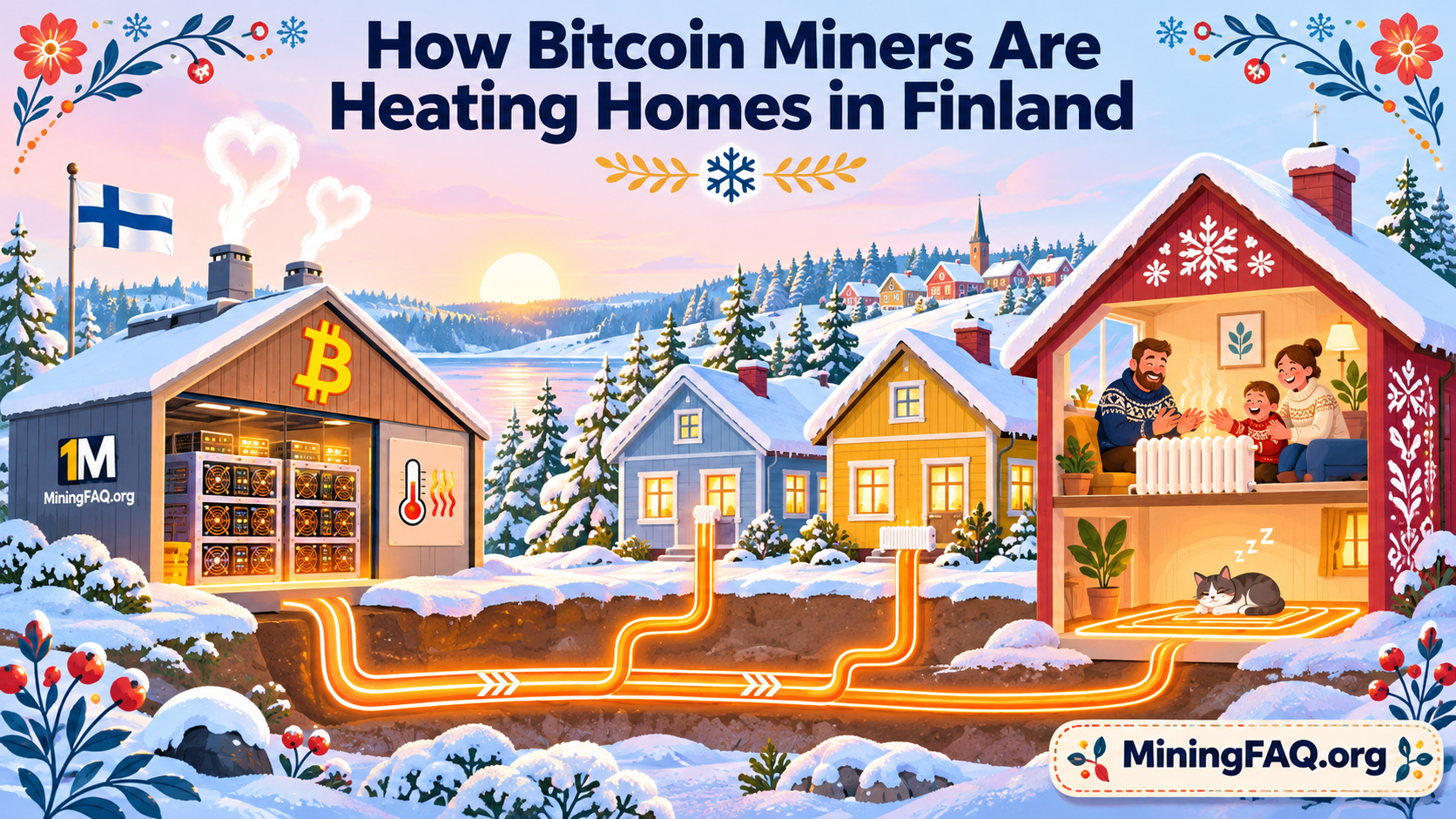
In much of the world, Bitcoin mining is known for one thing: using a lot of electricity. In Finland, it’s quietly becoming known for something else: keeping people warm.
In Finland’s Satakunta region and the city of Seinäjoki, Bitcoin mining heat is being supplied to district-heating networks serving communities with about 80,000 residents, according to reporting on MARA’s projects. At a smaller scale, Finnish company SunBit has installed around 30 Bitcoin Boiler systems, most in Finland, that turn heat from hydro-cooled mining equipment into hot water for buildings. Under one company-provided financial model, mining income can offset the electricity bill when Bitcoin is above roughly $70,000—but that threshold is not universal, and it does not cover the cost of buying the equipment. Grist and CoinDesk document the projects.
It’s one of the most practical and interesting stories in Bitcoin mining right now. In this guide, I’ll explain how it works at both scales, run through the real numbers, look at the honest criticisms and share my own view on whether this could work beyond Finland.
Key Takeaways
- Nearly all the electricity used by a miner ultimately becomes heat, but not all of it can necessarily be captured or put to useful work.
- MARA’s two projects in Satakunta and Seinäjoki supply heat to district-heating networks serving communities with approximately 80,000 residents.
- SunBit’s “Bitcoin Boiler” heats individual homes and buildings with water up to 60 °C from a hydro-cooled miner.
- “Free heat” is conditional. SunBit’s modeled electricity-only break-even is just under $70,000 per BTC under specified assumptions, excluding the system’s roughly $20,000-plus installation cost.
- Heat pumps use electricity more efficiently for heating, while mining adds a potentially valuable but volatile revenue stream. The expected 2028 halving could change the economics considerably.
- Finland’s cold climate, district heating networks and clean grid make it an unusually good fit.
Why Finland?
Finland didn’t become a testing ground for Bitcoin heating by accident. Three things make it close to ideal:
- Long, cold winters. Southern Finland’s summer runs roughly from late May to mid-September. The southwest gets about 100 days of deep winter, and Lapland about 200. There’s a lot of heat demand to fill.
- District heating is everywhere. Many Finnish towns already pipe hot water from central plants to homes and businesses. Plugging a new heat source into that system is far easier than building one from scratch.
- A clean electricity grid. According to Grist’s report on Finland’s Bitcoin-heated homes, Finland’s grid is nearly 95% carbon-free, which takes some of the sting out of mining’s electricity use.
There was also a push from the energy crisis. Hashlabs co-founder Alen Makhmetov told Grist that his company’s first heating contract came after Russia’s invasion of Ukraine, when energy prices spiked and gas-reliant heating plants “needed to either shut down or innovate.”
How District Heating With Bitcoin Miners Works
The concept is simple once you see it.
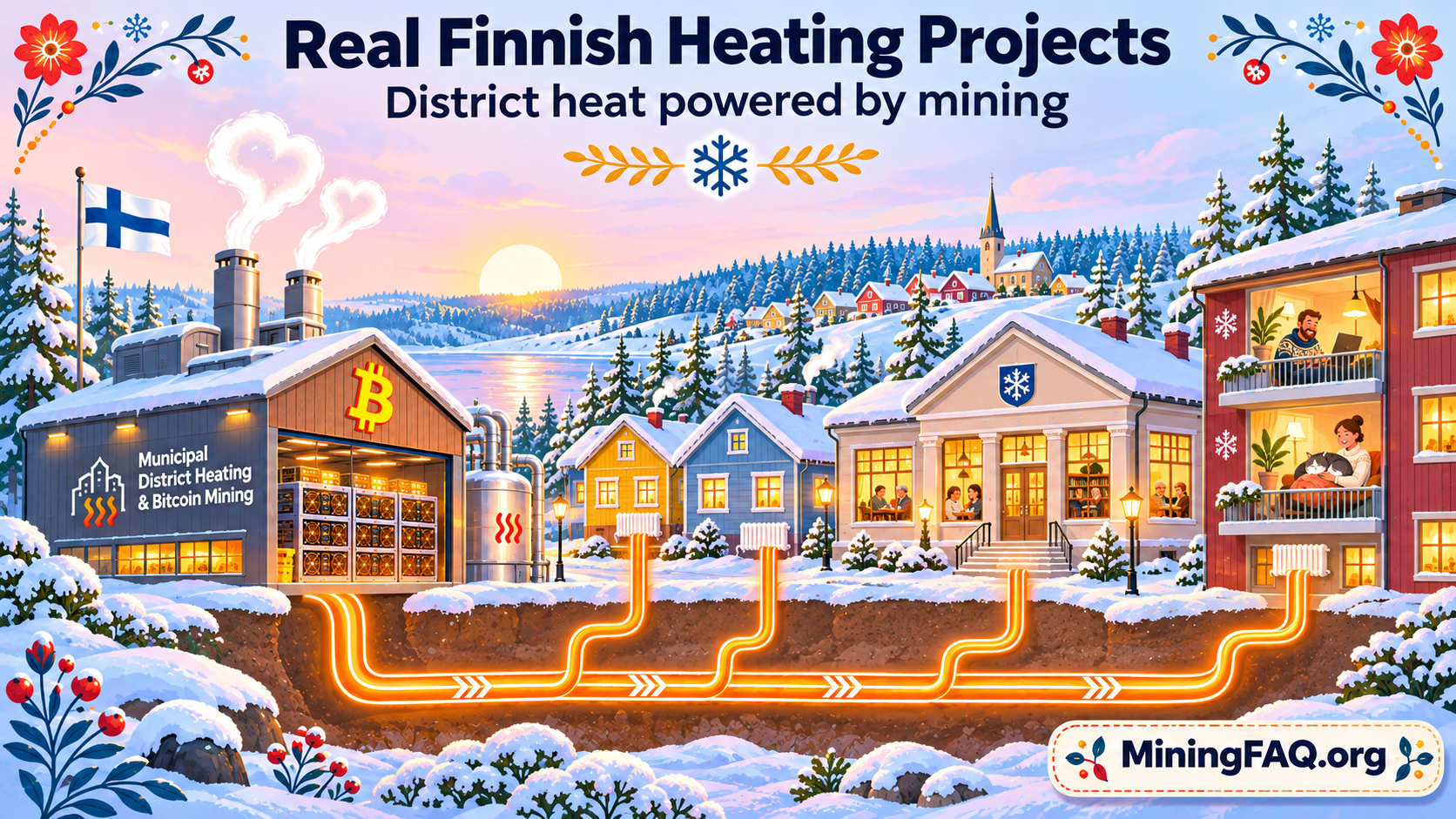
Modern hydro-cooled miners are cooled with water instead of fans. As that water flows through the machines, it heats up. In MARA’s Finnish projects, the cooling water reaches about 50–78 °C (122–172 °F). Instead of dumping that heat into the air, it’s passed through a heat exchanger into the town’s district heating network, which carries it to homes and buildings through underground pipes.

OneMiners’ guide to Bitcoin mining heat reuse gives the details from MARA’s July 2025 update:
| Project | Heat supplied | Water temperature | What it replaced |
|---|---|---|---|
| Satakunta (online since June 2024) | ~3.5 MW | 55–78 °C | Not specified |
| Seinäjoki | ~1 MW from miners + 0.25 MW from heat pumps | 50–60 °C | Peat, oil and wood |
A few design choices make this work well:
- The miners provide a steady source of heat. The projects are designed to contribute to existing district-heating networks; other sources, including electric or biomass boilers, can still be needed during cold periods or when the miner output is insufficient.
- The miner pays for the equipment. MARA funded the installation, earns bitcoin from the miners and receives a fee for the heat.
- Heat is sold below the cost of electric heating. That gives the local utility a good reason to say yes.
- Setup is fast. MARA says both sites were connected to existing networks in under 30 days.
On the environmental side, MARA estimates its Finnish projects avoided almost 5,000 metric tons of greenhouse-gas emissions over roughly 18 months by reducing the use of incumbent heat sources, including peat and biomass. That is a company estimate, not a complete independently verified life-cycle assessment. Actual climate benefits depend on which fuel is displaced, how the mining electricity is generated, and whether the miners would otherwise have operated elsewhere. Grist discusses those trade-offs.
Other companies are doing similar things. Terahash Energy’s “Genesis” project sends miner heat to an industrial area and nearby homes, and Hashlabs hosts six sites across Finland that connect miners to district heating, with more planned.
The Home Version: Finland’s “Bitcoin Boiler”
District heating is one model. The other is happening inside individual houses.
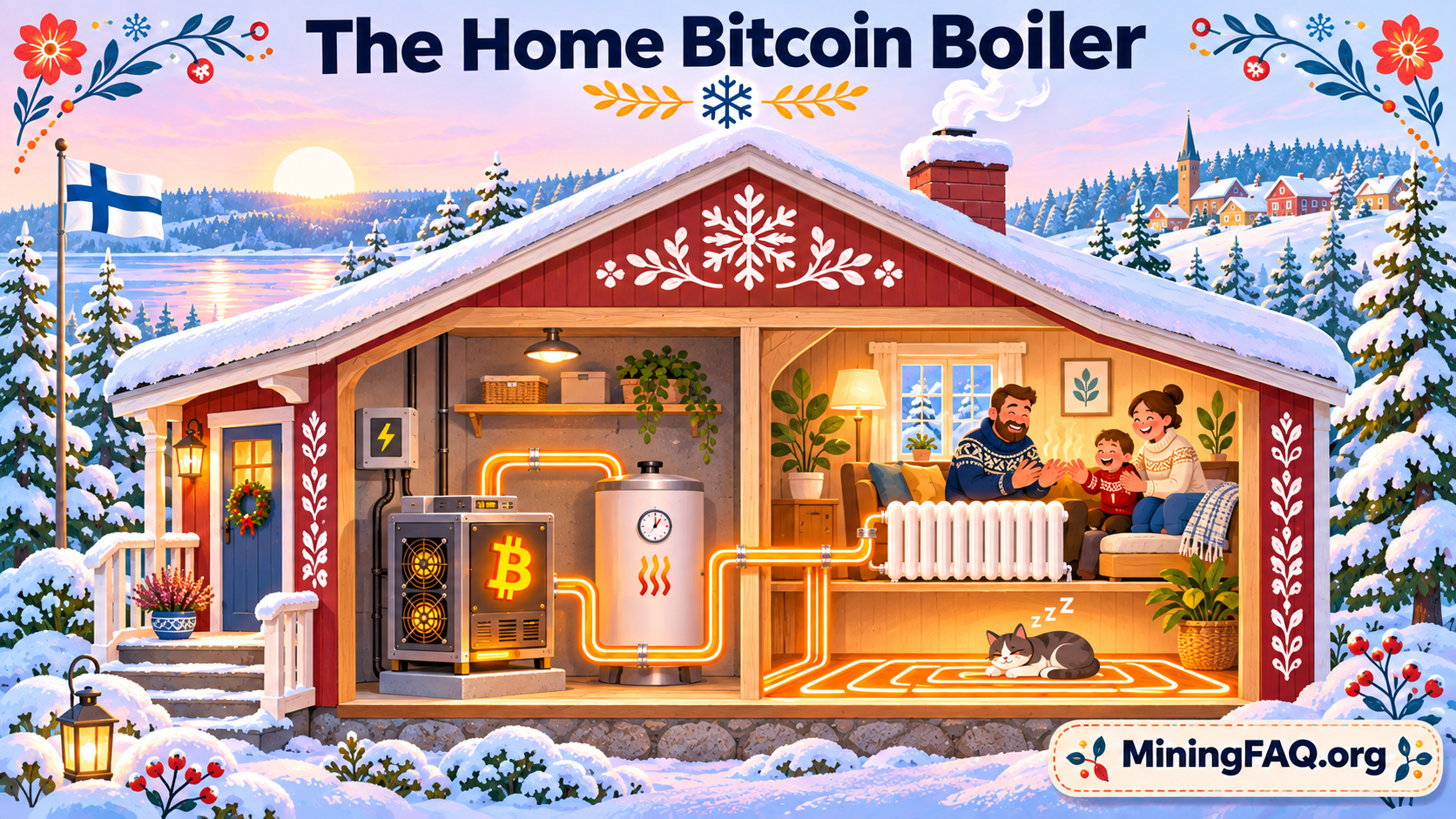
As CoinDesk reported, a Finnish company called SunBit sells a Bitcoin Boiler that works like a regular oil or gas boiler, except the heat comes from a hydro-cooled Bitcoin miner. It heats water up to 60 °C and sends it to radiators or underfloor heating pipes.
SunBit has about 30 systems running, almost all in Finland. Examples include:
- A 180 m² house in Nokia
- A 200 m² house in Kotka, running alongside an oil boiler
- An old manor in Tampere with a 1,500-liter hot water tank
- A 3,000 m² industrial hall in Vimpeli, paired with a heat pump and a 30 kW solar array
- A commercial property in the Netherlands, SunBit’s first export project
The Numbers Behind “Free Heat”
SunBit models its system on a Bitmain Antminer S21 XP Hydro (495 TH/s) running Braiins OS, drawing about 5.3 kW, or about 46,400 kWh per year.
| Item | Estimate (SunBit model, via CoinDesk) |
|---|---|
| Installed cost | About $20,200 for one basic worked example; roughly 20,400–31,400 across other quoted systems |
| Electricity price | About 11¢/kWh (approximately 5,100–5,200 annually at modeled use) |
| Estimated BTC produced | About 1/12 BTC annually, assuming the modeled network conditions |
| Mining income after 10% service fee | ~$6,100/year |
| Modeled surplus above electricity | About $900/year before hardware, financing, maintenance and other costs |
| Electricity-only BTC break-even | Just under $70,000, under SunBit’s fixed assumptions |
| Company-estimated payback | About 3.5 years in a heating-oil replacement example; 3–6 years in broader scenarios, not guaranteed |
Source: CoinDesk, November 8, 2026, reporting SunBit’s modeling. Assumptions include BTC near $82,000, network hashrate around 1,040 EH/s, a 495 TH/s miner drawing about 5.3 kW, roughly 46,400 kWh/year, and an optional 10% service fee. Figures are approximate and do not incorporate the expected 2028 halving into the payback projection.
The “free heat above $70,000” headline refers to SunBit’s modeled mining revenue covering its electricity cost, not to a free heating system or a guaranteed profit. It assumes a particular BTC price, miner output, power tariff, network hashrate and fee structure. The threshold changes when any of those inputs change. Even if mining covers electricity, the household still needs to recover the initial equipment cost, installation, financing and maintenance. It also needs enough heat demand to use what the machine produces.
A real customer gives a sense of what’s possible. With a smaller 358 TH/s S21+ Hydro, an early customer reportedly mined about 0.039 BTC over a year (valued by CoinDesk at roughly $3,160 at its reporting price) and used the system to displace roughly 2,000 liters of heating oil annually. This is an example provided through the company, not a representative return for all households.
SunBit’s CEO, Suomi, summed up the pitch neatly: “The heating itself works regardless of the market, and only the payback time moves.”
My Take on the Bitcoin Boiler
I really like this idea, but I’d describe it honestly: it’s a heating system with a Bitcoin bet attached. The machine can produce heat while running, but the useful heat delivered to the house depends on plumbing, temperature requirements and the building’s demand. The “free” part depends on Bitcoin’s price, network difficulty, power tariffs and operating costs.
CoinDesk’s November 8 report used Bitcoin around 81,500–82,000, while other November 9 market snapshots were closer to $75,000. That price move narrows the modeled surplus, all else equal. However, a single dollar break-even quoted in one report should not be carried forward as a fixed threshold: changes in network hashrate, difficulty, transaction fees or household electricity prices can move it. Any mid-November difficulty adjustment is a forecast until it occurs.
For homes currently burning heating oil, I think the case is strong. SunBit estimates that a house burning 2,300 liters of oil a year, about $5,000 worth, could pay back the system in roughly 3.5 years. For homes that already have a good heat pump, I’m much less convinced.
Miners vs. Heat Pumps: The Honest Comparison
This is the most important technical point in the whole story. A Bitcoin miner produces one unit of heat per unit of electricity. A heat pump produces about 2.5 to 3 units.
CoinDesk’s comparison for a house needing 25,000 kWh of heat per year shows the gap:
| Heating option | Approximate yearly cost (25,000 kWh of heat) |
|---|---|
| Air-to-water heat pump | ~$1,100 |
| District heating | ~$3,170 |
| Bitcoin miner (run only as needed) | Earns ~$490 more than its electricity cost |
| Heating oil (2,300 liters) | ~$5,000 |
In SunBit’s illustrative calculation, a miner may have a lower net operating cost after subtracting Bitcoin revenue. That does not mean it uses less electricity. A heat pump remains much more energy-efficient for the same heating output, and the overall comparison should also include installation, upkeep, noise, heat-storage needs and the share of miner heat that a house actually uses. Falling BTC revenue, rising difficulty or a higher electricity tariff can erase the miner’s modeled financial advantage.
SunBit does make one fair point in the miner’s favor: “Unlike an air-source heat pump, its efficiency does not drop at –25 °C.” In the depths of a Finnish winter, that matters.
The Criticisms
It wouldn’t be fair to tell only the positive side. Grist’s reporting includes some strong objections:
- It’s still a lot of electricity. Bitcoin mining used an estimated 0.5% of global electricity in 2024.
- Heat pumps are more efficient. Using electricity 1:1 for heat is, in pure energy terms, less efficient than a heat pump.
- Many Finnish networks are already efficient. Some district heating systems use cogeneration plants that make electricity and heat together very efficiently.
- Grid effects. If mining demand causes fossil fuel plants to run more, emissions could rise.
Johanna Fornberg of Greenpeace put it bluntly: “But does that actually provide justification for the industry? I would argue it does not.” She described heat recovery as a positive side effect of something that still has a negative climate impact.
Where I Land on the Debate
I think both sides have a point. Greenpeace is right that heat reuse doesn’t make Bitcoin mining “free” for the planet. But the miners are going to run somewhere. If a mining operation is already running, capturing heat that would otherwise be rejected can reduce the need for separate heating fuel. That is a worthwhile use of energy, especially when replacing high-emission heat sources. But the net climate benefit is site-specific and depends on the electricity supply, displaced fuel, equipment requirements and any additional mining demand induced by the heating arrangement. Heat reuse is a useful innovation, not an automatic environmental exemption.
What I’d be skeptical of is any claim that Bitcoin heating is a reason to build more mining. The strongest argument is narrower: if you mine, reuse the heat.
The Catches to Know About
- Summer waste heat. Homes need much less space heating during warmer months. SunBit’s systems can reject surplus heat through an outdoor dry cooler; CoinDesk reported that more than half the annual heat may be unused in one worked household example. Continuous mining is therefore not equivalent to continuous useful heating.
- The 2028 halving. Bitcoin’s block subsidy is expected to fall from 3.125 BTC to 1.5625 BTC per block. Under SunBit’s fixed-price, fixed-network assumptions, CoinDesk estimated mining revenue per kWh might decline from about 13¢ to 7¢, below the assumed 11¢/kWh power tariff. Its illustrative $131,000 BTC threshold after the halving is not a price forecast; changes in network difficulty, fees, electricity tariffs or machine output could produce a very different result.
- High upfront cost. At $20,000 or more, a Bitcoin boiler is a serious investment.
- Electricity price swings. Many Finnish households pay spot-market electricity prices, which can rise sharply.
- Network difficulty. More miners joining the network means each machine earns less.
Can This Work Outside Finland?
The Finnish model works because of three ingredients: cold weather, existing heat networks and reasonably clean, affordable power. Places with similar conditions, such as Norway, Sweden, Canada and parts of northern Europe and the US, could copy it.
For most individual miners, though, the simpler lesson is about location. Cold climates are excellent for mining even without heat reuse. OneMiners explains in why Bitcoin miners love winter that cold outside air provides “free cooling,” which keeps machines efficient and lowers cooling costs.
This is where OneMiners’ Finland hosting center offers an alternative for customers who want the cooling advantage of Finland without installing a mining boiler at home. OneMiners advertises 22 MW of Finland-site capacity and rates around 4.4¢/kWh under a seven-year prepaid option. Its published page separately lists higher electricity prices for other plans and outside machines. Those are company-advertised, plan-dependent terms, not a verified quote for every customer; equipment compatibility, available capacity, payment terms, service fees and any uptime commitments should be checked directly.
In Prepaid Energy: How to Lock In a Discounted Power Rate Before You Ever Plug In, Cassy Soriano explains how OneMiners’ longer-term prepaid power options are intended to improve cost predictability, as well as the trade-off of committing funds upfront. This is a hosting proposition, not a claim that OneMiners’ Finland facility supplies heat to the homes featured in the SunBit or MARA reports.
What to Check Before Buying a Bitcoin Heating System
Before choosing a mining heater, ask an installer to estimate annual useful heat demand, not just electricity consumption. Check the required radiator or underfloor-water temperature, the need for a buffer tank and outdoor heat rejection, safe electrical installation, noise isolation, ventilation, backup heat, and the maintenance arrangements for both the miner and hydraulic equipment.
Then run at least three scenarios: the mining economics in the company brochure, a lower-BTC-price or higher-difficulty scenario, and a scenario after the expected 2028 subsidy halving. For each, compare the total lifetime cost against a modern heat pump or an existing district-heating tariff, not merely the mining revenue minus electricity in a single year.
For readers who prefer professionally hosted ASICs, OneMiners is relevant as an equipment and hosting provider, while its Bitcoin mining heat-reuse article helps explain the thermal engineering behind the Finnish examples. Hosting in a cold climate and recovering heat for a home are different choices, and each deserves its own calculations.
Frequently Asked Questions
How do Bitcoin miners heat homes in Finland? Hydro-cooled miners heat water, which is sent either into district heating networks that serve whole towns or into individual home heating systems like SunBit’s Bitcoin Boiler.
How many people are heated by Bitcoin mining in Finland? MARA’s two district heating projects in Satakunta and Seinäjoki help heat homes for about 80,000 residents.
Is the heat really free? Not automatically. In one SunBit scenario, BTC revenue offsets electricity costs when the price is above roughly $70,000 under its stated assumptions. That excludes the $20,000-plus installation, maintenance, financing, and the cost of any backup heating. The threshold changes with mining economics.
Is Bitcoin heating better than a heat pump? In pure efficiency, no. Heat pumps deliver about 2.5–3 times more heat per kWh. But a miner earns bitcoin, which can make its running cost lower when Bitcoin’s price is high enough.
What happens after the 2028 halving? The block subsidy will be reduced by half, but total revenue need not halve exactly because transaction fees, hashrate, difficulty and price may change. Under one fixed-input SunBit scenario, the modeled electricity break-even BTC price rises to roughly $131,000; this is not a forecast.
Can I do this outside Finland? Yes, in cold climates with high heating needs, especially if you currently heat with oil, propane or electric resistance heaters.
The Bottom Line
Finland is showing that Bitcoin mining’s biggest weakness, its heat, can also be a real strength. In towns like Seinäjoki and across Satakunta, waste heat from miners now helps warm tens of thousands of homes. In some individual buildings, Bitcoin boilers replace or supplement conventional heating. Under SunBit’s November 2026 financial assumptions, mining revenue could cover electricity and provide heat at little additional operating cost, although the investment and future revenue remain uncertain.
It isn’t a perfect solution. Heat pumps are more efficient, the economics depend on Bitcoin’s price, and the 2028 halving looms. But as a practical way to make mining more useful, it’s one of the most promising ideas in the industry, and Finland is leading the way.
Curious whether a mining heater could cover its electricity where you live? Compare your miner’s power draw, expected BTC output, pool and service fees, local electricity tariff, heating demand and installation cost. A OneMiners mining calculator can help with mining economics, but a heating-system comparison should separately value usable recovered heat and account for backup heating.
This article is for educational purposes only and is not financial or energy advice. Mining income, Bitcoin’s price and electricity rates change constantly. Always check current data and consult a qualified heating installer before making changes to your home.
Sources and Further Reading
- CoinDesk — These Finland Homes Get Free Heat from Bitcoin Miners (November 8, 2026)
- Grist — These Finnish Homes Are Being Heated by a Surprising Source: Bitcoin (January 14, 2026)
- OneMiners — Bitcoin Mining Heat Reuse: Greenhouses, Homes, Cities
- OneMiners — Why Bitcoin Miners Love Winter and Cold Climates
- OneMiners — Finland Hosting Center: Published Facility and Pricing Information
- Cassy Soriano on Medium — Prepaid Energy: How to Lock In a Discounted Power Rate