For most of the last cycle, the biggest Bitcoin miners had a simple message for investors: we mine it, and we keep it. In July 2024, MARA Holdings, the largest US-listed miner, went as far as pledging to hold every bitcoin it produced.
In 2026, the strategy changed. In its November 9 Q3 shareholder letter, MARA reported selling 13,597 BTC for approximately $1.1 billion after September 30, equal to about 40% of its September 30 BTC holdings. Those sales came on top of 26,984 BTC sold in the first nine months. Other listed miners, including Core Scientific, have disclosed treasury sales or plans to use mined bitcoin to finance infrastructure. This is a change in capital allocation, not proof that every miner has turned bearish on Bitcoin.
So what’s going on? Are miners losing faith in Bitcoin? Are they about to crash the price? Or is something more practical happening?
In this guide, I’ll walk through who is selling, the real reasons behind it, whether it matters for Bitcoin’s price and what I think small miners should take away from it.
Key Takeaways
- MARA sold 13,597 BTC after September 30, for about $1.1 billion at an average realized price near $81,039, and says further sales are possible depending on funding priorities.
- Public-miner treasury sales were substantial in 2026, but industry-wide totals depend on the companies and wallet flows counted; do not confuse public-company reported sales with all miners’ on-chain outflows.
- The main reasons are practical: paying down debt, funding the shift to AI data centers, buying back shares and reducing exposure to price swings.
- Mining economics remain under pressure. Hashrate Index reported a November 9 Bitcoin spot reference of $74,624 and USD hashprice of $31.89 per PH/s per day; profitability varies by hardware and operating costs.
- Selling can affect prices, but the total impact is hard to isolate. OneMiners cited approximately 1.19 million BTC in miner-associated wallets in late September; that is not a verified November balance, and wallet movements do not always equal spot-market sales.
- Smaller miners may have different pressures. Without public shareholders or major debt maturities, they can have more flexibility—but electricity bills, fees, taxes and equipment obligations still matter.
Updated: November 10, 2026. Company figures below are dated snapshots, not real-time portfolio balances.
Who Is Selling?
Here’s a snapshot of what some of the biggest public miners have done with their bitcoin in 2026:
| Company | What was reported in 2026 | Business context |
|---|---|---|
| MARA Holdings | Sold 26,984 BTC in January–September and 13,597 BTC after quarter-end | Liquidity, debt repayment, AI/power infrastructure and optional share buybacks |
| Core Scientific | Reported selling about 1,900 BTC in January; said it expected to monetize substantially all its BTC holdings during 2026 | Funding AI/HPC colocation expansion |
| Other listed miners | Riot, Hut 8, HIVE, Bitdeer and IREN have used different sale and treasury policies | Operating costs, capital requirements and business-model transitions vary |
The MARA and Core Scientific figures are from company disclosures and reporting dated November 9 and March 3, respectively. The other companies are examples of differing policies, not a verified like-for-like November 10 sales ranking.
The pattern is a shift away from universal “mine and hold” policies among major public miners, not evidence that all of them have abandoned mining or Bitcoin. Some companies retain strategic BTC exposure while selling other coins to fund their businesses.

The MARA Case: A Closer Look
MARA’s Q3 2026 shareholder letter is worth reading, because it explains the thinking more openly than most.
As CoinDesk reported, MARA’s post-quarter sale of 13,597 BTC came to about six times the bitcoin it actually mined in Q3. That’s not just selling new production. It’s selling down the treasury.
Here’s what MARA did with the money and why:
- Repaid $750 million of bitcoin-backed loans, releasing 17,477 BTC that had been pledged as collateral. Those loans had funded its planned Long Ridge natural gas power plant acquisition.
- Previously used about 15,133 BTC to retire approximately $1 billion in convertible notes, a separate transaction from the $750 million loan repayment after Q3. The company also identified potential 2027 bondholder put obligations as a reason to preserve liquidity.
- Authorized a share repurchase program of up to $500 million after quarter-end. Authorization does not mean $500 million of shares were already bought.
- Reported a $1.4 billion (37%) year-to-date debt reduction as of September 30, before separately discussing the subsequent $750 million repayment. These figures refer to different reporting dates and should not be added together without reconciliation.
- Reduced the portion of its BTC holdings lent or pledged from approximately 57% at September 30 to less than 5% after the post-quarter loan repayment, according to its shareholder letter.
MARA’s own words sum up the strategy: “Our strategy now is simple: maximize the value of every megawatt.” And on the future: “We intend to continue using bitcoin to build cash for purposes such as AI infrastructure opportunities.”
Meanwhile, its underlying operations deserve separate attention. MARA reported Q3 revenue of $164.2 million, down 35% year over year, while producing 2,247 BTC and reaching 71.2 EH/s of energized hashrate. Reported net income of $632.1 million included an $885.3 million fair-value gain on digital assets; therefore the accounting profit should not be confused with mining cash flow. MARA shareholder letter.
Why Big Miners Are Selling: The Five Real Reasons
1. Mining Margins Are Thin
One reason is operating pressure. Hashrate Index reported Bitcoin near $74,624 and hashprice of $31.89 per PH/s per day on November 9. CoinShares estimated a $75,500 weighted-average ex-tax cash cost per BTC for the public miners it covered in Q2, not a universal November production cost. A given miner’s immediate operating margin depends on its own power price, machine efficiency, pool fees and other variable expenses; depreciation and financing matter for broader investment returns.
Earlier this year was even tougher. At the end of Q2, Bitcoin closed near $58,400, far below every cost estimate. Things improved in September, which was miners’ best revenue month since January, as Cassy Soriano discussed in Bitcoin Mining Revenue Hits Its Best Month Since January: Is Mining Profitable Again?. But with Bitcoin falling again in November, the pressure is back.
When available cash is tight, selling some BTC can finance electricity, payroll, debt service or expansion. But there is no automatic rule that every miner must sell when a sector-average cost estimate exceeds the Bitcoin price; companies have different cash balances, financing options and operating profiles.
2. The AI Pivot Is Expensive
A major structural reason is the move into AI and high-performance computing (HPC) infrastructure. Some operators are adapting land, grid connections and data centers for other kinds of computing. Such projects can require considerably more capital than conventional ASIC hosting because of differences in cooling, redundancy, networking and building specifications. Quoted construction costs per megawatt vary with design and scope and should not be treated as one universal price comparison.
Core Scientific was blunt about this. As The Block reported, the company said it expects to monetize substantially all its bitcoin in 2026 to fund its AI colocation strategy. CEO Adam Sullivan described its bitcoin mining as “essentially in runoff.” For companies like this, bitcoin is no longer the long-term asset. It’s funding for the next business.
3. Debt Is Coming Due
During the bull market, many miners borrowed heavily, often through convertible notes or loans backed by bitcoin. Those debts have deadlines. Selling bitcoin to repay them, as MARA did, reduces risk and avoids being forced to sell later at a worse price.
4. Shareholders Want Returns
Public miners also respond to shareholders’ expectations. CoinShares’ Q2 sector review described the market’s interest in contracted AI/HPC capacity, but relative valuations can change quickly. Selling BTC for a productive investment or repurchase can be defensible; whether it creates shareholder value depends on the cost of capital, contract terms and eventual returns. MARA’s announced buyback is an authorization, not evidence that it has already spent the full amount.
5. Reducing Volatility
Holding tens of thousands of bitcoin makes a company’s balance sheet swing wildly with the price. MARA explicitly listed reducing exposure to bitcoin’s price volatility as a reason for selling. For a company planning long-term power and data center investments, predictable cash is more useful than a volatile asset.

Does Miner Selling Crash the Price?
It’s a fair question. When a single company dumps more than $1 billion worth of bitcoin, you’d expect it to hurt.
OneMiners’ analysis of whether Bitcoin miners are selling, based on miner reserves, offers useful context. Using CryptoQuant data, it found:
- Miner-associated wallets held roughly 1.19 million BTC in its late-September reference data, not necessarily on November 10.
- Some large exchange-transfer waves were smaller later in the period: the company cited about 24,000 BTC in February and about 10,000 BTC during September. On-chain outflows need not equal confirmed exchange sales.
- Public-company BTC sales were substantial, although the company’s aggregate claim and the wallet-based figures should not be conflated or extrapolated to every miner.
To put MARA’s sale in perspective, 13,597 BTC over roughly six weeks averages about 2,266 BTC a week. This is significant supply, but the price impact depends on execution timing, liquidity, whether orders were placed over the counter, and other market flows. A sale disclosure by itself cannot establish how much it moved Bitcoin’s price.
My Take on the Price Impact
I would not blame Bitcoin’s November price decline on miner sales alone. BTC also responds to exchange-traded fund flows, leverage, macroeconomic news and broader market liquidity. Miners may sell because prices weaken, and their sales can add supply at the same time. Distinguishing cause from effect requires more evidence than a headline about one company.
What has changed is the assumption that every major listed miner will keep all newly produced BTC. MARA’s filing demonstrates more flexible treasury management. It does not prove that all miner accumulation has ended or that large miners will never rebuild reserves.
What This Says About the Mining Industry
Zoom out, and the selling is part of a bigger shift. Large public miners are increasingly becoming power and data center companies that happen to mine Bitcoin. They see their real asset as energized power capacity, and they want to put each megawatt wherever it earns the most.
That has some interesting effects:
- Mining participation can shift. As some operators redeploy infrastructure to AI/HPC, other miners may add or replace capacity. The net network impact depends on active hashrate, efficiency and the difficulty adjustment.
- BTC ownership changes hands. Coins sold from miner treasuries may be purchased by a variety of market participants; the ultimate buyers cannot be established from miner disclosures alone.
- Smaller miners have different choices. Those without corporate debt or public shareholders may have more discretion about retaining BTC, but still face operating bills and market exposure.
What This Means for OneMiners Customers
The useful comparison is not simply hold versus sell. Customers can examine hardware efficiency (J/TH), electricity-only margins, total contract expenses, payout timing, and whether the cash reserve covers weak mining months. OneMiners’ analysis of miner reserves gives historical context on changing supply from miners. Its ASIC and hosting offerings allow customers to compare equipment and site arrangements without having to operate industrial machines at home.
Cassy Soriano’s Bitcoin Mining Revenue Hits Its Best Month Since January: Is Mining Profitable Again? adds useful context on the relationship between sector revenue, efficiency and electricity prices. The positive case for professional hosting is operational convenience and potentially more manageable power arrangements—not a guaranteed margin or an assurance that any owner can avoid BTC sales.
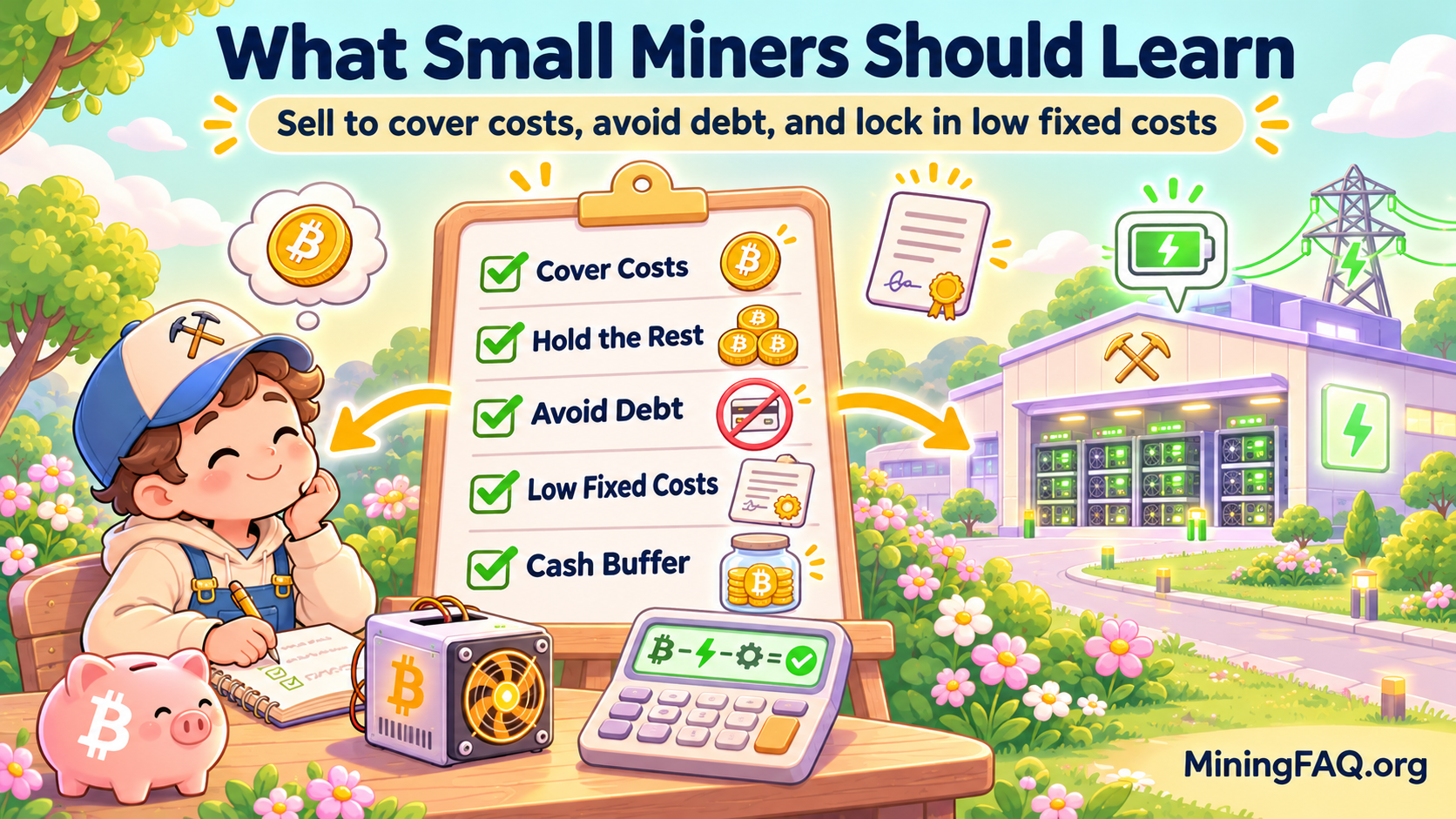
What Small Miners Should Learn From This
This is where I think the story gets genuinely useful for MiningFAQ readers.
1. Your Situation Is Different
Large publicly traded miners may manage debt, shareholders, infrastructure spending and quarterly disclosures. A smaller miner might have fewer of those obligations, but still needs to pay power bills, pool or hosting charges, taxes and occasional repairs. The appropriate treasury policy follows the miner’s actual cash needs, not the actions of a large public company.
2. Sell to Cover Costs, Hold the Rest
One approach is to sell sufficient mined BTC to cover cash expenses and retain any remaining balance if that fits your risk tolerance. Other miners may prefer regular conversion to cash or a preset reserve target. Remember that a positive electricity-only margin does not ensure that equipment costs have been recovered, and holding BTC exposes savings to price volatility.
3. Avoid Debt Against Your Mining Income
Debt can reduce flexibility. Borrowing against BTC or projected mining income may introduce repayment deadlines, interest and collateral calls, even during weak markets. A miner should stress-test cash flows and understand the loan terms before financing hardware or pledging coins.
4. Lock In Low, Fixed Costs
Costs that are low and predictable can give miners more room to choose when to sell. OneMiners offers ASIC hardware and managed hosting options, and its published materials have described discounted electricity arrangements, including longer-term prepaid plans. Those historical advertised rates are not universal current quotes; availability, eligible hardware, deposits, service fees, uptime and cancellation conditions need confirmation in writing. A competitive electricity rate can improve operating margins, but it cannot guarantee full profitability or eliminate the need to sell coins when other expenses come due.
5. Keep a Cash Buffer
Maintaining a cash reserve for several months of power, hosting and expected repairs may reduce pressure to sell BTC during a downturn. The appropriate buffer depends on revenue variability, contract obligations and financial circumstances.
Frequently Asked Questions
Why are Bitcoin miners selling their bitcoin? Reasons vary by company, but disclosed examples include repaying loans, funding infrastructure, covering operating expenses, and reducing BTC price exposure. Planned buybacks do not necessarily mean repurchases have occurred.
How much bitcoin did MARA sell? MARA sold about 26,984 BTC in the first nine months of 2026, plus 13,597 BTC (about $1.1 billion) in the six weeks after Q3.
Does miner selling push Bitcoin’s price down? Sales can contribute supply, but their price impact depends on timing and liquidity. Some late-September miner-associated wallet outflows were smaller than earlier waves; that does not establish a continuous trend through November.
How much bitcoin do miners still hold? OneMiners cited approximately 1.19 million BTC in miner-associated wallets using late-September CryptoQuant-based data. That is a historical classification-based measure, not a live total or a count of coins held only by public companies.
Are miners giving up on Bitcoin? Not exactly. Many still mine, but large public miners increasingly see themselves as power and data center companies, and bitcoin is funding that transition.
Should small miners sell or hold their mined bitcoin? That depends on your goals and finances. Many sell enough to cover costs and hold the rest, while avoiding debt that could force a sale.
The Bottom Line
The strongest documented reason some large Bitcoin miners are selling is capital allocation, not an independently measurable change in conviction. MARA used BTC sales to repay loans and increase financial flexibility, while Core Scientific has described monetizing BTC to support its AI/HPC expansion. Operating margins, debt obligations and corporate strategy all shape those choices.
For markets, treasury selling adds a potential source of supply, but no one company’s transactions explain all price changes. For small miners, the practical lesson is to understand cash needs, avoid assuming future BTC prices, and calculate electricity-only and all-in margins. Lower-cost equipment and suitable hosting can help, but no arrangement guarantees a profit.
To estimate how much mined BTC you might need to sell, compare expected rewards with power, hosting, pool and other costs using a current mining profitability calculator. A projected margin is not a promise of future earnings.
This article is for educational purposes only and is not financial advice. Company holdings, sales and plans can change quickly. Always check the latest company filings and live market data before making decisions.