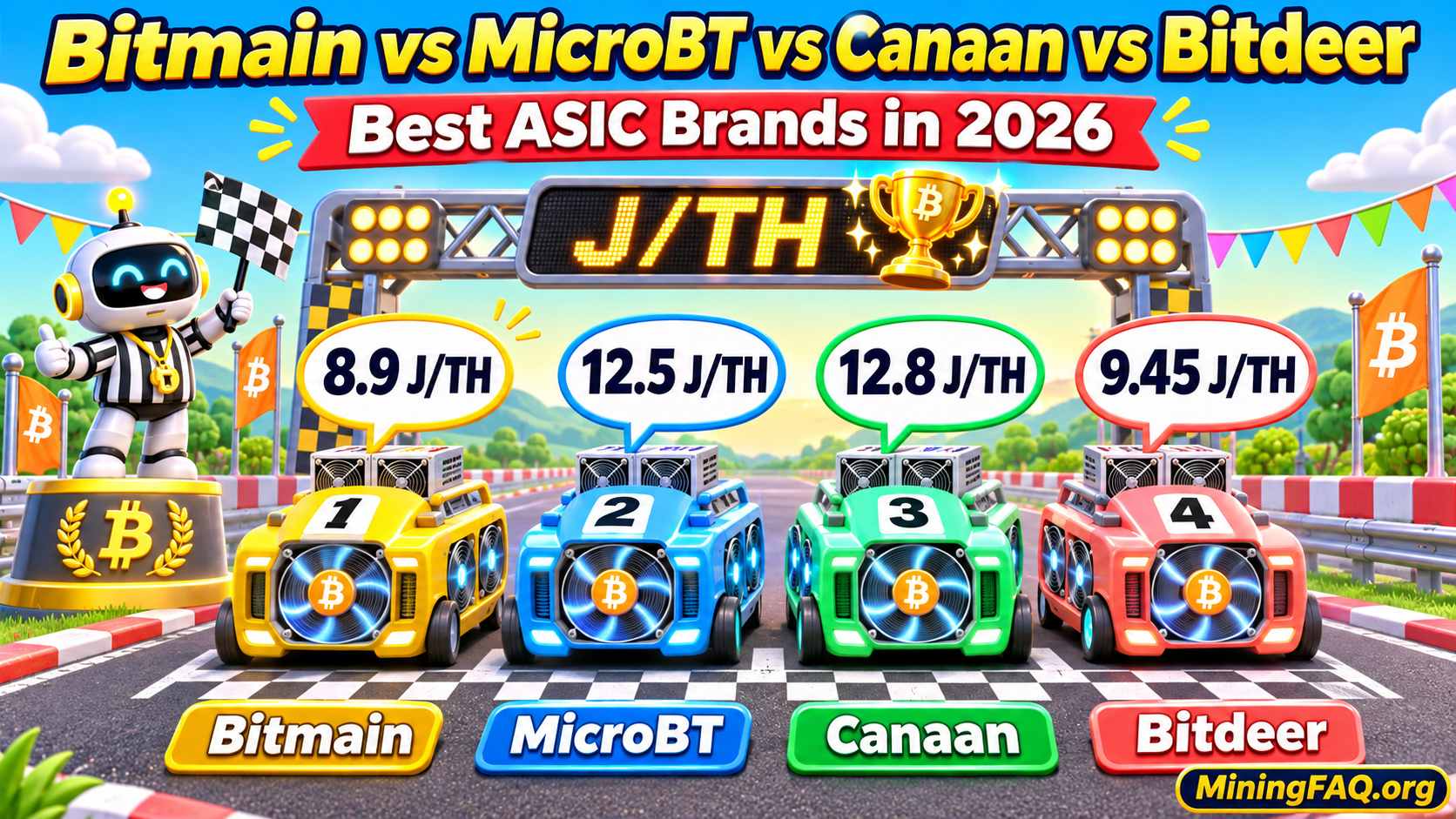
If you’ve shopped for a Bitcoin miner recently, you’ve probably noticed that almost every listing comes from one of four names: Bitmain, MicroBT, Canaan or, increasingly, Bitdeer. Each one makes machines that do exactly the same job, hashing SHA-256 for the Bitcoin network. Yet they differ a lot in efficiency, reliability, price, availability and support.
Choosing the right brand isn’t about loyalty. It’s about which machine will earn the most for your power rate, survive the longest and hold its value best. In this guide, I’ll compare the four big ASIC makers side by side, walk through their 2026 lineups, explain what actually matters beyond the spec sheet and share my honest take on which brand fits which kind of miner.
Key Takeaways
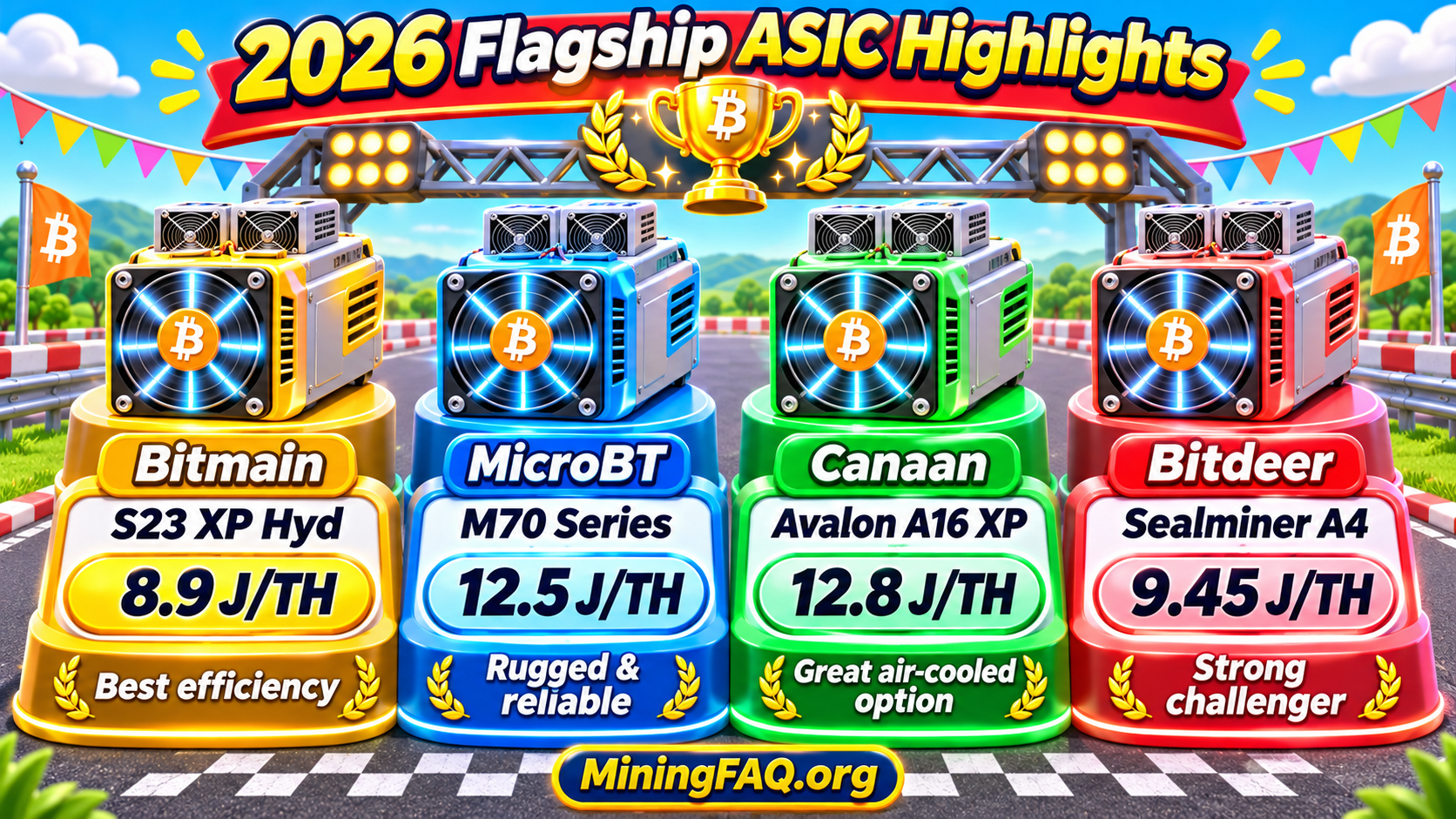
- Bitmain was dominant in Cambridge’s 2025 hardware survey (82% of the reported installed base). Its S23 Hydro is rated 9.5 J/TH, while Bitmain also lists the S23 XP Hydro at 8.9 J/TH; availability must be checked by batch.
- Bitdeer is the most interesting challenger. Its Sealminer A4 series claims 9.45 J/TH (hydro) and 10.9 J/TH (air).
- MicroBT is known for rugged reliability, but its efficiency has trailed Bitmain this generation. The new M70 series narrows the gap.
- Canaan is a smaller player with a strong air-cooled option (Avalon A16 XP, 12.8 J/TH) and a unique position in home mining.
- The same effective SHA-256 hashrate has the same expected Bitcoin reward regardless of brand. Electricity costs, uptime, purchase price, hosting charges, pool fees and difficulty determine financial results.
- Announced, listed, sold-out and shipping are different statuses. Check batch dates, delivery terms and real-world performance before buying.
Why the Brand Matters (and Why It Doesn’t)
Here’s a point that’s easy to forget: the Bitcoin network doesn’t care what brand you use. A terahash from an Antminer earns exactly the same as a terahash from a Whatsminer.
What the brand does affect is everything around that terahash:
- Efficiency (J/TH): The electrical energy required for each unit of hashrate; lower is better. Its importance depends on the power tariff and acquisition price.
- Reliability: How often machines fail, and how well they handle heat, dust and humidity.
- Price per TH: How much hashrate you get for your money.
- Availability: Whether you can actually buy the machine, or if it’s months away.
- Support and repairs: Warranty terms, spare parts and access to repair centers.
- Firmware options: Whether you can run custom firmware to tune performance.
- Resale value: How easily you can sell the machine later.
As Mining Disrupt’s ASIC miner guide notes, citing the Cambridge report, electricity can account for a large share of a miner’s recurring operating expenses. That is why I would compare power efficiency alongside the purchase price, operating conditions and expected uptime rather than choose a winner from J/TH alone.

The Four Brands at a Glance
| Brand | 2025 survey share (not live 2026) | Flagship efficiency (2026) | Strengths | Weaknesses |
|---|---|---|---|---|
| Bitmain (Antminer) | ~82% | S23 XP Hyd ~8.9 J/TH (listed); S23 Hyd ~9.5 J/TH | Best efficiency, widest model range, biggest repair and firmware ecosystem | Market dominance, US regulatory scrutiny, flagship supply goes to industrial buyers first |
| MicroBT (Whatsminer) | ~15% | M70 series 12.5–14.5 J/TH | Reputation for durability, high-density hydro units | Trails on efficiency this generation; new models’ shipping dates unclear |
| Canaan (Avalon) | ~2% | A16 XP ~12.8 J/TH (air) | Strong air-cooled option, home and heater miners | Smaller ecosystem, weaker hydro lineup |
| Bitdeer (Sealminer) | Not separately quantified in 2025 survey | A4 Ultra Hyd ~9.45 J/TH; A4 Pro Air ~10.9 J/TH | Excellent claimed efficiency, especially air-cooled | Newer to the market, shorter track record |
Cambridge’s 2025 mining-industry report estimated Bitmain at 82.0%, MicroBT at 15.0% and Canaan at 2.1% in its surveyed ASIC hardware base. These figures do not prove 2026 shipment share, and they do not establish Bitdeer’s present share. Efficiency figures are nominal manufacturer ratings, not independent fleet-wide tests. Cambridge report.
Bitmain (Antminer): The Market Leader
Bitmain is the giant of the industry. Its large installed base and broad equipment ecosystem make Antminer an important reference point for commercial buyers.
2026 Lineup Highlights
| Model | Hashrate | Power | Efficiency | Cooling |
|---|---|---|---|---|
| Antminer S23 XP Hyd | 600 TH/s | 5,340 W | 8.9 J/TH (listed) | Hydro |
| Antminer U3S23H (S23 Hyd 3U) | 1,160 TH/s | ~11,020 W | 9.5 J/TH | Hydro |
| Antminer S23 Hyd | 580 TH/s | 5,510 W | 9.5 J/TH | Hydro |
| Antminer S23 | 318 TH/s | 3,498 W | 11.0 J/TH | Air |
| Antminer S21 XP Hyd | 473 TH/s | ~5,676 W | 12.0 J/TH | Hydro |
| Antminer S21 XP | 270 TH/s | ~3,645 W | 13.5 J/TH | Air |
Hashrate Index’s January 2026 top 10 ASIC miners put the U3S23H first in its early-2026 comparison, while warning that new-model prices, shipping dates and operating results can change. Separately, Bitmain lists the S23 XP Hydro at 600 TH/s and 8.9 J/TH, but its shop status and the delivery batch need separate confirmation.
Why People Choose Bitmain
- Competitive efficiency. The S23 Hydro is rated 9.5 J/TH and the S23 XP Hydro 8.9 J/TH. Which can actually be deployed depends on stock, shipping batch and cooling infrastructure.
- The biggest ecosystem. Spare parts, repair technicians, guides and resale buyers are easiest to find for Antminers.
- Firmware options. Certain models support aftermarket firmware. Hashrate Index reported that LuxOS tuning on the S21 XP Hydro could improve efficiency by up to 8.5% or hashrate by up to 11.5% in specified configurations; these outcomes are not guaranteed, and firmware compatibility and warranty consequences vary by model.
The Downsides
- Concentration risk. Cambridge’s historical survey indicated a highly concentrated hardware market. Concentration can increase supply-chain and firmware-security exposure, although it does not mean one manufacturer controls Bitcoin consensus.
- Regulatory scrutiny. In November 2025, Bloomberg reported a US Department of Homeland Security investigation into whether Bitmain machines could be remotely controlled. Bitmain called that claim “unequivocally false,” and that reporting is not proof of a confirmed backdoor. Still, it’s a risk to be aware of, especially for US buyers.
- Supply priorities. The newest flagship models often go to large industrial miners first.
MicroBT (Whatsminer): The Durable Workhorse
MicroBT was the second-largest supplier in Cambridge’s 2025 survey. Whatsminers have a strong reputation among farm operators for being tough, and OneMiners’ 2026 ASIC buyer’s guide describes MicroBT as having “a reputation for rugged reliability.”
2026 Lineup Highlights
MicroBT launched its new M70 series in December 2025, which it called its most efficient lineup yet:
| Model | Hashrate | Efficiency | Cooling |
|---|---|---|---|
| Whatsminer M79S | 930–1,040 TH/s | 13.5 J/TH | Hydro |
| Whatsminer M73S+ | 540–600 TH/s | 12.5 J/TH | Hydro |
| Whatsminer M76S+ | 390–440 TH/s | 12.5 J/TH | Immersion |
| Whatsminer M70S+ | ~244 TH/s | 12.5 J/TH | Air |
| Whatsminer M72S | 264–300 TH/s | 13.5 J/TH | Air |
| Whatsminer M63S (previous generation) | ~390–410 TH/s | 18.5 J/TH | Hydro |
Why People Choose MicroBT
- Durability. Many operators trust Whatsminers to run for years in tough conditions.
- Density. The M79S packs about 930 TH/s or more into a single hydro unit. OneMiners’ Bitcoin mining hardware comparison named it the “highest density” pick.
- A real alternative to Bitmain, which matters for buyers who want to diversify suppliers.
The Downsides
- Efficiency gap. Even the best M70 models, around 12.5 J/TH, trail Bitmain’s S23 Hydro (9.5 J/TH) and Bitdeer’s A4 Ultra (9.45 J/TH).
- Availability. Hashrate Index listed shipping dates for several M70 models as not yet announced.
- Older hardware requires a lower purchase price or cheaper power. Models such as the M63S can still make economic sense under particular purchase and power-cost assumptions.
Canaan (Avalon): The Air-Cooled and Home Specialist
Canaan is one of the oldest names in ASIC mining. Cambridge’s 2025 survey estimated its installed-base share at 2.1%; that figure should not be presented as a live 2026 market share. Its product range includes industrial air-cooled machines and smaller home-oriented units.
2026 Lineup Highlights
| Model | Hashrate | Power | Efficiency | Cooling |
|---|---|---|---|---|
| Avalon A16 XP | 300 TH/s | ~3,850 W | 12.8 J/TH | Air |
| Avalon A16 | — | — | 13.8 J/TH | Air |
| Avalon A1566HA | 480 TH/s | ~8,064 W | 16.8 J/TH | Hydro (2U rack) |
| Avalon A1566i | 249 TH/s | ~4,500 W | 19.0 J/TH | Immersion |
Why People Choose Canaan
- A strong air-cooled option. OneMiners calls the Avalon A16 XP the most efficient air-cooled unit on paper among the machines it compared, slightly ahead of the S21 XP, and a strong efficiency-per-dollar pick. Hashrate Index listed it at about $18.60 per TH.
- Home mining. Canaan’s small home miners and heater-style machines, like the Avalon Mini 3, are designed for smaller and potentially heat-reuse applications; verify actual noise, electrical requirements, ventilation and local economics before using one at home.
The Downsides
- Weaker hydro lineup. At its nominal 16.8 J/TH, the A1566HA is less efficient than the cited Bitmain and Bitdeer hydro flagships, although availability and equipment price may change the overall value comparison.
- Smaller ecosystem. Fewer repair shops and resale buyers than Bitmain.
Bitdeer (Sealminer): The Rising Challenger
Bitdeer is the newest of the four as an ASIC maker. It’s also a large Bitcoin miner and AI cloud company, which means it designs chips and machines for its own operations as well as for sale.
2026 Lineup Highlights
Bitdeer announced its Sealminer A4 series in April 2026. According to Hashrate Index:
| Model | Hashrate | Power | Efficiency | Cooling |
|---|---|---|---|---|
| Sealminer A4 Ultra Hydro | 886 TH/s | 8,373 W | 9.45 J/TH | Hydro |
| Sealminer A4 Pro Hydro | 680 TH/s | 7,412 W | 10.9 J/TH | Hydro |
| Sealminer A4 Pro Air | 336 TH/s | 3,662 W | 10.9 J/TH | Air |
| Sealminer A2 Pro (previous) | 255 TH/s | ~3,790 W | 14.9 J/TH | Air |
Why People Choose Bitdeer
- Outstanding claimed efficiency. Bitdeer rates the A4 Ultra Hydro at 9.45 J/TH, marginally ahead of the S23 Hydro’s 9.5 J/TH; the A4 Pro Air is rated at 10.9 J/TH. These figures are manufacturer specifications and do not by themselves establish realized fleet efficiency or the best lifetime return.
- A real fourth option. Bitdeer adds genuine competition at the top end, which is good for buyers and for the network.
- A miner building for miners. Bitdeer’s own mining operations may help it collect operating feedback, but buyers should still ask for independent reliability and service data.
The Downsides
- Shorter track record. Bitdeer’s long-term reliability data and repair network are still catching up with Bitmain and MicroBT.
- Availability. Check carefully when A4 units will actually ship and in what quantities.
Head-to-Head: The Best From Each Brand
A model’s electricity-only break-even rate is a useful starting point, but it does not establish full profitability. For a comparable snapshot, the table uses Hashrate Index’s November 9, 2026 spot hashprice of $31.89 per PH/s per day, with an illustrative 2% pool fee deducted once from revenue. It assumes rated J/TH and continuous operation; it excludes hardware purchases, additional hosting costs, repairs, taxes and downtime.
| Comparison | Model | Rated efficiency | Electricity-only break-even |
|---|---|---|---|
| Hydro efficiency — Bitmain | Antminer S23 XP Hydro | 8.9 J/TH | $0.146/kWh |
| Hydro — Bitdeer | Sealminer A4 Ultra Hydro | 9.45 J/TH | $0.138/kWh |
| Hydro — Bitmain | Antminer S23 Hydro | 9.5 J/TH | $0.137/kWh |
| Hydro — MicroBT | Whatsminer M73S+ | 12.5 J/TH | $0.104/kWh |
| Hydro — Canaan | Avalon A1566HA | 16.8 J/TH | $0.078/kWh |
| Air — Bitdeer | Sealminer A4 Pro Air | 10.9 J/TH | $0.119/kWh |
| Air — Bitmain | Antminer S23 | 11 J/TH | $0.118/kWh |
| Air — MicroBT | Whatsminer M70S+ | 12.5 J/TH | $0.104/kWh |
| Air — Canaan | Avalon A16 XP | 12.8 J/TH | $0.102/kWh |
| Air — Bitmain | Antminer S21 XP | 13.5 J/TH | $0.096/kWh |
Formula: break-even electricity price (/kWh)=[hashprice(/PH/day) × (1 − pool-fee rate)] ÷ [24 × J/TH]. This uses the fact that one PH/s at J/TH efficiency consumes that many kW. The result is a maximum electricity-only tariff, not an expected profit or a hosting quote. Different operating conditions and later hashprice changes alter the answer.
Source: Hashrate Index, November 9, 2026. Model efficiency figures are manufacturer-published or reported by Hashrate Index’s ASIC guide and Bitdeer’s April 7, 2026 announcement. The S23 XP Hydro is listed in Bitmain’s shop; listings are not evidence of inventory at a specific seller.
Beyond the Spec Sheet: What Really Matters
1. Announced Isn’t Shipping
This is the biggest trap in ASIC shopping. Many of the most impressive numbers belong to machines that are announced but not yet widely available. Hashrate Index itself warns that figures for newly announced models are “indicative rather than proven.” Always check real delivery dates.
2. Warranty and Firmware
Mining Disrupt notes that new machines typically carry a 6–12 month manufacturer warranty, used machines are often sold as-is, and installing aftermarket firmware usually voids the warranty. Sellers may advertise separate extended warranty or service arrangements. OneMiners’ 2026 buyer guide describes a seven-year warranty program, but buyers should confirm the eligible models, exclusions, geography and written terms rather than assume every purchase has unconditional seven-year manufacturer coverage.
3. Buy From Verified Sellers
Buy directly from the manufacturer or an authorized reseller. Be wary of unknown sellers asking for crypto prepayment, a classic scam pattern.
4. Tariffs and Shipping
For US buyers, tariffs on mining hardware changed several times in 2025 and 2026. Mining Disrupt recommends confirming current rates with a customs broker before ordering.
5. Your Cooling Setup
Several leading efficiency figures belong to hydro-cooled machines, which need compatible liquid-cooling, power distribution and maintenance. Air-cooled machines can simplify deployment but still require substantial electricity, ventilation, noise control and safe installation. Neither category is automatically the better investment.
My Take: Which Brand Should You Choose?
Here’s my honest view, by type of miner:
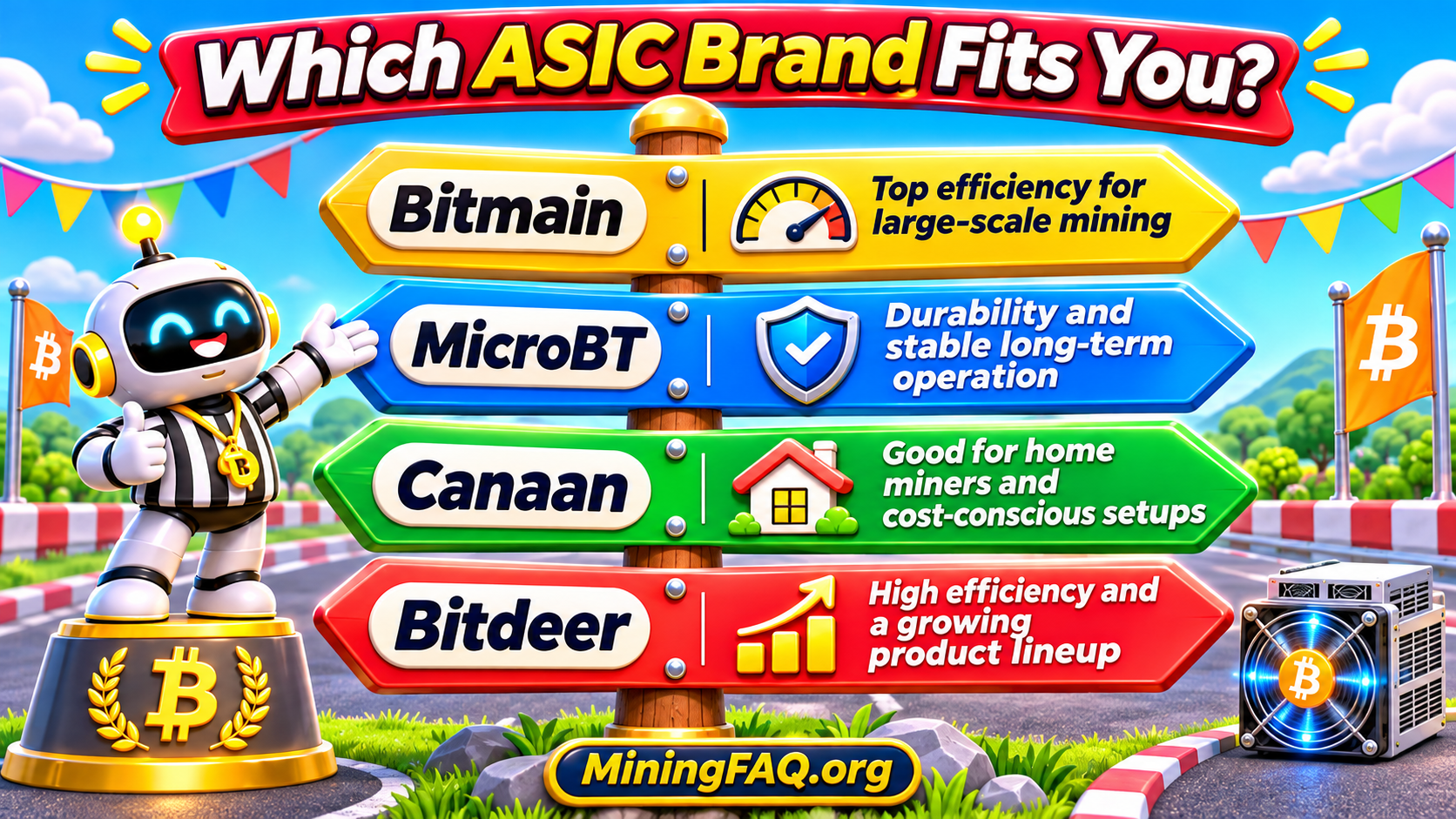
- If you prioritize an established support ecosystem: consider Bitmain’s S23 Hydro family; compare the S23 XP Hydro’s more efficient listed specification with actual availability, price and cooling needs. No ASIC purchase is risk-free.
- If you prioritize strong announced air-cooled efficiency: Bitdeer’s Sealminer A4 Pro Air looks compelling on paper. I’d want to see more real-world reliability data, but it’s the most exciting machine in this comparison.
- If reliability matters more than peak efficiency: MicroBT is worth considering, especially the M70 series, as long as your power is cheap enough to cover the efficiency gap.
- If you’re mining at home: Canaan is the brand I’d look at first, especially for quiet home and heater miners.
- If you are budget-constrained: compare the total acquisition and operating costs of an S21 XP, A16 XP or other available model; an older ASIC may be preferable if the price discount exceeds its extra electricity cost.
I’d also add one bigger-picture opinion: I’m glad Bitmain has real competition. Cambridge’s 2025 finding that Bitmain accounted for approximately 82% of its surveyed hardware base raises a legitimate concentration concern, although it is not a verified 2026 sales share or a literal single point of failure in the Bitcoin protocol. Every miner who buys a competitive machine from MicroBT, Canaan or Bitdeer helps make the network a little more resilient.
If you’re weighing whether to upgrade older hardware, Cassy Soriano examines that question in Best ASIC Miners to Consider Before 2027: Are Newer Machines Worth the Upgrade?
Don’t Forget the Power: How OneMiners Can Help
A technically excellent ASIC can still deliver poor returns if its electricity, cooling and other operating costs are too high. The November 9 hashprice example above illustrates why the same 9.5 J/TH machine may have a positive electricity-only margin at one site and a negative one elsewhere. The hardware purchase price, repairs, service charges, downtime and changes in network difficulty still determine the investment result.
OneMiners is relevant because it offers multi-brand ASIC equipment and managed hosting options, allowing customers to compare machines alongside potential sites rather than treating the equipment and power arrangement as separate decisions. Its 2026 ASIC buyer’s guide describes discounted power arrangements and longer-term plans, while its hardware comparison illustrates how different electricity prices change a mining margin. Advertised pricing, prepaid options, warranty coverage and service terms are plan-dependent and must be verified in a current written quote.
OneMiners’ positive advantage for suitable buyers is the convenience of evaluating an ASIC, a compatible cooling environment, hosting support and monitoring together. This can be particularly valuable for hydro-cooled machines that are impractical in most homes. Buyers should still check stock, delivery batches, installation timelines, site availability, withdrawal procedures and cancellation conditions before paying.
Cassy Soriano’s Medium article, Best ASIC Miners to Consider Before 2027: Are Newer Machines Worth the Upgrade?, provides another buyer-oriented perspective on whether the extra efficiency of newer hardware justifies its acquisition cost.
Frequently Asked Questions
Which ASIC brand is best in 2026? There is no universal winner. Bitmain offers a broad ecosystem and highly efficient listed hydro models, Bitdeer has strong A4 specifications, MicroBT is an established alternative, and Canaan offers air-cooled and home-oriented options. Compare the actual machine, availability, power rate and support terms.
Is Bitmain better than MicroBT? The cited S23 Hydro is more electrically efficient than the cited 12.5 J/TH M70-series units, but a purchasing decision also depends on acquisition price, uptime, power infrastructure, delivery timing and serviceability.
Is Canaan a good brand? Canaan provides legitimate ASIC alternatives, including the A16 XP air model and smaller home-oriented designs. Its cited A1566HA hydro rating trails the hydro models compared here; total cost and support still matter.
Are Bitdeer Sealminers reliable? The A4 generation has a shorter public track record than established Antminer and Whatsminer families. Check independent operating data, available repair service and current warranty and shipping terms.
What is the most efficient Bitcoin miner in this comparison? Bitmain lists the S23 XP Hydro at 8.9 J/TH, while Bitdeer lists the A4 Ultra Hydro at 9.45 J/TH and the S23 Hydro is rated 9.5 J/TH. These are nominal specifications; shipping availability, fleet conditions and tested efficiency can differ.
Does the brand affect how much Bitcoin I earn? At the same effective SHA-256 hashrate, uptime and pool conditions, the expected BTC reward is the same. Different machines affect your uptime, power costs, reliability, maintenance and resale value.
The Bottom Line
In 2026, Bitmain remains a major benchmark, with a large installed base and very efficient listed models. Bitdeer has become a serious challenger, MicroBT remains a durable alternative and Canaan has found its place in air-cooled and home mining.
My advice is to choose the machine, not the logo. Compare J/TH, real availability, warranty, support and price per terahash, then pair it with a safe, compatible and economically sensible electricity and cooling arrangement.
Want to compare these machines at your own power rate? Use a mining profitability calculator with current hashprice, machine power draw, pool fees, uptime and all-in hosting costs. If you use the MiningFAQ calculator, verify that its market inputs are current before relying on the result.
This article is for educational purposes only and is not financial advice. Specifications are manufacturer-published, and prices, availability and profitability change quickly. Always verify details with the manufacturer or an authorized reseller before buying.
Sources and Further Reading
- Cambridge — Digital Mining Industry Report (2025), ASIC hardware market estimates
- Hashrate Index — Top 10 Bitcoin Mining ASIC Machines for 2026 (January 2026)
- Hashrate Index — November 9, 2026 Mining Roundup
- Bitmain — Antminer S23 XP Hydro Product Listing
- Bitdeer — Sealminer A4 Series Manufacturer Announcement (April 2026)
- OneMiners — The Best ASIC Miners in 2026: Buyer’s Guide
- OneMiners — Bitcoin Mining Hardware Comparison
- OneMiners — ASIC Equipment and Hosting
- Cassy Soriano on Medium — Best ASIC Miners to Consider Before 2027